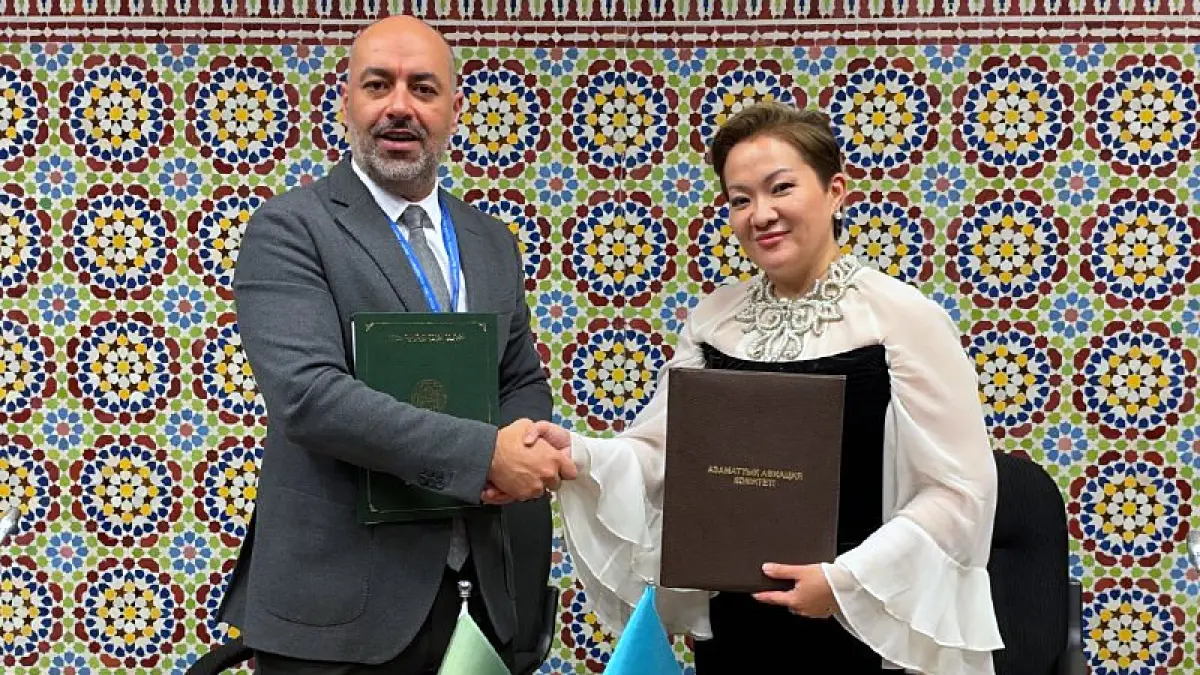
Astana, 22 November. The Civil Aviation Committee of Kazakhstan’s Ministry of Transport has signed memoranda of understanding with the aviation authorities of Algeria and Jordan under which each side may operate up to 14 flights a week, the committee said.
The documents were signed in Montreal on the sidelines of the Seventh Worldwide Air Transport Conference of the International Civil Aviation Organization (ICAO).
For Algeria the memorandum was signed by Hassan Boulfelfel, director general of the National Civil Aviation Agency (ANAC), and for Kazakhstan by Saltanat Tompiyeva, chair of the Civil Aviation Committee. The document allows each country’s designated carriers to operate up to 14 flights a week. The sides also initialled a draft Air Services Agreement. Initialling means the negotiators sign each page of the text: it fixes the agreed wording but does not bring the document into force. The agreement is meant to become the legal basis for scheduled flights between the two countries. The sides also discussed a future memorandum on technical cooperation between the two aviation authorities, the statement says.
On Jordan, Tompiyeva met Captain Deifallah Farajat, chairman of the Board of Commissioners of Jordan’s Civil Aviation Regulatory Commission. The Jordanian side said the national carrier Royal Jordanian is interested in opening scheduled flights to Kazakhstan and noted growing interest among Jordanians in Kazakhstan as a tourist destination, the committee said. The signed memorandum provides for scheduled flights, and each side also gets the right to operate up to 14 flights a week.
Such a memorandum sets how many flights the sides are prepared to allow, but it does not open any routes by itself. The committee did not say which Kazakh airlines will be designated for these routes, when flights could begin or to which cities.
The Jordanian route follows recent political contacts. In early November King Abdullah II of Jordan visited Astana, where President Kassym-Jomart Tokayev presented him with the Al-Farabi order and called Jordan a reliable partner in the Arab world.
What it means: Kazakhstan now has a legal framework for scheduled air links with two Arab countries, and the next steps are up to the airlines and flight permits. Work with Algeria has gone further: the text of an intergovernmental agreement has been agreed.
Who benefits: Airlines on both sides, which will get the right to fly, and travel companies: according to the committee, the Jordanian side notes growing interest among its citizens in Kazakhstan. Royal Jordanian has said it wants to enter the Kazakh market.
Background: The Seventh Worldwide Air Transport Conference of ICAO was held in Montreal alongside a session of the organisation’s Assembly. At that session Kazakhstan ran for the ICAO Council for the first time and received 78 votes out of 158.
We have also reported on how Kazakhstan ran for the ICAO Council for the first time and failed and how Tokayev awarded the King of Jordan the Al-Farabi order.



