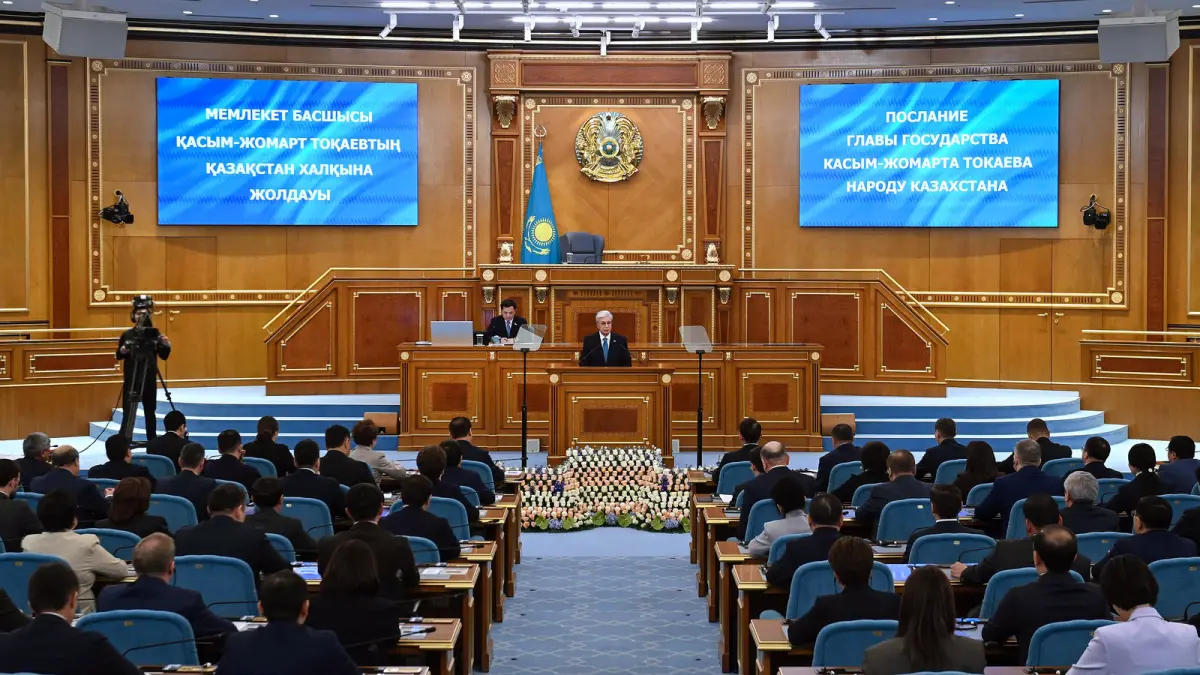
Wednesday 28 October was dominated by President Kassym-Jomart Tokayev’s annual Address to the People of Kazakhstan, ‘Kazakhstan’s Current Tasks in a New Historical Cycle’ — the first since a new Constitution was adopted in March [1][2]. The President proposed turning part of the National Fund’s savings into a large-scale construction drive, raising the minimum wage by almost a third and discussing a tax on the wealthiest. The rest of the day showed how such statements turn into action: by evening the head of the state energy holding had been replaced, the Vice President had sat down with the Kurultai factions, and auditors had reminded everyone that National Fund money demands discipline. The Head of State himself was in Ankara by the evening.
National Fund money, wages and taxes
The Address’s main proposal is an Infrastructure Modernisation Plan: about 6.5 trillion tenge from the National Fund until the end of 2029, plus another 1.5 trillion tenge to launch social projects before February 2027 [3][4]. The President proposed calling the construction drive “Halyqtyq qurylys” — “People’s Construction” — and declaring 2027 the Year of Nationwide Large-Scale Construction. This marks a turn in how the National Fund is used: money saved for a rainy day for three decades is to be invested in hospitals, schools, roads, gas and water, on condition that public money attracts private investment rather than replacing it [3]. The government is to present a first list of projects by the end of the year.
The measure most tangible for people is the minimum wage: from 1 January 2027 it will rise from 85,000 to 110,000 tenge, by about 29%, for the first time in three years; according to the President, this will raise the incomes of 1.8 million people, including more than 370,000 public-sector employees [5]. During the day the Telegram channel Astanovka claimed that 100,000 tenge had been said on air, and we checked the figure [6]; in the evening Akorda published the full text of the Address and a video clip giving 110,000 [7]. For business the President proposed a new three-year moratorium on inspections of micro and small enterprises from 2027 — after the previous moratorium ended, he said, pressure from inspectors increased [8]. He opened the tax debate by saying that “the time has come to discuss introducing a higher rate for owners of large fortunes”; there is no threshold or rate yet, and these are to be proposed by the government and the Kurultai [9].
Independent fact-checkers checked the facts in the Address. Factcheck.kz confirmed that about 85% of overland rail freight between China and Europe passes through Kazakhstan, that in 2025 the country produced 123.1 billion kWh of electricity against consumption of 124.6 billion and covered the gap with supplies from Russia, and that bank assets stood at 75.6 trillion tenge on 1 September [10]. The fact-checkers left without a verdict the claim that 1.5 trillion tenge of concessional funding would go to agriculture in 2026: 894 billion tenge had been allocated by August, and the year is not over yet [10].
First steps after the Address
The President spoke most harshly about energy: he called electricity generation catastrophically insufficient and listed delays in commissioning new capacity in Turkestan, Kyzylorda, Almaty and Ekibastuz [3]. A few hours later the management board of the Samruk-Kazyna fund dismissed Kairat Maksutov as chairman of Samruk-Energo, citing unsatisfactory progress on strategic investment projects and weak control over construction deadlines for new generating capacity [11]. Officially the dismissal was not linked to the President’s words, but its subject matched his criticism.
The executive immediately started preparing legislation. Vice President Yerlan Karin met the leaders of the Kurultai factions to discuss the legislative basis for the Address’s initiatives: the inspection moratorium, the tax on large fortunes and other instructions require amendments [12]. A government meeting on measures to implement the Address was scheduled for 09:00 on 29 October [13].
Warnings came at the same time. The Supreme Audit Chamber raised questions about 66 projects worth about 1 trillion tenge that are seeking National Fund money in 2027: some of them are classed as neither critically important nor national, whereas the Budget Code allows financing only for such projects [14]. Meanwhile the Finance Ministry’s draft budget provides 5 trillion tenge from the National Fund for infrastructure in 2027–2029, while the Address speaks of 6.5 trillion; the ministry has not explained how the two figures relate [14]. The same auditors found that municipal waste recycling has lagged behind plan for a third year in a row — 30.69% in 2025 against a target of 32% [15].
Markets, resources and laws
The same day the Kurultai ratified a protocol making some 30 amendments to the Treaty on the Eurasian Economic Union, covering the internal market, public procurement, the common electricity market and transport control [16]. The Energy Ministry proposed extending the ban on exports of liquefied petroleum gas, propane and butane by another six months from 14 November to prevent winter shortages [17]. The Financial Times reported that Glencore would decide by the end of the year on selling a controlling stake in Kazzinc to a Kazakh investor; analysts value the stake at up to $5 billion [18]. Tokenised bonds were placed on the Kazakhstan Stock Exchange for the first time: ALTA Telecom issued 100 million tenge worth on the Solana blockchain [19].
External track
In the evening Tokayev flew to Turkey on an official visit; at Ankara airport he was met by Turkish President Recep Tayyip Erdogan [20]. At talks in the Presidential Palace Erdogan spoke of the intention to raise trade to $15 billion [21]. The figure is not new — it was also named in May, while trade amounted to $5.4 billion in 2025 [22]. Also on 28 October the Head of State sent condolences to King Felipe VI of Spain after the high-speed train crash in Toledo province [23].
What comes next
On 29 October the government discusses measures to implement the Address, and Tokayev attends the 13th summit of the Organization of Turkic States in Ankara. The new minimum wage should appear in the law on the national budget for 2027; the inspection moratorium and the tax on large fortunes in bills still to be submitted to the Kurultai. The government must prepare the list of “People’s Construction” projects by the end of the year.


