Sunday drew a line under two large international gatherings. In Antalya the UN climate conference broke up without its main political decision because nearly 200 countries could not agree on oil, gas and coal. In Panama the World Boxing congress rewrote the rules and renewed the leadership of Olympic boxing, which now includes three people from Central Asia. Kazakhstan has something to record from both: signed projects in Antalya, and seats at the table in boxing where Olympic qualification is decided.
The evening in numbers
- 2 days
of overtime at COP31 - 1.5 °C
the warming threshold the world is on course to exceed, as the draft decision acknowledged - 170
national federations in World Boxing after the congress - 44
Olympic quota places to be decided in Astana in April - 14
flights a week per side under the memoranda with Algeria and Jordan
Based on data from the UN, World Boxing and the Civil Aviation Committee of Kazakhstan
- 2 days
Antalya: the consensus that never came
Climate conferences live by the rule of general agreement, and in Antalya it worked against everyone at once. After two weeks of negotiations and two days of overtime, the COP31 president, Turkish environment minister Murat Kurum, acknowledged that there was no agreement on the text and the decisions had not been adopted. The co-presidents, Türkiye and Australia, rewrote the draft several times. The latest versions acknowledged that warming is on course to exceed the 1.5 °C threshold and called for expanding carbon-removal technologies, while the reference to moving away from fossil fuels disappeared.
That is where it all broke down. The European Union called a text with no mention of oil, gas and coal unacceptable, Panama and the Marshall Islands opposed it, and Saudi Arabia, for the League of Arab States, defended carbon capture and storage. UN Secretary-General António Guterres answered with a short formula: there may be no consensus in the negotiating room, but there is no ambiguity in the science.
The failure of the common text does not cancel earlier commitments. At COP28 in Dubai countries had already agreed to transition away from fossil fuels, and Guterres has now called for that shift to be accelerated and financed. Simon Stiell, executive secretary of the UN Framework Convention on Climate Change, also named what was achieved: an agreement on a just transition and initiatives on electrification, resilience and investment. The unresolved questions travel on to COP32 in Addis Ababa.
What Antalya left Kazakhstan
For Kazakhstan, COP31 was from the start more of a business fair than an arena of high diplomacy, and the results of the fair do not depend on the fate of the final text. In the first days the Ministry of Ecology and Natural Resources presented its Country Climate Investment Platform, whose first strand is a just energy transition platform meant to help bring at least 10 GW of renewable capacity online by 2035. Five agreements were signed at the national pavilion, among them financing for wind farms of 150 MW in Turkistan region and 1 GW in Kostanay region, as well as a project to detect methane leaks in gas networks.
Prime Minister Olzhas Bektenov invited partners to create an International Water Organisation under the UN. With Uzbekistan, Kazakhstan gained another joint task on the sidelines: on 17 November the International Green Technologies and Investment Projects Center and Uzbekistan’s State Environmental Expertise Center agreed to write best available techniques reference documents together for the chemical, energy and cement industries.
Yet the dispute that tripped up Antalya concerns Kazakhstan directly. The country has pledged to cut emissions by 17% from 1990 levels by 2035 on its own and has adopted a Strategy for carbon neutrality by 2060, but at the same time it plans to produce about 96 million tonnes of oil in 2026. So the words about oil and coal that were fought over in Antalya are not abstract for Kazakhstan but a question about the future of its oil industry.
The ring: rules are written in Central Asia too
The World Boxing congress in Panama on 20 November admitted 47 new federations, bringing the total to 170, approved 53 amendments to the competition rules and rejected a motion to bring back headguards in elite men’s boxing. Shohid Tillaboev, secretary general of the Uzbekistan Boxing Federation, was elected vice-president, Kazakhstan’s Rauan Igenev became chairman of the sport and competition committee, and the federation itself is led by Gennady Golovkin.
These are working seats. Igenev’s committee prepares the qualification rules, and the first stage of qualification for the 2028 Olympics will take place in Kazakhstan: at the world championships in Astana on 10–26 April the first 44 Olympic quota places will be decided. For a federation that the International Olympic Committee provisionally recognised in February 2025, this is the first Olympic qualification under its responsibility, as World Boxing itself notes.
The sky after Montreal
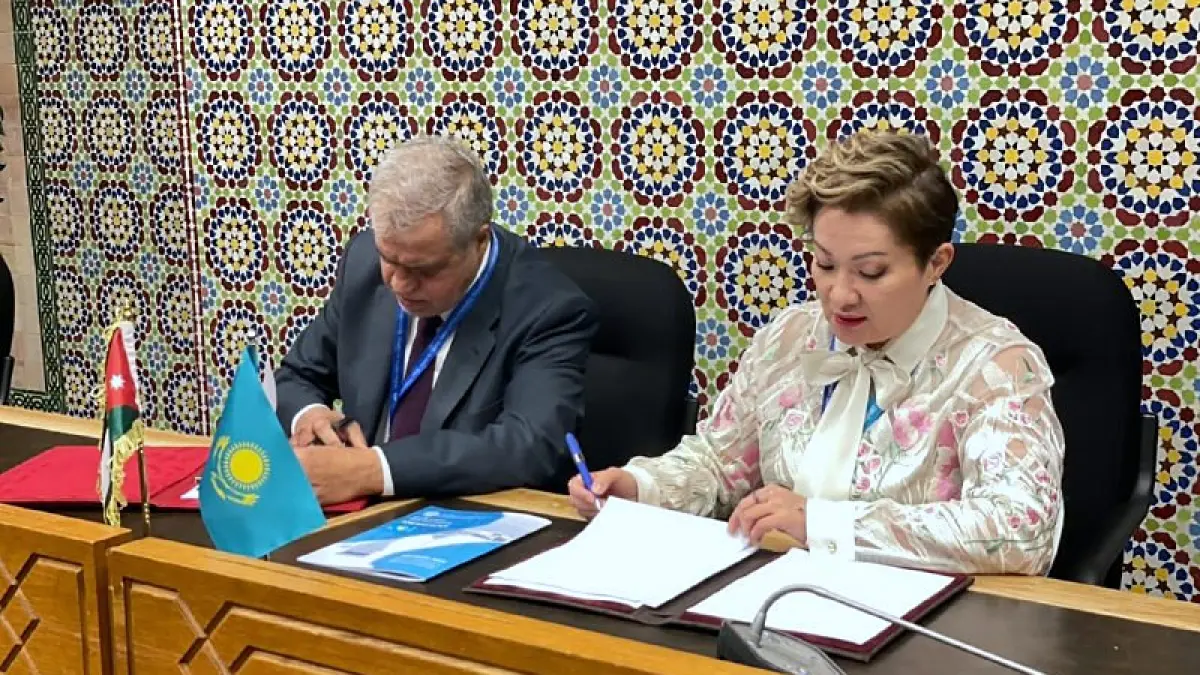
Montreal, where on 20 November Kazakhstan lost the ICAO Council election with 78 votes out of 158, also brought a gain at the end. Saltanat Tompiyeva, chair of the Civil Aviation Committee, signed memoranda with the aviation authorities of Algeria and Jordan under which each side may operate up to 14 flights a week, and with Algeria the sides also initialled the text of an air services agreement. Jordan’s Royal Jordanian, according to the Jordanian side, wants to fly to Kazakhstan. The committee did not say when flights will begin or who will operate them.
What lies ahead
The climate dispute moves to Addis Ababa, where COP32 will have to search again for words about oil, gas and coal. Boxing is waiting for April and Astana, and the next World Boxing congress will meet in December on Bali. For Kazakh aviation the next step is to turn the memoranda into a timetable: without designated airlines and permits, fourteen flights a week will remain a figure on paper.



