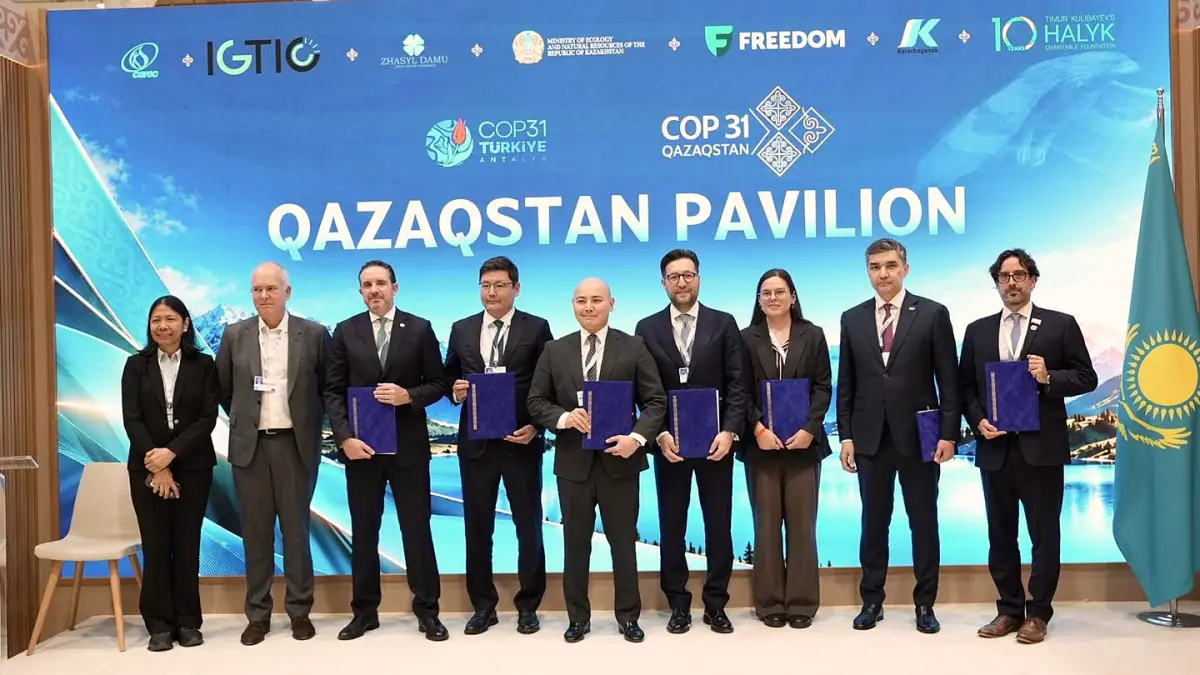
Antalya, 10 November. At the 31st Conference of the Parties to the UN Framework Convention on Climate Change (COP31) in Antalya, Kazakhstan presented its Country Climate Investment Platform (QCIP), through which the state, banks and investors will jointly select projects for financing, the Ministry of Ecology and Natural Resources said.
The platform is designed as a national mechanism that brings together government bodies, international financial institutions, climate funds, investors and project developers. Its task is to build a portfolio of priority climate projects, raise their investment readiness and attract domestic and international capital. QCIP will be run by the Ministry of Ecology and Natural Resources as the national authorised body, and its secretariat will sit at the International Centre for Green Technologies and Investment Projects. The ministry's first release says the platform will cover all sectors of the economy; the report on the speech by Minister Alibek Kuantyrov speaks of five priority sectors.
The first sectoral track is the Just Energy Transition Investment Platform of Kazakhstan (QaJET), developed by the Ministry of Energy with the support of the European Bank for Reconstruction and Development (EBRD). Its aim is to bring on stream at least 10 GW of renewable capacity by 2035, modernise power grids, develop energy storage and electrify end consumers. Two memoranda were signed at the presentation. The first, on partnership between the Ministry of Ecology, the Ministry of Energy and the QaJET partners led by the EBRD, is described by the ministry as the official launch of the platform. The second was concluded by the International Centre for Green Technologies and Investment Projects and the Development Bank of Kazakhstan.
Kuantyrov spoke about the platform at two venues on the second day of the conference. The first was an event of the multilateral development banks. The second was the UNFCCC side event "Mobilizing Finance for Country-Led Climate Action", organised by the EBRD, the Asian Infrastructure Investment Bank, the Black Sea Trade and Development Bank, Germany's development bank KfW and the OPEC Fund for International Development. He said that for Kazakhstan the fight against climate change means reliable energy, competitive exports and resilience to climate risks. The country has adopted a strategy for carbon neutrality by 2060 and a commitment to cut emissions unconditionally by 17% by 2035, the ministry reported. According to the same source, the platform is to become a single entry point for investors and to help promising measures "grow" into projects ready for investment.
The minister described the country's goals in more detail at the panel "From Commitments to Action. NDC 3.0" in the national pavilion of Kyrgyzstan. NDC stands for nationally determined contribution, a country's pledge to reduce greenhouse gas emissions. Kazakhstan has pledged to cut them by 2035 by 17% from the 1990 level on its own and by up to 25% with international support. The Government has already approved the document and, together with the NDC Partnership and the UN Industrial Development Organization (UNIDO), is drawing up an investment plan that is to set out the cost of the measures, the sources of financing and a portfolio of projects. For 2026–2029, the minister said, 45 renewable energy projects with a combined capacity of more than 7 GW are planned, and they already have investors, the ministry's release says.
For Central Asia, Kuantyrov proposed three steps. The first is shared data and joint monitoring of glaciers, river flow and water intake, including the permanent digital monitoring in the Syr Darya and Amu Darya basins that President Tokayev has spoken about. The second is coordination of water and energy regimes on transboundary rivers. The third is regional projects financed by the Green Climate Fund and development banks. In 2024–2026 Kazakhstan chairs the International Fund for Saving the Aral Sea, and in April the heads of state of the region adopted in Astana the Declaration "Environmental Solidarity of Central Asia".
The same day, a session on creating a Regional Climate Centre of the Turkic States took place in Kazakhstan's national pavilion. It was organised by Kazhydromet and the Turkish State Meteorological Service; participants included World Meteorological Organization Secretary-General Celeste Saulo, heads of the hydrometeorological services of the Turkic states and experts. Kazhydromet Director General Danara Alimbayeva set out Kazakhstan's vision of the centre's functions and prospects, taking into account the organisation's requirements. The participants agreed to set up a technical working group that will prepare proposals and a phased roadmap, the ministry said.
What it means: Kazakhstan's targets have not changed: they are still the 17% and 25%. What is new is the mechanism: climate projects now have a single operator and a first track, energy, with a target of 10 GW by 2035. For now the platform is described only as an architecture and two memoranda; the releases give no sums, no timetable for selecting projects and no list of projects, and the test will be the first projects chosen and the money raised.
Who benefits: Development banks and investors, to whom the platform promises one entry point instead of searching for projects across ministries. Project developers, to whom it promises help in preparing for financing. The Ministry of Ecology and Natural Resources and the International Centre for Green Technologies and Investment Projects, which get the role of coordinator. The releases do not disclose the terms for projects that do not make it into the portfolio.
Background: The Conference of the Parties is the annual meeting of the countries that have signed the UN Framework Convention on Climate Change. The 31st is being held in Antalya, Türkiye; its second day fell on 10 November. At the conference Kazakhstan has a national pavilion with its own programme of events.
We have also reported on how Kazakhstan was preparing to present more than 35 events in its national pavilion at COP31 and on the opening of the conference in Antalya.



