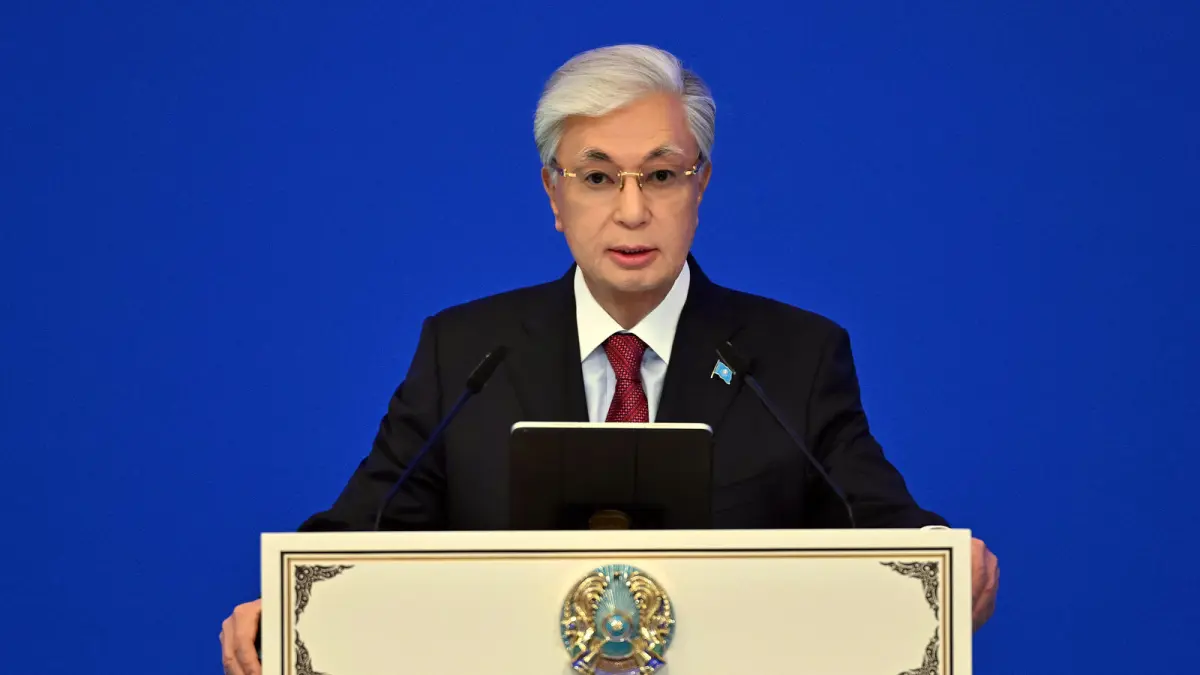
Astana, 10 November. President Kassym-Jomart Tokayev, at the Tenth Kurultai of the international society Kazak Tili, ordered a review of Kazakh orthography to be completed by the end of 2027, dictionaries to be updated and a national digital database of the language to be created, Akorda said.
Orthography is the system of rules for spelling words; the word comes from the Greek orthos (“correct”) and graphō (“I write”). The current orthographic dictionary of Kazakh, the President recalled, was approved by a decree of the Presidium of the Supreme Soviet and published in 1983. Several dictionaries have appeared since, but none has been approved at state level or has legal force. In some neighbouring states such works are updated every five years. The work is entrusted to a working group of linguists, scholars, experts and public representatives, coordinated by the Presidential Administration. Akorda did not name deadlines or membership for the group.
Separately Tokayev spoke about new words. He acknowledged that “tūzhyrymdama” (concept), “qaġidat” (principle), “shäkirtaqy” (scholarship), “ġalamtor” (internet) and “zhasandy sana” (artificial intelligence) have entered the language, but warned that moderation is needed here too. He called artificial words such as “küisandyq” (piano), “qyltima” (balcony), “subūrqaq” (fountain), “sebezgi” (shower), “qyryqqabat” (cabbage), “ünqaġaz” (newspaper), “zhedelsaty” (lift) and “zhelköz” (small window) doubtful, and described the fashion of replacing ancient words related to religion with Arabic vocabulary as raising questions. The last word, he said, should belong to professional scholars.
The second big task is digital. “First of all” the President named the creation of a national digital database of the Kazakh language: a significant part of the literary heritage, he said, has not yet been digitised to proper quality, so books, periodicals, audio and video recordings, and archive and museum holdings must be digitised. The day before, on 9 November, Tokayev received the society’s chairman Rauan Kenzhekhanuly, who described a project with OpenAI: the Kazakh corpus has reached 14 billion tokens, Akorda reported. The President also called for more Kazakh-language content in the digital space, more IT products, films and games to develop children’s speech, and a universal digital system in linguistics.
On textbooks he said “many mistakes were made” in preparing them, and demanded conditions for studying engineering, medicine, law, economics, the natural sciences and information technology in Kazakh. The President ordered the Oxford Qazaq Dictionary project to continue and bilingual and multilingual dictionaries to be prepared linking Kazakh with the official languages of the UN: French, Spanish, Chinese and Arabic, as well as German, Italian, Japanese, Korean and Persian. The Kazakh-Russian dictionary is to be updated and electronic versions constantly supplemented.
To confirm the growing demand for the language Tokayev gave figures. This year 71% of schoolchildren were enrolled in classes taught in Kazakh. Of the more than 6,000 books published last year, 70% were in Kazakh, as were 63 of the 71 films shot in Kazakhstan this year. Kazakh, he said, is becoming “soft power”: the term refers to a state’s influence through the attractiveness of its culture rather than coercion, and was introduced by the American political scientist Joseph Nye. As the country’s spiritual ambassadors the President named the singer Dimash Kudaibergen, the actress Samal Yeslyamova, the chess player Bibisara Assaubayeva, the wrestler Yersin Baltagul (Kimbozan Haruki) and Yerzat Dulatov, co-founder of the global startup Higgsfield AI.
A separate block is devoted to linguistic harmony. The development of Kazakh, Tokayev repeated, must not hinder the development of other languages; setting languages against one another is unacceptable. He called the activity of those who manipulate the language issue to split society extremely dangerous and ordered such people to be held to account under the principle of “Law and Order”.
The speech went beyond the topic of language. The President backed the society’s “Dala Ormany” project: over a year participants with partners planted 5 million trees on 400 hectares, and four large nurseries appeared in three regions. Green zones are planned of 25 hectares by every village, 50 hectares in district centres and 100 hectares by large cities, which, the President said, will raise the country’s forest area to 14.5 million hectares; the Government and akimats were instructed to support the project. Tokayev declared 2027 the Year of nationwide large-scale construction: the “People’s Construction” programme will receive 6.5 trillion tenge from the National Fund over three years, and a special commission, whose membership the President is now considering, will monitor the spending.
What it means: The President treats language as a matter of state and handles it with three instruments: the norm (spelling and dictionaries), the digital (database and content) and an appeal for harmony between languages. A deadline is set only for orthography, the end of 2027; the text gives none for the digital database and dictionaries.
Who benefits: The society Kazak Tili, to which the President promised support and whose Qazaq Tili Endowment fund he urged entrepreneurs to help. Linguists and dictionary compilers, who have been given work of state importance. The country’s other languages, since the President separately said the development of Kazakh must not hinder them.
Background: The society Kazak Tili was founded in 1989; its origins lie with the academicians Abduali Kaidar and Umirzak Aitbaiuly. The Qazaq Tili Endowment fund has operated within its structure for the past three years; the President said he had assisted this initiative. “Soft power” is the English term in translation.



