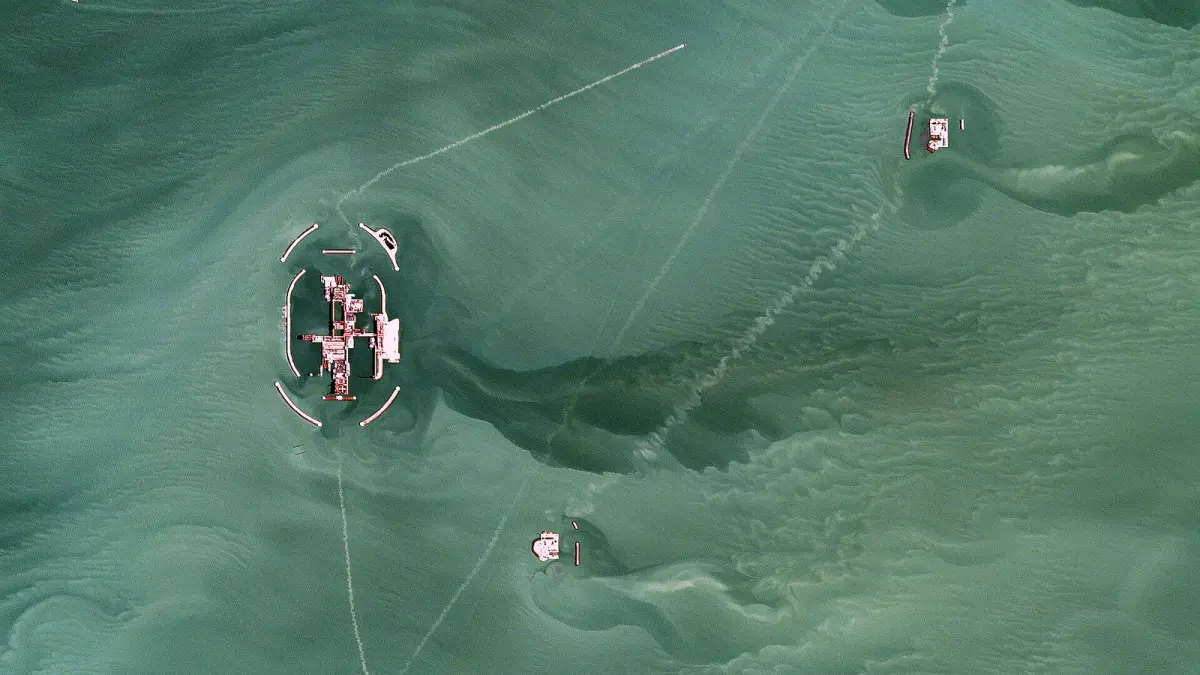
“We’re on plan for now: the declared figure is 96 million,” Energy Minister Yerlan Akkenzhenov said on November 4. For the plan to come true, Kazakhstan must produce oil and gas condensate roughly 15% faster in October–December than in September: nine months have yielded 69.4 million tonnes of the 96 million tonnes.
Kazakhstan’s oil, 2026
- 96 million tonnes
the current annual plan, cut three times from 100.5 - 69.4 million tonnes
produced in nine months, 8.3% less than a year earlier - 26.6 million tonnes
left to produce by year-end - 7.7 million tonnes
September output - 8.9 million tonnes a month
needed in October–December - 99.6 million tonnes
the 2025 record
Based on data from Interfax, Reuters and KAZENERGY
- 96 million tonnes
How the plan shrank
The economic development plan for 2026 had 100.5 million tonnes of oil and gas condensate, Akkenzhenov recalled in March. The starting point was the record year 2025: 99.6 million tonnes, 13.5% more than a year earlier, after the launch of the Future Growth Project at Tengiz, we wrote in our review of the KAZENERGY National Energy Report. From that height the plan began to descend.
The first failure came in January. Transformers caught fire at the Tengiz power plant; production was halted on January 19 and resumed on the 31st, Interfax wrote. The preliminary estimate of the loss from the stoppage was up to 700,000 tonnes, Kapital.kz reported. On March 11 the minister was already speaking of 96–98 million tonnes because of attacks on the Caspian Pipeline Consortium (CPC) and the accident at Tengiz, and said that Tengiz had returned to 120,000 tonnes a day. In the first quarter the country produced 19.7 million tonnes, the same minister said: noticeably less than planned.
The second failure was drone attacks on the CPC, the pipeline that carries oil from Tengiz, Kashagan and Karachaganak to the world market through a terminal near Novorossiysk. On August 25 Akkenzhenov cut the plan from 98 to 96 million tonnes because of export restrictions on the CPC and gave the losses from the attacks: 3.5 million tonnes, Reuters reported. The original target, as Kommersant retold the minister’s words, was the same as last year’s result: 99 million 550 thousand tonnes, rising to 100 million tonnes. Part of the exports was rerouted in July to other directions, including Atyrau–Samara and deliveries to China, the same newspaper writes.
The backup routes were still on the agenda in early November: on November 3 the Energy Ministry reported the resumption of transport along Atyrau–Samara, and on November 4 Kazakhstan was awaiting Russia’s reply on resuming exports via the Druzhba pipeline. Interfax summed it up: over the year the ministry revised the forecast three times, from 100.5 to 96 million tonnes.
The October–December arithmetic
Nine months gave 69.4 million tonnes, 8.3% less than a year earlier, Interfax reported. Eight months had 61.688 million tonnes, also 8.3% less, Reuters noted. The difference between the two figures gives September: about 7.7 million tonnes, exactly the same as the monthly average for the first nine.
To reach 96 million tonnes, 26.6 million tonnes still have to be produced by year-end, about 8.9 million tonnes a month. That is 15% above September and above the monthly average of the record year 2025: 99.6 million tonnes over twelve months make 8.3 million tonnes a month. September was, however, depressed by repairs: Reuters reported that planned repairs at Karachaganak would take 400,000–450,000 tonnes in September. Without them the month would have given about 8.1–8.2 million tonnes, and the gap to the required 8.9 million tonnes would shrink but not vanish: about 0.7–0.8 million tonnes a month would still be missing.
The minister calls the plan on track. The test will be October’s monthly figure: for the plan to hold, it must be close to 8.9 million tonnes.
Two numbers for 2027
There are two numbers for next year as well. National Bank Governor Timur Suleimenov said the 2027 budget assumes a drop in production to 96 million tonnes, taking into account the postponement of repairs at Tengiz from 2026 to 2027; repairs at Kashagan were also moved to 2027, Interfax reported. Akkenzhenov said on November 4 that for next year “we are determining now” and that, in his view, “around 99 million tonnes” would be provided for.
Deputy Finance Minister Abzal Beisenbekuly named the same sequence on September 17: 96 million tonnes in 2027 and growth to 99–100 million in the following years, Reuters reported. Deputy Energy Minister Yerlan Akbarov said on September 30 that production would grow to 100 million tonnes in 2028 from 96 million in 2026 and 2027, the same agency reported. The Energy Ministry stresses that 96 million tonnes in the draft budget does not mean abandoning the growth of production, Vesti.az writes.
Forecasts outside the government look further ahead. The KAZENERGY National Energy Report, prepared together with S&P Global, puts the production peak in the base scenario at 109.4 million tonnes in 2035, and in the pessimistic one at 103.3 million tonnes as early as 2027. Even the pessimistic maximum is higher than the budget’s 96 million tonnes.
What is left outside the brackets
The minister’s statements, as agencies relay them, contain no breakdown of the plan’s figures. It is not known from public data how much of the cut from 100.5 to 96 million tonnes is due to the CPC, how much to Tengiz and how much to repairs: the minister named only the losses from attacks on the CPC, 3.5 million tonnes. There is no monthly production for October and no export plan by route: after the first quarter the minister named 76 million tonnes of exports for the year. Nor is there an explanation of why the 2027 budget has 96 million tonnes, the S&P Global report’s pessimistic maximum is even higher, and the minister expects about 99 million tonnes.
The oil price adds uncertainty: according to Interfax, Brent is ending the week with its biggest weekly drop since 2020. The 96-million-tonne plan remains a number with a footnote about the export route: via the CPC, through Samara, via Druzhba or to China. Until the Energy Ministry discloses monthly production and the breakdown of losses, the fourth quarter remains a test of a plan the minister describes as “on plan”.



