On Saturday, November 7, the authorities announced four large undertakings at once: a trade road map with Tajikistan, a special economic zone near Semey, a congress centre in Burabay and a sports complex in Shchuchinsk. Each has an address and a scale, but the announcements lack what allows a project to be checked: a target figure, a sum or a deadline.
November 7
- 14
documents exchanged by Kazakhstan and Tajikistan - 1.4 trillion tenge
investment forecast for the Semey special economic zone - 400 billion tenge
forecast given earlier in the report to the President - 14,000
permanent jobs in the new forecast - 1,000
seats in the Burabay congress centre hall - 0.6
“contribution units” of Kazakhstan’s share in the ITU programme
Based on the review materials
- 14
A road map without a scale
A road map is drawn to be followed, not admired, and the first thing one looks at on it is the scale. President Kassym-Jomart Tokayev and Tajik President Emomali Rahmon adopted a Joint Statement after talks in Astana, and the delegations exchanged 14 documents, among them a road map for raising trade turnover by 2030. The direction is shown, the distance is not: the Akorda reports do not name the turnover the sides regard as the goal, and the texts of the maps have not been published, the Akorda report shows.
The starting figures do not match either. Rahmon said trade turnover in the first nine months of 2026 exceeded 1 billion dollars, almost 26% more than a year earlier. Tokayev said at the talks that annual turnover “steadily exceeds 1 billion dollars”, and at the briefing spoke of approaching two billion.
What the sides are betting on is clear: half of the turnover, about 600 million dollars in 2025, is agricultural supplies. The agriculture ministers of the two countries agreed to increase deliveries of Kazakh wheat, including under the existing contract for 100,000 tonnes, and in 2026 Tajikistan has already received 900,000 tonnes of grain from Kazakhstan. Next to that figure the 100,000-tonne contract looks like a small part of deliveries, and the one new thing is that both sides publicly put their intention to expand them on record. Tokayev also said that Kazakhstan will support Tajikistan’s candidacy for a non-permanent seat on the UN Security Council for 2028–2029. The statement came a year before the vote and does not guarantee election: seats are distributed by regional groups, and the General Assembly decides.
A 600-hectare zone and three different forecasts
Prime Minister Olzhas Bektenov signed a resolution creating the Semey special economic zone (SEZ) of 600 hectares in the Abai region, with an investment forecast of 1.4 trillion tenge and 14,000 permanent jobs. A special economic zone is a plot with a special legal regime: investors get tax and customs breaks, and the state prepares the infrastructure. It will be the nineteenth zone in the country, and the comparison with the eighteen existing ones is telling. According to the Ministry of Industry and Construction as of October 9, the zones attracted 11.5 trillion tenge of investment and created more than 38,000 jobs. One new zone promises 1.4 trillion, about an eighth of what has been invested in all the earlier ones, and 14,000 jobs, more than a third of what they created.
The figure itself has grown. When the regional governor reported on this zone to the President, 400 billion tenge of investment and 2,500 jobs were named; the area stayed at 600 hectares, while the forecast grew three and a half times. The Government has not said what explains the difference. One thing is known: a brick plant costing 1.5 billion tenge began to be built on the future zone’s site in August, so part of the project already exists.
A thousand-seat hall and ice for three thousand
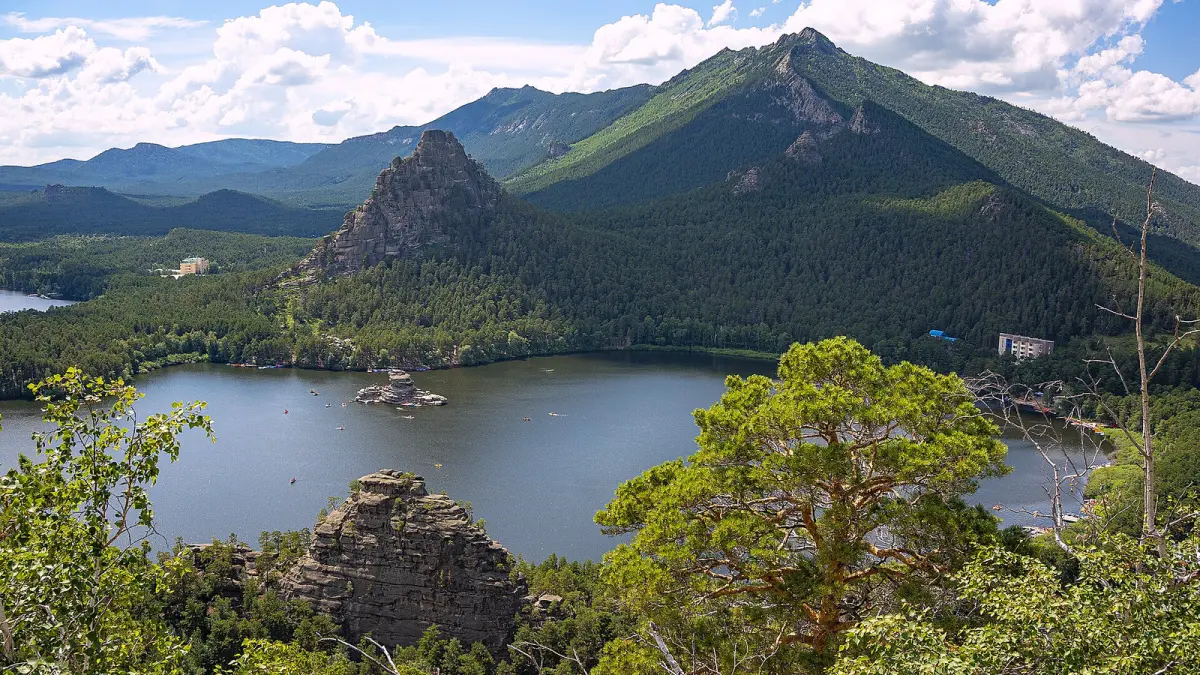
Akmola region announced two projects in one day. In Burabay, Akmola Governor Marat Akhmetzhanov launched construction of a congress centre of 12,800 square metres with a 1,000-seat hall, a conference hall for 160 participants and a digital exhibition, “Kazakhstan Panorama: Museums of the Regions”, of 10,000 exhibits. In Shchuchinsk the third stage of the Winter Sports Olympic Training Centre is being built: four training ski jumps, a 300-place boarding school and a covered ice arena for almost 3,000 spectators.
The congress centre is needed, according to the governor, for MICE tourism. The abbreviation MICE stands for the English words meetings, incentives, conferences, exhibitions; the English word mice itself means “mice”. The sense of the abbreviation is a business one: the resort empties in the off-season, and conferences and forums are meant to fill it. Burabay is one of the country’s three priority tourist centres, and the logic is clear. The main thing is missing from the announcements: neither the cost of the two projects nor the completion dates. The regional administration described the thousand-seat hall in more detail than what it will cost.
Digital diplomacy priced in units
Kazakhstan has joined the Junior Professional Officers (JPO) programme of the International Telecommunication Union (ITU). The programme is simple: a country pays for a young specialist’s work in an international organisation, and the specialist later applies the experience at home. Deputy Prime Minister and Minister of Artificial Intelligence and Digital Development Zhaslan Madiyev and ITU Secretary-General Doreen Bogdan-Martin signed the agreement in Doha; Kazakhstan’s contribution equals 0.6 of a “contribution unit”, and Kazakh telecom operators helped allocate these units. With a second document Kazakhstan offers 100 free training places for participants from African countries, and with a third it formalises funding for designing the ITU Acceleration Centre in Kazakhstan: the centre itself is still at the design stage.
What was left outside the brackets
Each story lacks one line. The Tajik road map has no target turnover, the agreement with the ITU has no money amount for the contribution, the Akmola region projects have no cost or deadlines, and the Semey resolution does not explain why the investment forecast grew three and a half times. The questions to the Government and regional administrations are clear: what turnover is fixed in the maps, what sum each facility is designed for and when it will be handed over. Until there are answers, all four projects have an address and a scale, but no measure, and the reader has nothing to tell whether this is a lot or a little.



