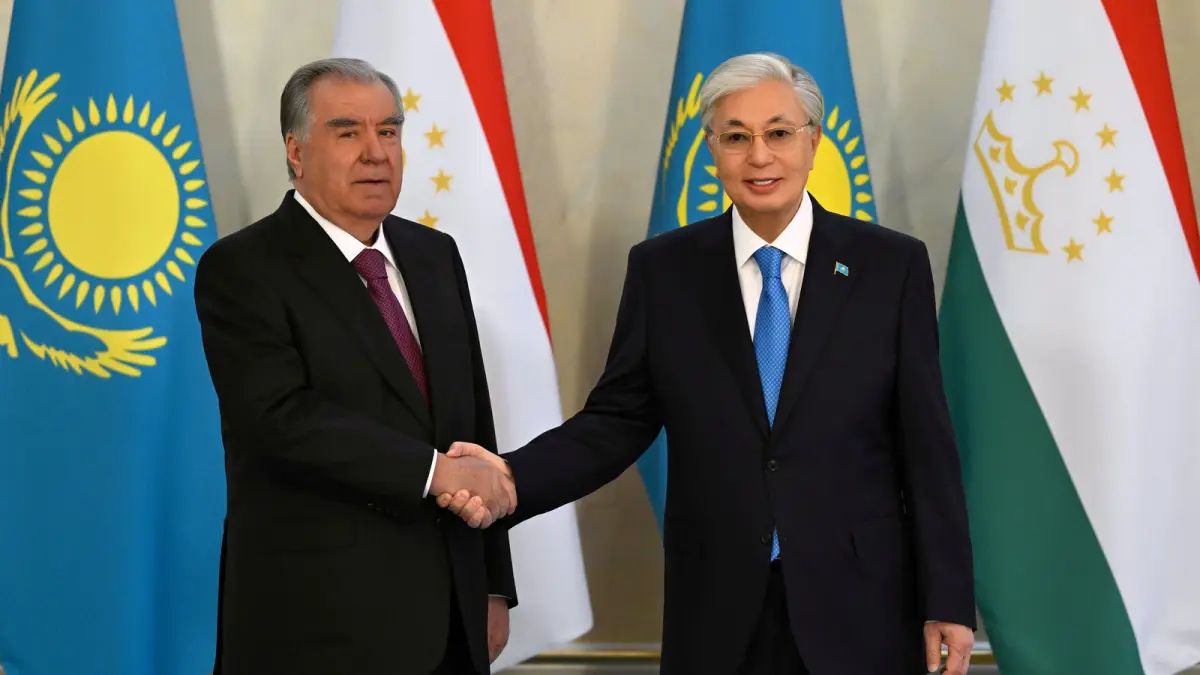
Astana, November 7. President Kassym-Jomart Tokayev of Kazakhstan and President Emomali Rahmon of Tajikistan adopted a joint statement on priority areas of cooperation after talks in Astana; the delegations exchanged 14 documents, among them a roadmap for increasing trade turnover through 2030, the Akorda reported.
Rahmon arrived in Astana on an official visit. The welcoming ceremony took place at the Akorda: in the guest’s honour, helicopters of the Air Defence Forces performed a demonstration flight with the flags of the two countries. At the talks Tokayev said there are no problems in cooperation, only questions that need to be resolved, and that the sides intend to look only forward. The presidents then addressed journalists.
The two leaders described trade in different terms. Rahmon said that in the first nine months of 2026 turnover exceeded $1 billion, almost 26% more than a year earlier. At the talks Tokayev said annual trade turnover “steadily exceeds $1 billion” and that Kazakhstan is among Tajikistan’s three largest trading partners. At the briefing that followed he said trade volume is “confidently approaching the mark of two billion dollars,” according to Akorda reports. The Akorda text does not say which period the figure close to two billion refers to. Rahmon added that more than 130 companies with Kazakh capital are registered in Tajikistan, while more than 580 companies with Tajik participation operate in Kazakhstan, 500 of them wholly Tajik-owned.
The roadmap through 2030 was adopted to increase mutual trade, and the governments, Tokayev said, have been instructed to ensure its high-quality implementation. The president named the agrarian sector as a separate reserve: in 2025 agricultural deliveries between the countries grew by 11% to about $600 million, half of all trade. The talks also covered production chains for processing agricultural goods.
On transport, Tokayev said that in 2025 road freight between the countries grew by 8% and rail freight by 15%, together about 7 million tonnes. Conditions created for carriers helped keep growth going in 2026. A working group of the national railway companies has been tasked with preparing proposals for transport and logistics projects; the sides agreed to pay attention to digitalising transport so that cargo moves “seamlessly.”
The President of Kazakhstan thanked Tajikistan for its consistent policy and support on the use of transboundary rivers. The priorities are digital solutions in the water sector and joint development of water accounting and monitoring systems. In information technology, Kazakhstan has passed e-government platform solutions to the Tajik side. Specialists from Tajikistan have completed internships at Kazakh IT schools, and a joint IT faculty with L.Gumilyov Eurasian National University operates at M.Osimi Tajik Technical University. Tokayev proposed drafting a Comprehensive Cooperation Plan through 2030. Kazakhstan, he said, provides the largest number of educational grants in the region precisely to students from Tajikistan, up to 100 places a year, and the training of Tajik military personnel is now covered by a signed intergovernmental agreement.
Tokayev presented Rahmon with the Qoja Ahmet Yasaui order, which, in his words, was established as a mark of recognition for services in education, science, culture and international affairs, the Akorda said. The presidents then opened the new Tajik embassy building on Anatoly Khrapaty Street in Astana, toured the complex and planted trees on its grounds, and Tokayev made an entry in the book of honoured guests, the Akorda reports. Tokayev said it is not one building but a complex of buildings, and saw in it a sign that Tajikistan will be represented in Kazakhstan “on a permanent basis.”
What it means: The visit, preceded by a business forum and sectoral meetings, ended with a package of documents: a trade roadmap through 2030, an agrarian roadmap for 2027–2028, an industry plan for 2027, and memorandums on artificial intelligence and e-commerce. The Akorda reports do not name a target figure for trade turnover, and the texts of the roadmaps have not been published.
Who benefits: Kazakh exporters of grain, oil and processed goods: agricultural products account for half of trade, and the sides singled them out as a reserve. The railway companies of the two countries, which have been assigned a working group on projects. The Tajik market: Kazakhstan’s Ministry of Agriculture speaks of stable food supplies, and Tokayev recalled that e-government digital solutions have already been passed to the Tajik side.
Background: Tajikistan is one of Kazakhstan’s neighbours in Central Asia; the two countries have no common border. On November 5, a Kazakh-Tajik business forum in Astana produced 11 agreements worth $135.3 million, and on November 6 the energy ministers discussed oil and gas and the digitalisation of power systems. The Akorda lists all 14 documents in its report on the talks.
We have also reported on the business forum of Kazakhstan and Tajikistan and on the meeting of the energy ministers.



