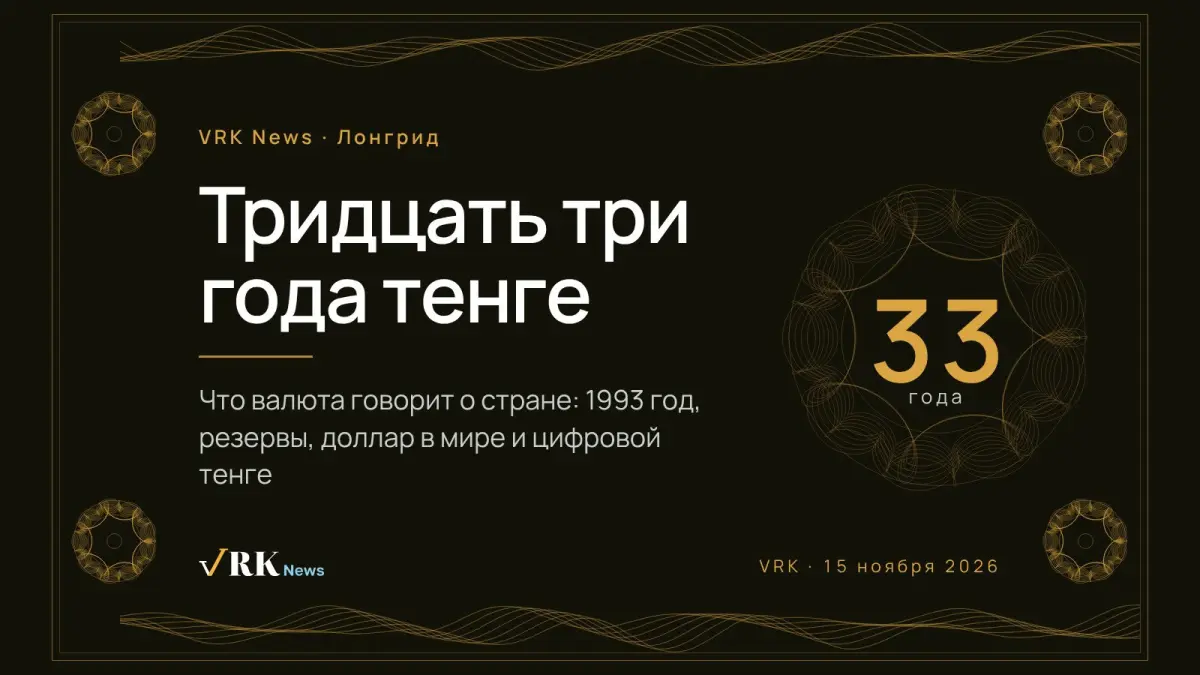
Astana, November 11. The VRK News newsroom has published its own study of thirty-three years of the national currency in Russian, Kazakh and English.
It rests on two interviews with participants in the events of 1993, never before brought together in one text, and on a test of the seven charges laid against the world currency in 2009 against the data of 2026.
The occasion is November 15, National Currency Day: the tenge was introduced on that date in 1993 at a rate of 500 roubles to one. The study asks what backs the currency today and what has become of it over these years.
The first part reconstructs November 1993 from the accounts of those who prepared the changeover. Grigory Marchenko, that year an aide to vice-president Yerik Asanbayev and later twice governor of the National Bank, recounted that until the last moment the country meant to stay in the rouble zone: promissory letters came from Moscow in August 1993 and the working group on the tenge was disbanded. By late September it was clear that no one was letting Kazakhstan in, and the group was reassembled. When the exchange began the regulations were not ready — it had not even been settled at what ratio to exchange the money or how much to hand over per person.
Nurlan Isin, who ran the National Bank’s information technology department in those years, added the technical side: the funds in every corporate account were converted from roubles to tenge within a single operating day, and Kazakhstan was the first country in the Commonwealth to build its own interbank settlement system.
A second thread of the study grew out of the same interview. Electronic money was studied in the republic as early as the start of the 1990s: on an American grant obtained with IBM’s help, European consultants drafted a concept of electronic cash, but the National Bank’s leadership judged it premature. The second attempt came in 2013, when a drafted bill on the issue of electronic money by the central bank never reached parliament. Marchenko took the same idea to the People’s Bank of China, and in 2019 its governor Zhou Xiaochuan said publicly that he was the man who first brought it to China. Kazakhstan got its digital tenge in 2025.
The third part sets the seven questions Nursultan Nazarbayev put to the world currency in a 2009 article against the state of affairs today. The dollar’s share of world reserves has fallen from roughly 71 per cent at the turn of the century to 56.70 per cent in the second quarter of 2026, yet not one of the supranational units of account proposed back then has been created.
What it means: The newsroom has gathered in one piece what usually lies apart: the recollections of those who carried out the monetary reform, statistics from the National Bank and international bodies, and a test of an old political forecast. The study appeared in three languages at once, with interactive charts and a glossary in which terms are unpacked with their etymology.
Who benefits: Readers who want one source instead of a dozen scattered ones: the piece cites thirty sources and states what was taken from each. Researchers of Kazakhstan’s monetary history: two interviews with participants have been translated into Kazakh and English for the first time.
Background: A longread is a long-form piece with its own layout, graphics and navigation, meant to be read at a sitting. The illustrations in this study are drawn in code: they are guilloches, the pattern of interwoven curves used to protect banknotes from forgery. The drawing is built from the same curves — hypotrochoids and epitrochoids — that a nineteenth-century guilloche lathe traced.
We have also reported on the National Bank’s intention to reduce the share of gold in its reserves.



