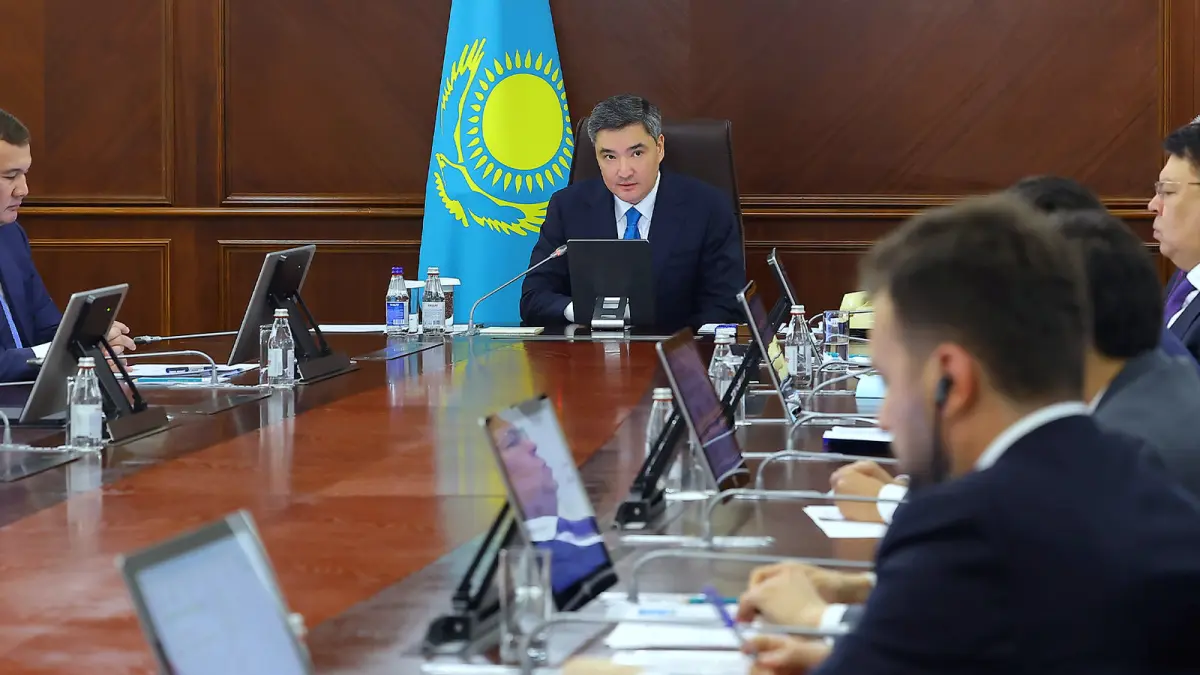
Tuesday was almost entirely about communications. In the morning the government discussed how to bring mobile internet to every village, by lunchtime the operators had named the price of these plans for subscribers, and in the evening the digital development minister was already answering questions about satellites, databases on the darknet and state verification of phones. Alongside this big conversation came smaller but no less tangible changes: a new head of the railways, a new power plant in Zhanaozen, new rules for hotels and a crossing on the Kyrgyz border closed for half a year.
The day in figures
- 1.3 trillion tenge
investment in communications over three years - 10–15%
rise in operators' tariffs in 2027 - 16.6 million
citizens whose data is allegedly being sold on the darknet - 120 MW
capacity of the new gas-fired power plant in Zhanaozen - 6 months
closure of the Sypatai Batyr checkpoint to vehicles
According to the Government of Kazakhstan, telecom operators, SOCRadar, KMG and the Transport Ministry
- 1.3 trillion tenge
Communications: cheap but getting dearer
At a government meeting Deputy Prime Minister and Minister of Artificial Intelligence and Digital Development Zhaslan Madiyev reported that more than 1.3 trillion tenge will be invested in the sector over three years and that by the end of 2027 the country will completely abandon 3G networks. On the same day Prime Minister Olzhas Bektenov demanded that civil servants send official information only through the national messenger Aitu.
The minister also named a figure that is convenient to be proud of: the average mobile tariff in Kazakhstan is about $10 a month, almost three times lower than the global average. A few hours later, at a briefing, the heads of the operators warned that prices would rise by 10–15% in 2027. Madiyev, for his part, said that operators have already paid 7 billion tenge in fines over service quality. How the two sides reconcile these figures we examined separately.
Data, phones and satellites
The second half of the briefing concerned security. Madiyev said that a darknet advert offering a database, which the seller links to the Supreme Court and to data on 16.6 million citizens, is being checked by the ministry's Information Security Committee and the National Security Committee. Nobody has yet confirmed that the database is genuine, and the minister recalled that his ministry imposes fines for breaches of data protection requirements even when the leak itself has not been proven.
Phones are also coming under state control. From 1 July 2027 mobile devices will be checked by IMEI by the State Radio Frequency Service rather than a private company, the minister said. About 23,000 new smartphones, most of them brought in by bypassing official importers, have not yet passed verification and risk ending up on the "black" list.
In space, by contrast, the country is shrinking its own fleet. By the end of the year Kazakhstan will take its KazSat-2 communications satellite, which has outlived its design life, out of orbit and, until KazSat-3R arrives in 2029, will be left with a single national spacecraft. Part of the work will be taken over by foreign operators whose ground stations are being built inside the country. The dream of a launch market of its own, which the minister spoke of the same day, for now sits next to a single satellite in orbit.
People and institutions
The fastest personnel decision of the day came at noon. President Kassym-Jomart Tokayev relieved Yersayyn Nagaspayev of his post as Minister of Industry and Construction, and less than an hour later the Samruk-Kazyna fund appointed him chairman of the management board of Kazakhstan Temir Zholy. Human Rights Commissioner Artur Lastayev appointed Anvar Sabirov head of the National Centre for Human Rights.
In the evening the Head of State updated the membership of the National Commission for Women's Affairs and Family and Demographic Policy. It is now headed by Bibigul Zheksenbay, deputy chair of the management board of the Kazakhstan television and radio corporation; the commission has shrunk from 34 to 30 members, more than half of whom are new, and no members of the government remain on it.
Energy and borders
In Zhanaozen, KazMunayGas and Italy's Eni opened a 120 MW gas-fired power plant. It is the backbone of a 247 MW hybrid complex with a solar plant and a wind farm still under construction, which is meant to rid the oilfields and the gas processing plant of power outages. On the wholesale market, Sergey Aleyev, head of the Settlement and Financial Centre, reported that after the role of intermediaries was cut, the single buyer's price fell by a quarter between June and August.
On the border with Kyrgyzstan the day brought a closure. From 25 November the Sypatai Batyr checkpoint in Zhambyl Region closes to all types of transport for about half a year while a new inspection and screening complex is built there. On the same day Zhibek Zholy on the border with Uzbekistan reopens after repairs, so one gateway to Central Asia opens while another closes.
Order in small things
Several decisions of the day concern everyday life. From 1 March 2027 a national standard for hotel services will take effect in the country: drinking water round the clock, daily cleaning and tea for a guest whose room is not yet ready. It will become mandatory for a hotel that decides to confirm compliance. The Ekibastuz prosecutor's office returned to the state pumping stations and pipelines worth 515 million tenge that had been handed to a private manager without approvals, and the company that manages returned assets put up for auction another former liqueur and vodka plant.
The day that began with a promise to bring the internet to every village ended with questions about who will store data, check phones and keep communications running in orbit. The government is handing out the answers piece by piece, and each new answer so far requires money that will have to be found either by the state or by the subscriber.



