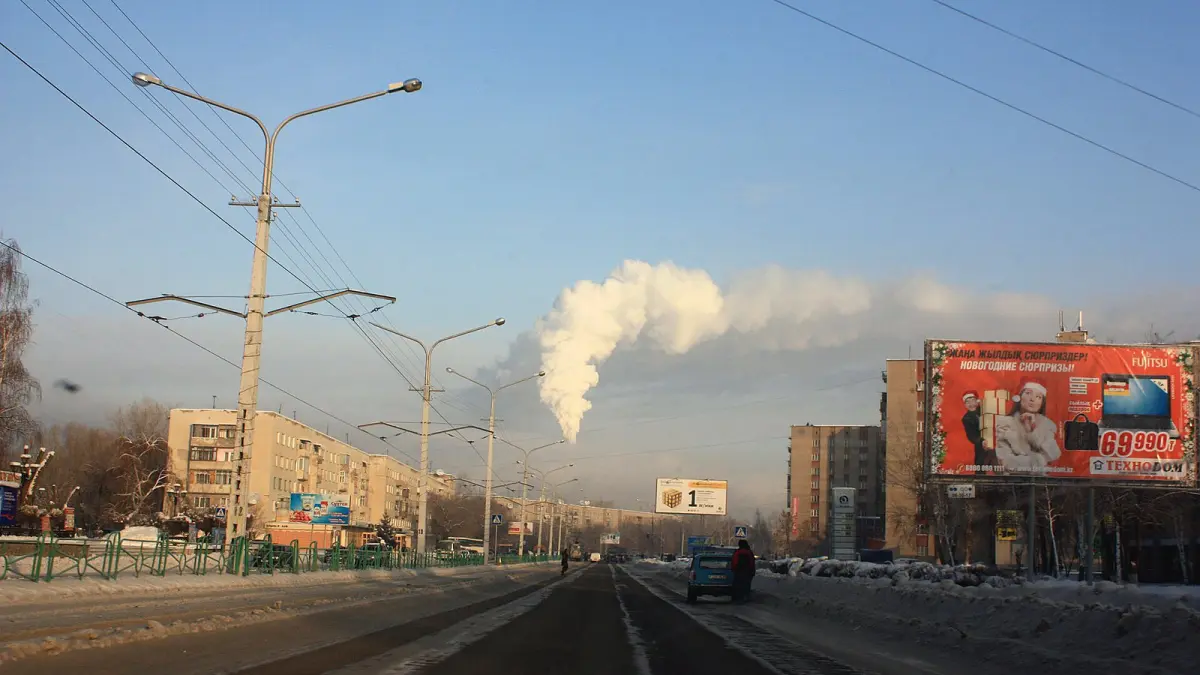
Ust-Kamenogorsk, 24 November. Kazhydromet, Kazakhstan’s state weather service, is recalculating for every city in the country the threshold values of the integrated air pollution index used to forecast adverse meteorological conditions (AMC), reported Inbusiness.kz, which has examined the agency’s administrative act.
Kazhydromet intends to approve the new thresholds and grading scale and bring them into force from 1 December 2026.
The act was issued at the end of an administrative procedure launched by Alexei Bozhkov, a lawyer and civic activist from East Kazakhstan Region. It was prompted by complaints from residents of Ust-Kamenogorsk, who say the city chokes on smog even on days when an AMC regime has not been officially declared. The document was signed by Kazhydromet’s deputy director general Manas Urinbasarov. The agency is using observation data for 2023–2025 and expects the updated criteria to let it issue AMC warnings faster.
These thresholds decide whether a special regime begins. The Environmental Code defines adverse meteorological conditions as weather in which pollutants accumulate in the surface air layer in concentrations dangerous to people’s life and health. When Kazhydromet, as the national hydrometeorological service, reports such conditions, the local akimat must immediately inform the public and introduce temporary measures to regulate emissions. During that period enterprises with stationary emission sources must meet the akimat’s requirements to cut emissions, up to a partial or full shutdown of those sources where the law allows it.
The index itself is simple. As Kazhydromet explained to Bozhkov, the concentration of each measured pollutant is divided by its maximum permissible concentration (MPC, a hygiene standard), the ratios are added up, and the sum is divided by the total number of observations per day at all of the city’s stationary monitoring posts. In physical terms, the agency said, this is close to the city-wide average normalised concentration of pollutants.
It is precisely the averaging that the activist sees as the main problem. “I tell them: please understand, you cannot set AMC by an average figure. In Ust-Kamenogorsk, for example, there is the KShT district, which is well ventilated. And there is the district where I live, Gagarin Boulevard. Here we are suffocating: there are stoves, the power plant, industrial emissions nearby,” Bozhkov said. The city lies in a mountain basin with frequent calm weather and temperature inversions, so pollution builds up in particular districts. Since the switch to automatic monitoring posts, the critical threshold for the city has, by his estimate, more than doubled.
The bulletins show the difference. According to Inbusiness.kz, in January and February 2026 the band of very high pollution for Ust-Kamenogorsk began at 0.46, while from March the published bulletins put it at 0.90. The same threshold stood at 0.45 in Almaty, 0.47 in Karaganda, 0.38 in Temirtau and 0.35 in Balkhash. In other words, for an AMC regime to be declared in Ust-Kamenogorsk, the air had to become roughly twice as dirty as in Almaty.
Bozhkov proposed abandoning city-wide averaging and calculating the index separately for the industrial zone, the residential districts next to it and the better-ventilated parts of the city. Kazhydromet has not promised that: for now the plan is to update the threshold values rather than to calculate by district, the outlet notes. The applicant himself regards the result as interim. “At first we were told the recalculation would come closer to spring, but the administrative act already gives a specific date, 1 December 2026. It remains to wait, compare the results and see what comes of it,” he said.
What it means: The index threshold works like a switch: until pollution crosses it, no AMC regime is declared, the akimat imposes no restrictions and plants are not obliged to cut emissions. Kazhydromet has undertaken to recalculate these thresholds for all cities on fresh data, but the method in which clean districts “dilute” dirty ones remains the same.
Who benefits: Residents of industrial cities, if the new thresholds allow AMC to be declared when the air really is dirty: the regime determines both companies’ duty to cut emissions and akimats’ decisions. For owners of stationary emission sources, every declared regime means restrictions. Kazhydromet has not said in which direction the thresholds will move.
Background: Ust-Kamenogorsk is the capital of East Kazakhstan Region and one of the country’s centres of non-ferrous metallurgy. Requirements for enterprises during AMC periods are set out in Article 210 of the Environmental Code, adopted on 2 January 2021.



