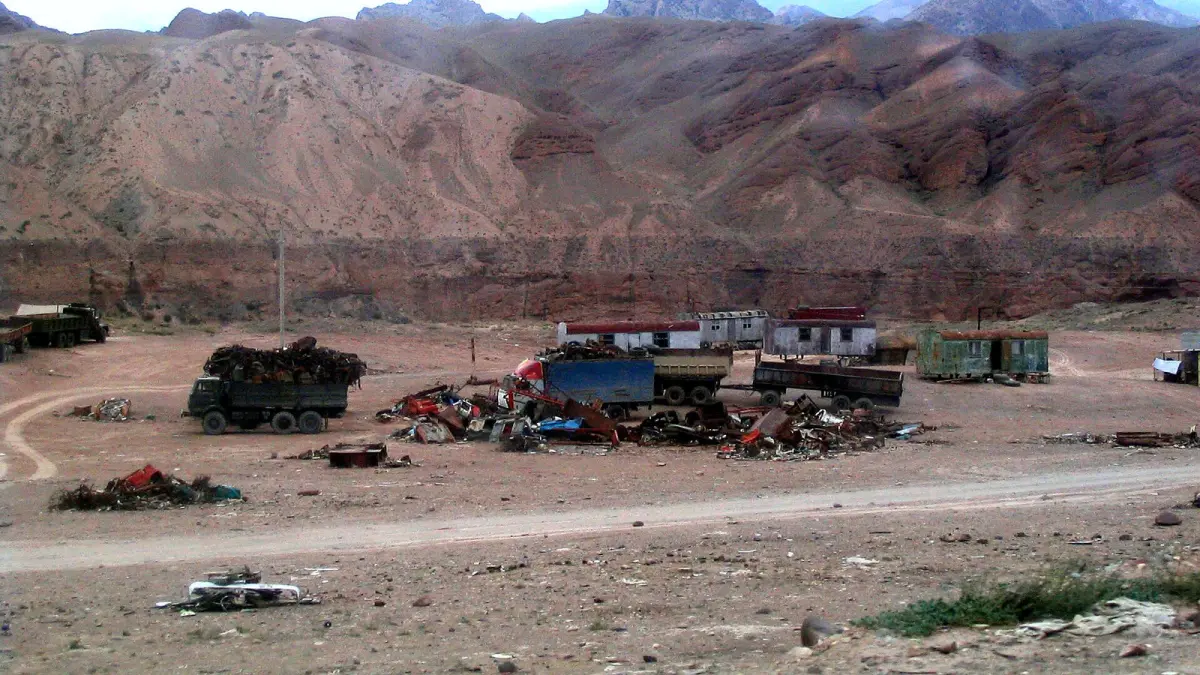
Bishkek / Urumqi, 23 November. More than 4 million tonnes of cargo in both directions have passed through the Chinese side of the Irkeshtam road crossing on the border with Kyrgyzstan since the start of 2026, said Irkeshtam customs, whose data China News Service published on 17 November.
It is an all-time high for the crossing. In Kyrgyzstan the record has been discussed since 23 November, when local outlets wrote about it.
According to customs statistics, 3.779 million tonnes of cargo passed through the crossing in January–October, 49.8% more than a year earlier. Cargo traffic has grown for the third year in a row, adding more than a million tonnes each year.
Irkeshtam is China’s westernmost first-category road border crossing. It lies in Wuqia County of the Kizilsu Kyrgyz Autonomous Prefecture of Xinjiang and borders Kyrgyzstan’s Osh Region; on the Kyrgyz side the crossing is called Erkech-Tam. It is one of two road crossings between the countries, the other being Torugart.
Customs names construction as one reason for the growth. Materials for the China – Kyrgyzstan – Uzbekistan railway, which is to link Xinjiang with the Fergana Valley bypassing Kazakhstan, pass through the crossing. In addition, according to customs, exports of petroleum products are growing steadily and shipments of live cattle have become routine. In the other direction, into China, dried fruit, livestock products and mineral raw materials pass through Irkeshtam, 24.kg relays.
Clearance has also become faster. Customs officer Qu Rui said the crossing automatically extracts cargo data, recognises vehicle number plates and checks vehicles at the gate, while electronic seals monitor cargo in transit. Thanks to this, the clearance of export cargo under the fast-track scheme has become 80% more efficient, according to customs. Since June 2025 the crossing has operated around the clock, seven days a week, 24.kg recalls.
For Kazakhstan the figure matters as a measure of competition. For now almost all overland traffic between China and Central Asia goes through Kazakh crossings. According to the Eurasian Development Bank, Kazakhstan accounts for 84% of such rail and road transport, and in 2025 a total of 51 million tonnes were carried between the region and China. The 4 million tonnes through Irkeshtam are still less than a tenth of that volume, but they are growing faster: by 49.8% over ten months against 8% for rail transport between the region and China over the same period, according to the bank. Once the railway through Kyrgyzstan opens, the southern route will gain a rail leg as well.
What it means: The Kyrgyz-Chinese border is becoming an ever busier route from China to Central Asia, and part of this growth comes from building a railway that will itself become an alternative to transit through Kazakhstan. Kazakhstan still holds the overwhelming share of traffic, but the southern route is growing faster.
Who benefits: Kyrgyzstan, through which a growing flow passes, and Chinese exporters, who gain a second route to the south of Central Asia. For Kazakh railways and carriers it is a signal of future competition on the route to Uzbekistan and beyond.
Background: In January–September 2026 more than 5.6 million tonnes of cargo passed through both Kyrgyz-Chinese crossings, Irkeshtam and Torugart, 50% more than a year earlier, and over 540,000 vehicle border crossings were registered, Economist.kg reported.
We have also reported that Kazakhstan handles 84% of overland freight between China and Central Asia.



