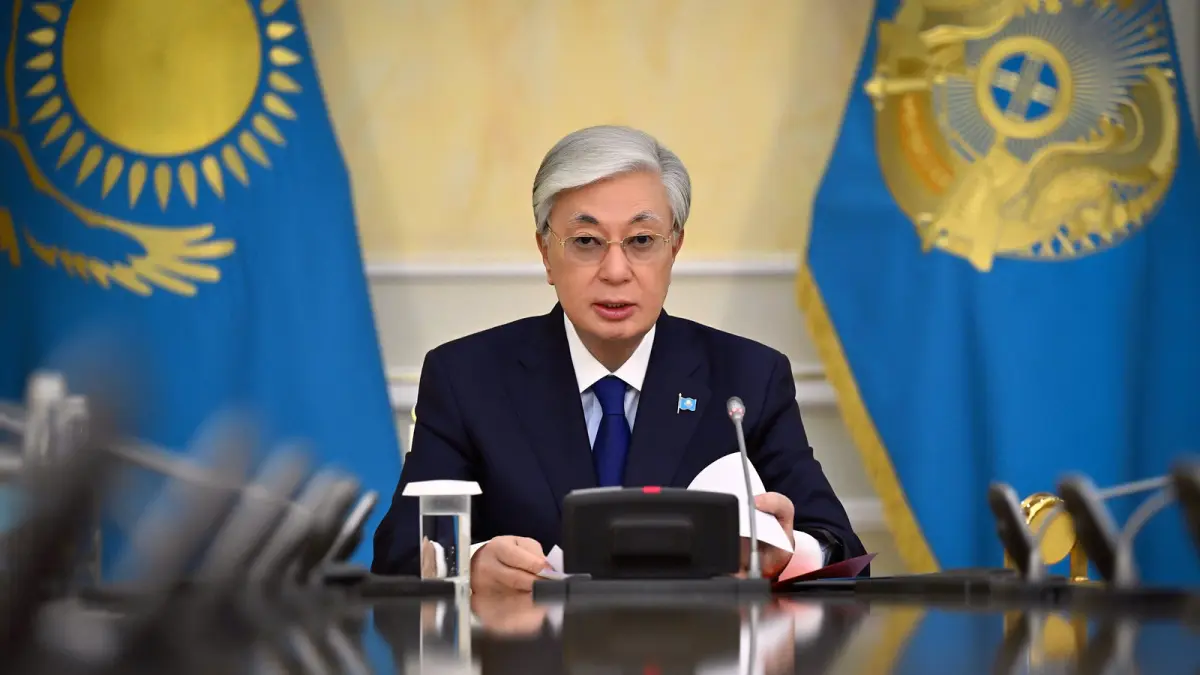
President Kassym-Jomart Tokayev called corruption risks the Achilles’ heel of state companies on 13 November, two days after the head of the Samruk-Kazyna fund was detained. Less than two weeks later investigators named a new name, this time at Kazatomprom, the world’s largest uranium producer. A case that began in one office is moving through the fund’s companies along the same path by which its decisions spread through them.
Two weeks of one case
- 14 days
from the detention of the fund’s head to the announcement of a detention at Kazatomprom - 3,168
corruption offences uncovered in 2023–2025 - 248 billion tenge
the sum of those offences - 97%
of KazMunayGas shares managed by the fund - 25,190.01 tenge
the 52-week low of the Kazatomprom share price
According to Akorda, the KNB, KazMunayGas and KASE
- 14 days
From the fund to the mine
The anti-corruption service of the National Security Committee (KNB) detained Nurlan Zhakupov, chair of the management board of the Samruk-Kazyna fund, and Yelzhas Otynshiyev, chair of the management board of the national railway company Kazakhstan Temir Zholy (KTZ), on 11 November. The committee announced this the next day and named neither an article nor a sum. As early as 13 November the President made a statement at a meeting of the Security Council that set the tone for everything that followed. He called the detention an extremely serious signal of large-scale corruption in state companies and gave the tally: in 2023–2025, 3,168 corruption offences worth more than 248 billion tenge were uncovered. Another 751 were added in the first 10 months of 2026. The case of the fund and KTZ, the President said, was the first major corruption case in state companies since the principle of “Law and Order” was enshrined in the Constitution. “There will, naturally, be no division into ‘our own’, ‘not quite our own’ and, still less, ‘outsiders’,” Tokayev said. The work of the fund and the companies, in his words, must not stop: “The serious incident that has occurred is no reason for disruptions in the work of the Fund and state companies.” He gave the Government and oversight bodies until 24 November to propose how to cut corruption in such companies sharply.
A court sanctioned the arrest of Zhakupov and Otynshiyev on 14 November, although the KNB announced this only on the 18th. In those days the head of the committee itself was replaced: on 16 November the President appointed Marat Irmenov in place of Yermek Sagimbayev. The President’s press secretary, Aibek Smadiyarov, explained that the dismissal also took into account “the detention of those involved in the corruption incident”: in the President’s view, “miscalculations were made by the security forces”. On the case itself the press secretary was definite: “the corrupt nature of the case of the heads of the Samruk-Kazyna fund and the company Kazakhstan Temir Zholy is beyond doubt”. And he added: “The President was aware of the investigation from the very beginning.”
On Monday, 23 November, the same KNB service detained Kazatomprom management board member Kuanysh Omarbekov and other persons. The committee announced this on Wednesday, 25 November. A day earlier Kazatomprom’s board of directors had terminated early the powers of two management board members: chief production officer Omarbekov and chief commercial officer Vladislav Baiguzhin. The company gave no reasons at the time. Four people remain on the management board.
One shareholder, many seats
Samruk-Kazyna is the national wealth fund through which the state owns the country’s largest companies. The state is the fund’s sole shareholder; it appoints its management and uses the fund as an instrument for strategic state tasks. That is how its structure is described by the rating agency Fitch Ratings, whose assessment the fund cited on 23 November. The fund’s board of directors is chaired by Prime Minister Olzhas Bektenov.
Blocks of shares fan out downwards from the fund. In Kazatomprom the fund owns 62.99%, and it holds a further 12.01%, the property of the Ministry of Finance, in trust management. In the national company KazMunayGas (KMG) the fund has 67.42%, and together with the stakes of the Ministry of Finance and the National Bank, which have also been placed under its management, this comes to 97%. KTZ belongs to the fund entirely, and the chair of its management board is appointed by the fund’s management board.
Seats follow the shares. Zhakupov, while heading the fund’s management board, was also chair of KMG’s board of directors. On the company’s website he is still listed as such, and he chaired a board meeting as recently as 30 October. Of the eight members of that board, three, including Zhakupov, represent the fund’s interests, one heads the company’s own management board and four are counted as independent directors. Otynshiyev was the fund’s managing director for strategy and asset management until July 2026, and then, by decision of the fund’s management board, took charge of KTZ.
The difference between the two bodies matters here. The management board runs the company day to day, while the board of directors, by KMG’s own definition, is responsible for overall direction and for control over the management board. Whoever chairs the board oversees those who dispose of the company’s money. The list of documents that guide the KMG board names, alongside laws and the charter, the documents of Samruk-Kazyna that extend to the company.
With such a structure, a decision taken at the top reaches every company quickly. The scheme, if one follows the KNB’s wording, travelled the same way: the committee writes of a corruption scheme organised by the fund’s former management, and describes those detained at Kazatomprom as involved in it.
An article about those who give
The only article of the Criminal Code that investigators have named publicly appeared only in the announcement about Kazatomprom. It is part 4 of article 367 of the Criminal Code: giving a bribe on an especially large scale or by a criminal group. The penalty under it is a fine of 50 to 60 times the amount of the bribe, or imprisonment for 10 to 15 years with confiscation of property. The announcement of the detention of the heads of the fund and KTZ contained no article at all.
It follows from the two announcements that people from Kazatomprom are suspected of giving a bribe, while the scheme, in the committee’s version, was built by the fund’s former management. On who received, how much and for what, the committee is silent, referring to article 201 of the Criminal Procedure Code, which prohibits disclosing the data of a pre-trial investigation. How many people have been detained at Kazatomprom is also unknown: only Omarbekov has been named. Whether Baiguzhin has been detained is reported neither by the committee nor by the company. Detention and suspicion do not mean guilt: that is for a court to decide.
“Operating as normal”
The companies responded to the investigators’ news with one and the same formula. On 12 November the fund said it was continuing to operate as normal, and the next day KTZ repeated the same about itself. “All companies of the group continue to operate as normal,” Bektenov said on 18 November. In the same statement he drew a line: “At this stage we are talking about a specific case that gives no grounds to call into question the activity of the Fund’s entire group of companies.” A week later the KNB announced a detention at one more company of the group. On 25 November Kazatomprom wrote that it “continues to operate as normal” and confirmed its guidance for 2026. In its case the assurance is addressed not only to Kazakhstan: the company, by its own figures, accounted for about 20% of global primary uranium production in 2025, and its depositary receipts are traded on the London Stock Exchange.
Creditors and shareholders heard these assurances differently. Fitch Ratings affirmed the fund’s rating at BBB and KTZ’s rating at BBB- with a stable outlook, the fund said on 23 November; both assessments, the announcement says, rest on a high probability of state support. Kazatomprom shares on the Kazakhstan Stock Exchange (KASE) fell as low as 25,190.01 tenge on 25 November, a 52-week low. By 14:00 Astana time they were worth 2.2% less than at the previous day’s close, and two and a half times as many of them had been sold as over the whole of the previous day. The flotation of KTZ shares, conceived as a triple listing, the arranging banks advised postponing until 2027; the fund, in a reply to the Interfax-Kazakhstan agency, put this down to worsening conditions on world markets. Preparations had gone far by then: on 5 November the company passed a hearing of the Hong Kong exchange’s listing committee.
The difference can be explained. A rating, as the same announcement makes clear, leans on state support, whereas a share price is set every day by buyers who care who runs the company.
People and rules
Personnel decisions followed one after another. The head of the KNB was replaced five days after the detentions, and Minister of Internal Affairs Yerzhan Sadenov received an official reprimand. On 24 November KTZ was taken over by Yersaiyn Nagaspayev, relieved the same day of the post of minister of industry and construction. “Those who are not ready to work for the good of the state must leave,” Bektenov said as he introduced him to the staff. Among the tasks of the new management he named strengthening corporate discipline, stepping up anti-corruption work and the personal responsibility of managers for the decisions they take. At Kazatomprom the duties of the two departed management board members were divided among the remaining executives.
Rules change more slowly, but the first signs are there. Back on 18 November Bektenov promised to strengthen the role of the boards of directors of the fund and its subsidiaries and of their audit and risk management committees, and to revise internal control, compliance and internal audit. KMG has called an extraordinary meeting of shareholders for 24 December with two items: the composition of the board of directors and amendments to the Corporate Governance Code. Exactly what will change in the code will become known from the materials for the meeting: the company promises to prepare them no later than 10 calendar days beforehand. The meeting will also have to formalise the departure of independent director Philip Malcolm Holland, who left the board back on 14 August.
What has not yet been said
The deadline the President gave the Government and oversight bodies expired on 24 November. By midday on 25 November neither Akorda nor the Government had reported what proposals had been submitted. Nor has the fund yet named the new chair of the Samruk-Kazyna management board, whom Bektenov promised on 18 November to appoint in the near future.
There are more questions for the investigators. It is unknown how many people have been detained in the Kazatomprom case and who they are. It is unknown for whom, in the investigators’ version, the bribes were intended and what decisions were at stake. Whether the inquiry will touch other companies of the fund is also an open question. Nor has it been explained what the miscalculations by the security forces were that the President took into account when dismissing the KNB chair. For the fund and the Government the question is a different one: whether the arrangement under which one person heads both the fund’s management board and the board of directors of its company will remain, and who will select independent directors.
Speaking of the Achilles’ heel, the President demanded not only a sharp reduction in the number of corruption offences but also a qualitative improvement of the companies themselves and their staffs. Arrests and dismissals answer the first half of that demand. The answer to the second will begin with the proposals whose deadline expired on 24 November and with the decisions of KMG’s shareholders on 24 December: they will show whether the fund’s structure is changing or only the names in its offices.



