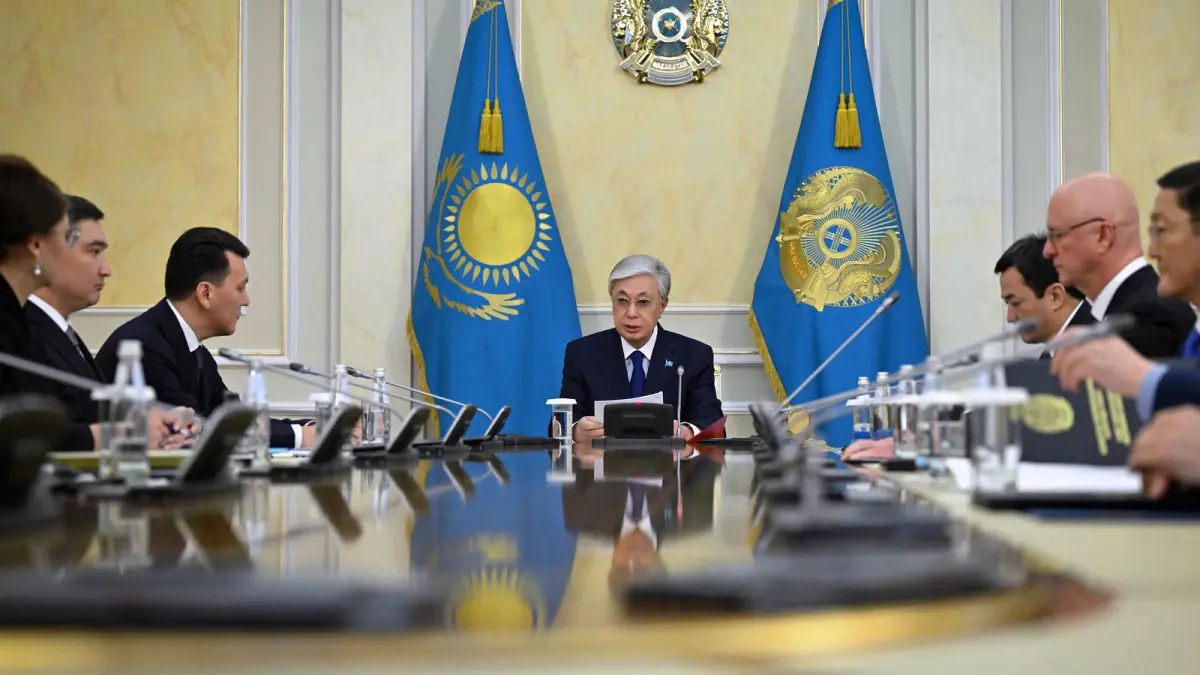
Astana, 13 November. President Kassym-Jomart Tokayev, speaking at an operational meeting of the Security Council, instructed the Government and oversight bodies to present proposals on 24 November for a sharp reduction in corruption offences in state companies, Akorda said.
He called the detention of the heads of the Samruk-Kazyna fund and of Kazakhstan Temir Zholy an extremely serious signal of large-scale corruption in such companies.
The President did not disclose details of the case. “By law, investigative matters may not be announced or disclosed, all the more so as the investigation has only just begun,” he said. According to him, this is the first major corruption case in state companies since the concept of “Law and Order” was included in the Constitution as one of the principles of public administration and public life. Tokayev recalled that the Constitution was adopted in a nationwide referendum on 15 March and came into force on 1 July.
The Head of State cited statistics. Over three years, from 2023 to 2025, a total of 3,168 corruption offences were identified, involving more than 248 billion tenge. Of these, 2,165 were committed by civil servants and the rest by other persons, including employees of the quasi-state sector. In the first ten months of this year, 751 such offences were committed: 546 by civil servants and 205 by other persons. “As these statistics show, the corruption situation remains difficult, but we do not intend to hide anything from the public or, like an ostrich, bury our head in the sand,” the President said.
All signals of corruption offences by managers at various levels, he said, will be checked promptly and thoroughly by the Anti-Corruption Service of the National Security Committee (KNB) with the participation of the Prosecutor General’s Office. “There will, naturally, be no division into ‘our own’, ‘not quite our own’ and, still less, ‘outsiders’,” Tokayev said. He called it his position of principle that no one, regardless of post, merits or connections, including family ties, has the right to count on exceptions from the law.
The President also spoke about business. Recently the authorities have reviewed some agreements and contracts which, in his opinion, had been signed in error. At the same time the authorities do not intend to introduce any restrictions for entrepreneurs. Tokayev recalled that he had instructed that another three-year moratorium on inspections of small business be declared from 1 January next year.
Separately, he gave an assurance that the work of the Samruk-Kazyna fund’s staff and of state companies, including Kazakhstan Temir Zholy (KTZ), has not stopped. “The serious incident that has occurred is no reason for disruptions in the work of the Fund and state companies,” the President said. He is confident that the fight against corruption should increase the confidence of investors and creditors in the fund. About half an hour before the statement was published, KTZ itself said it was operating as normal: transport is running without interruption, passenger and freight trains are running in full, and obligations to passengers and clients are being met.
Tokayev recalled that the Prosecutor General’s Office had secured the return of illegally acquired assets worth more than 1.3 trillion tenge. The money went to build 466 social and infrastructure facilities, and 383 of them have already been built: medical institutions, water supply systems, schools and sports complexes. The President believes there are grounds to check how well they were built. “The quality of various facilities often suffers here, including, above all, roads,” he said.
Tokayev called corruption risks the Achilles heel of state companies. The proposals he expects on 24 November are to cover not only a sharp reduction in the number of corruption offences but also a qualitative improvement in quasi-state sector companies and in the staff of their head offices.
The statement ends with words about the Narodnaya Stroika (People’s Construction) programme. “The corrupt community are our enemies, who are already hatching plans to discredit and undermine ‘People’s Construction’,” the President said. He demanded that roads, airports, polyclinics, schools and other social infrastructure facilities be built to a high standard. The proper spending of public funds will be overseen by a special State Commission, and its membership is to be published at the beginning of next week.
What it means: The President has turned a criminal case against two executives into a task for the whole system of state companies. It has a deadline, 24 November, and those responsible: the Government and oversight bodies. About the detainees themselves he said nothing beyond the KNB statement. Detention and suspicion do not mean guilt: that is for a court to decide.
What we know now: It is known that signals of corruption by managers will be checked by the KNB Anti-Corruption Service together with the Prosecutor General’s Office. Proposals on state companies are expected by 24 November, and a State Commission will be put in charge of overseeing spending on People’s Construction. It is not known under which article the detainees are suspected, what measure of restraint has been chosen for them or who is acting as head of the fund and of KTZ: the statement does not say.
Background: The KNB said on 12 November that a day earlier it had detained Nurlan Zhakupov, chairman of the management board of the Samruk-Kazyna fund, and Yelzhas Otynshiyev, chairman of the management board of KTZ, on suspicion of a corruption offence. On the same day the fund stated that it was operating as normal. Samruk-Kazyna is the national wealth fund which, in the President’s words, manages the country’s strategic assets and works with the largest foreign companies. The quasi-state sector is the name for companies that are owned or controlled by the state but are not government bodies: the national companies, the fund and their subsidiaries.
We have also reported on how the KNB detained the heads of Samruk-Kazyna and KTZ, on how the fund declared its assistance to the investigation and the preservation of its obligations and on how Akorda announced the Security Council meeting.



