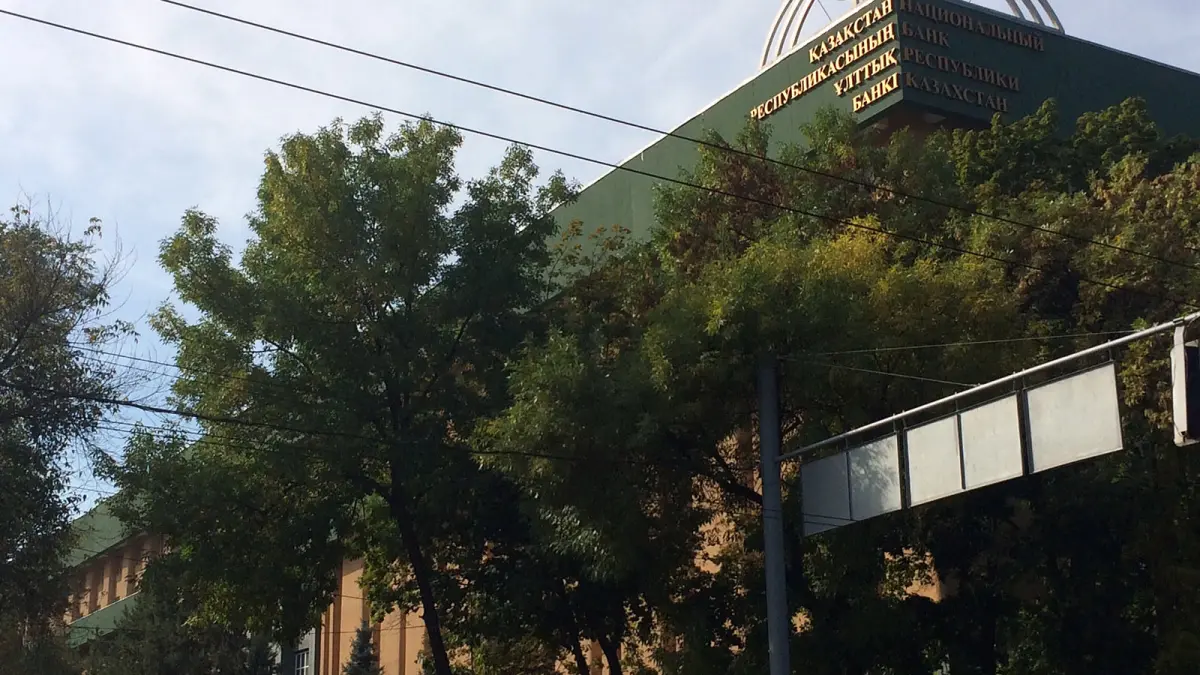
Almaty, 13 November. The National Bank, together with the Ministry of Finance, plans to issue tokenised government bonds in the first quarter of 2027, National Bank Governor Timur Suleimenov said at the XIV Congress of Financiers of Kazakhstan in Almaty.
A tokenised security is one issued as a digital record on a dedicated platform. The National Bank itself made the first such issue. At an auction on 9 November it placed short-term notes worth 50 billion tenge, of which 10 billion tenge were in tokenised form: the notes were sold on the digital financial assets platform of the Kazakhstan Stock Exchange (KASE). Their maturity is 91 days, the weighted average yield is 15.72% a year, and demand, at 70.2 billion tenge, exceeded supply 1.4 times. Now it is the turn of the Finance Ministry’s securities. Suleimenov did not name their volume, maturity or platform.
The head of the National Bank also spoke about inflation. According to him, it has been slowing for 12 months in a row and stood at 9.2%, while the regulator’s goal is unchanged: to bring it down to 5% by 2028.
Suleimenov dwelt separately on how three platforms should work together: KASE, the Astana International Financial Centre and Alatau City. “We see mutual recognition of traded instruments, administrative cooperation, exchange of information, protection of our financial perimeter and joint international positioning. The basic legal and infrastructure conditions are already in place. Now what is needed is the active involvement of all market participants,” he said.
Madina Abylkassymova, chair of the Agency for Regulation and Development of the Financial Market, spoke about how to expand banks’ participation in financing investment projects, including the People’s Construction initiative. She also presented the main lines of the Strategy for Digitalisation and the Development of Artificial Intelligence in the Financial Market for 2027–2030, which the agency is drafting.
Yelena Bakhmutova, chair of the council of the Association of Financiers of Kazakhstan, named the yardstick for these changes. “It is fundamentally important that technological and regulatory changes lead to positive economic results, namely: that they expand business access to financing, strengthen competition, make financial services more accessible and help attract long-term investment into the economy,” she said.
The Congress is organised by the Association of Financiers of Kazakhstan with the support of the National Bank and the agency. Its sessions also discussed the relaunch of the capital market, the management of pension assets, the insurance market, the crypto industry and the regulation of digital assets.
What it means: Government securities are starting to be moved into digital form step by step: first the National Bank’s notes, and in a few months the Finance Ministry’s bonds. In parallel, regulators want a security admitted on one Kazakhstani platform to be recognised on the others too.
Who benefits: Bakhmutova named those for whose sake the changes are being made: business that needs access to financing, consumers of financial services and an economy short of long-term investment. Banks, according to Abylkassymova, are being given a way into financing investment projects.
Background: The Congress met on the eve of National Currency Day, which is marked on 15 November and is considered the professional holiday of financiers: Suleimenov began his speech with congratulations. Short-term notes are debt securities of the National Bank with which it regulates the amount of money in circulation.
We have also reported on how the National Bank placed notes worth 50 billion tenge, 10 billion of them in digital form.



