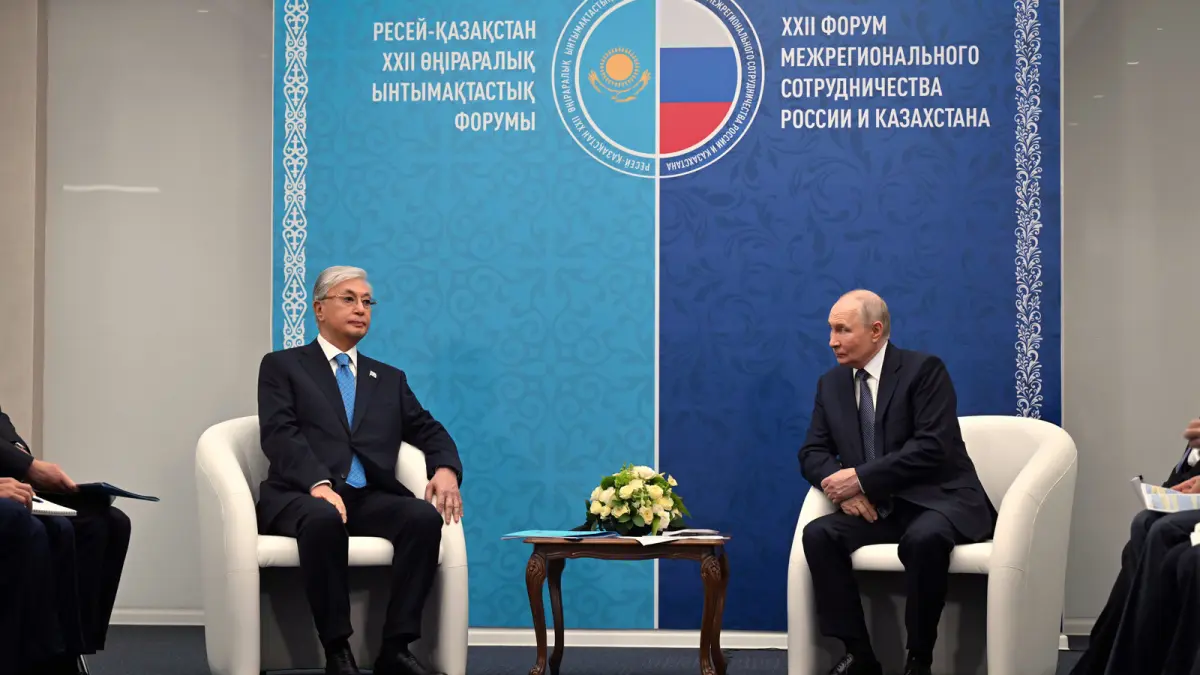
The second half of Wednesday sent the news to two addresses: Moscow and the southern border. Akorda and the Kremlin announced at the same time a trip by President Kassym-Jomart Tokayev of Kazakhstan to see Russian President Vladimir Putin, and in Turkistan Region the Zhibek Zholy checkpoint opened after lengthy repairs. Between these events there was room for a bank survey on loans, amendments on medicine and artificial intelligence, and a trading day for Kazatomprom in which its shares sank to a one-year low.
The day in figures
- 22 months
almost how long the Zhibek Zholy crossing was closed - 100,000 people a day
peak capacity of the renovated crossing - 16.4 million
applications for unsecured loans in the quarter - 18%
share of car loan applications approved - 4,800 people
waiting for an organ transplant - 2,817
illegal dumps identified since the start of the year
According to the Ministry of Finance, the National Bank, the Ministry of Healthcare and the Ministry of Ecology and Natural Resources
- 22 months
Moscow: a meeting and a conference
Aibek Smadiyarov, adviser and press secretary to the President, said that on 25–26 November Tokayev would pay a working visit to Moscow at the invitation of the Russian president. The heads of state will discuss “prospects for further strengthening the Kazakh-Russian strategic partnership and alliance”, and the President of Kazakhstan will take part in AI Journey 2026, an international conference on artificial intelligence (AI).
The Kremlin added details in its own announcement: the meeting is called informal, and the presidents will go together on 26 November to the conference, which Sberbank is holding for the 11th time. Neither side speaks of documents to be signed. The presidents discussed bilateral affairs in July in Omsk, and Tokayev then put trade between the two countries in 2025 at about $28 billion. Two weeks ago he was in Moscow for a summit of the Collective Security Treaty Organisation.
For Kazakhstan, where 2026 has been declared the Year of Digitalisation and Artificial Intelligence, the Moscow conference continues a series. In July Tokayev spoke at the World Artificial Intelligence Conference in Shanghai, and on Monday he ordered the launch of a “people’s digital economy”.
The border: a gate to the south and a gate to the east
Kazakhstan and Uzbekistan opened the adjoining checkpoints Zhibek Zholy and Gisht-Kuprik after reconstruction. More than 11 million people used this crossing in 2024: it is crossed on foot and by car and bus. It now has two terminals, six entry lanes instead of two, 82 passport control booths and 20 Q-gate automated systems. On peak days the post, according to the Ministry of Finance, will be able to handle up to 100,000 people.
The crossing was closed in February 2025 for four months. The State Revenue Committee explained at the time that the Uzbek side needed to finish building its post; the crossing stayed closed for almost twenty-two months. On the border with Kyrgyzstan the same story is only beginning: on 25 November the Sypatai Batyr checkpoint closed for the construction of an inspection complex, and the period is given as about six months.
The Chinese border was discussed the same day at the Ministry of Transport. Deputy Prime Minister and Minister of Transport Assel Zhanassova received a delegation from the company Guo JingAn. According to the ministry, the expansion of the Nur Zholy checkpoint on the Chinese side will make it possible to let through up to 1,500 lorries a day instead of 800. The Chinese side, it adds, is thinking of extending the working hours of the Khorgos checkpoint by three hours. Zhanassova proposed creating a distribution centre based on Khorgos and the city of Alatau. The goal named in the statement is to increase freight traffic with China tenfold; no deadline is given.
Loans: to whom the banks say “yes”
The National Bank published the results of a survey of 21 banks for the third quarter. Business demand for loans rose, above all among large and medium-sized companies: the average application from large business grew by 82%, to 20.9 billion tenge, and banks link this to infrastructure projects, including the modernisation of energy and utilities. Such borrowers have 64% of their applications approved.
Individuals hear “yes” far less often. Of 16.4 million applications for unsecured loans banks approved 31%, of 271,000 mortgage applications 29%, and of 1.6 million car loan applications 18%. Demand for mortgages, in the banks’ assessment, fell because one large bank suspended lending under a state programme, although the number of applications itself rose by 19%. In the fourth quarter banks expect a significant rise in demand for mortgages. Loans were also the subject in the morning at the Baiterek holding, which is channelling 4.1 trillion tenge through banks.
The Kurultai after the sitting
The Ministry of Healthcare disclosed another part of the amendments that deputies approved in the first reading in the morning: the bill introduces rules for the use of AI in medicine. First Vice Minister Timur Sultangaziyev described the principle this way: AI helps the doctor, while the decision on diagnosis and treatment remains with the specialist. Consent to medical intervention can be given in digital form. At a briefing after the sitting the vice minister said that about 4,800 people in the country are waiting for an organ transplant and that roughly 3,100 such operations have been performed since 2013.
Deputies’ inquiries of the day concerned everyday safety. Aizhan Aimaganova proposed introducing criminal liability for spiking — secretly adding dangerous substances to a person’s food or drink — regardless of the consequences. The faction of the Nationwide Social Democratic Party (OSDP) asked the Government to study a full ban on energy drinks. We reported earlier in the day on two other decisions: the ratification of the UN Convention against Cybercrime and the effect of the energy-saving amendments.
Uranium: the day after the detention
Kazatomprom shares on the Kazakhstan Stock Exchange fell as low as 25,190.01 tenge, a 52-week low, after the National Security Committee announced the detention of a member of the company’s management board. Kazatomprom said it was continuing to operate as normal. The national company KazMunayGas, meanwhile, put the composition of its board of directors before an extraordinary meeting of shareholders on 24 December; its website still lists the arrested Nurlan Zhakupov as chair of the board. How the case of the Samruk-Kazyna fund reached the uranium company in two weeks, we examined in a separate piece.
In brief
The Ministry of Ecology and Natural Resources reported that 2,817 illegal dumps have been identified since the start of the year and 93% of them cleared; 177,800 people have been fined a total of 738.9 million tenge. The Ministry of Transport announced three additional trains for the holidays: from Almaty and Aktobe to Astana and from Astana to Shymkent.
There are no grounds for moving schools to distance learning because of the seasonal rise in colds, said Sarkhat Beisenova, chair of the Committee for Sanitary and Epidemiological Control. In no school, she said, has the illness rate exceeded the threshold of 20% of pupils. Since the start of the year 381 cases of COVID-19 have been registered, 2.6 times fewer than a year ago.
The fall in cryptocurrency prices on 9–15 November did not cause a mass withdrawal of money from the licensed exchanges of the Astana International Financial Centre (AIFC), the centre’s regulator said in reply to an inquiry from BES.media. More than 200,000 clients had registered on these platforms by the middle of the year.
Wednesday’s daytime news converged on throughput. It was counted at the borders with Uzbekistan and China, in banks, where individuals have about a third of applications approved, and in transplantation, where the waiting list is longer than the list of operations performed in thirteen years.



