Astana, 25 November. The Baiterek National Investment Holding has earmarked 4.1 trillion tenge for 2026 for stimulating bank lending and for indirect measures of business support.
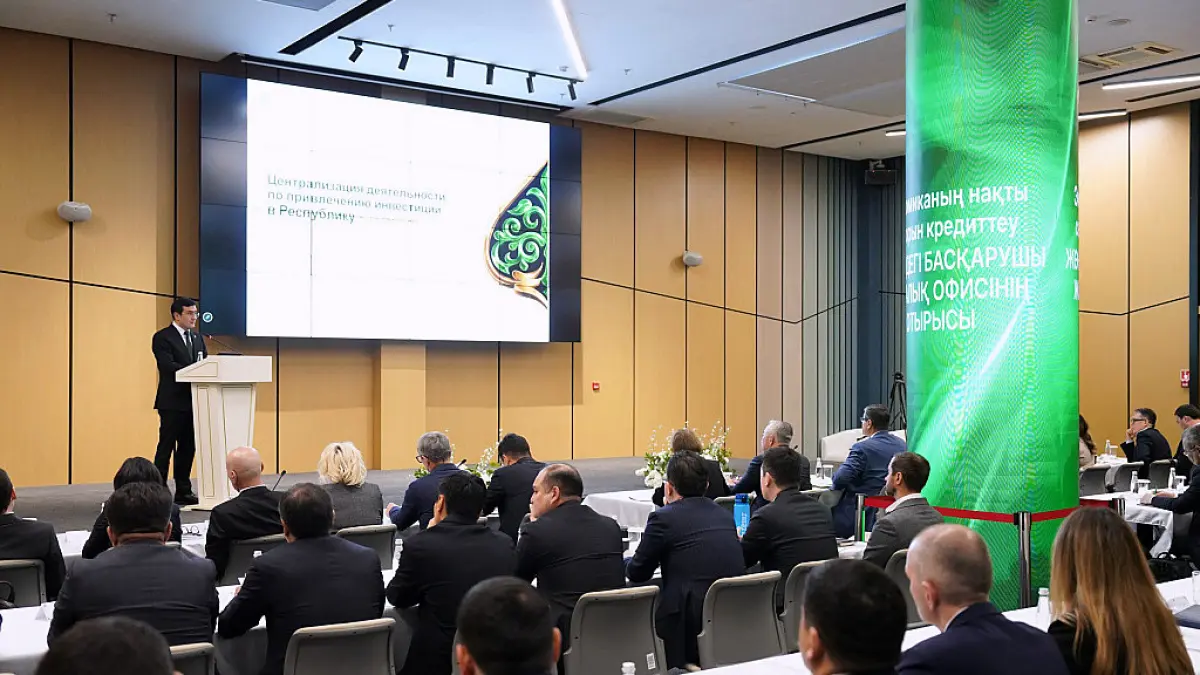
This is more than half of the planned volume of support for the economy, which amounts to 8 trillion tenge excluding the housing block, the holding’s management board chair Rustam Karagoishin said. He was speaking at a meeting of the Managing Project Office for Lending to the Real Sector of the Economy, which was chaired by Deputy Prime Minister and Minister of National Economy Serik Zhumangarin.
The holding published its statement on 24 November, and the Ministry of National Economy repeated its main figures on 25 November. The holding describes as indirect those measures under which money reaches enterprises through second-tier banks, that is, commercial banks, and other financial institutions, rather than directly from Baiterek. There are four such instruments. Guarantees account for 2 trillion tenge, and conditional financing, that is, providing banks with funds for lending to enterprises, for 1.1 trillion tenge. Subsidies and insurance are allotted 500 billion tenge each.
A guarantee covers a borrower’s shortage of collateral: that is how the Ministry of National Economy explained this instrument in February 2025, when it announced the creation of guarantee funds. A subsidy makes the interest rate on a loan cheaper for the borrower; subsidies and guarantees for small and medium-sized businesses are handled by the Damu Entrepreneurship Development Fund, a subsidiary of the holding.
The sum itself is not new. Back on 8 May Karagoishin told journalists on the sidelines at the government that of the 8 trillion tenge, 3.9 trillion would be direct financing of large investment projects and 4.1 trillion support for lending through banks. According to him, a year earlier 3.1 trillion tenge had gone to stimulating banks. What is new in the holding’s statement is the breakdown by instrument and the results of its work with banks.
In 2025 the holding’s subsidiaries, together with banks, supported 6,490 business entities for a total of more than 3.56 trillion tenge. Another 20 investment projects with a total cost of about 12 trillion tenge are being or will be financed jointly, with several financial institutions pooling their resources. About 43% of the money for these projects comes from banks and international financial institutions. The holding also quoted National Bank data: as of 1 October 2026 the portfolio of bank loans to business stood at 19.8 trillion tenge. Of this, 4.2 trillion tenge, or just over a fifth, was issued with the holding’s support — with conditional financing, guarantees and subsidies.
Baiterek intends to concentrate direct financing on large investment projects in the non-resource sector and to send projects worth less than 15 billion tenge mainly to banks. The government, the National Bank and the Agency for Regulation and Development of the Financial Market agreed this division with the banks in the summer. The National Bank reported on 24 July that the holding would deal with large and strategic projects costing more than 15 billion tenge, as well as investment projects in mechanical engineering, the production of building materials and the agro-industrial complex.
For medium-sized businesses the Orleu programme (Kazakh for “rise”) has been expanded: the maximum financing for a single project has been raised to 15 billion tenge. The Damu fund launched this programme of concessional lending to micro, small and medium-sized businesses in June 2025. At that time a borrower could obtain up to 7 billion tenge for investment at a rate of no more than 12.6% a year.
Karagoishin also presented a new model of working with investors. Each project is to be assigned a manager who will accompany the investor from the moment of application, during construction and after the enterprise is commissioned. In a single digital system the holding and its subsidiaries will be able to see what stage a project is at, what financing it needs and what issues remain to be resolved. The meeting also discussed mortgage and venture financing, cooperation between the Agrarian Credit Corporation and banks, support for exporters and the modernisation of energy and utilities infrastructure.
The Managing Project Office brings together state bodies, development institutions and second-tier banks. As the holding reported on 4 November, a project office for syndicated lending first appeared on its initiative, and the role of this platform was then strengthened by creating the managing office.
A week earlier, on 17 November, Karagoishin reported to the government that in nine months the holding’s development institutions had directed 8.7 trillion tenge to supporting the economy, or 90% of the annual plan. The plan of 8 trillion tenge named at the office’s meeting is calculated excluding the housing block; the holding did not explain how the two figures relate to each other.
What it means: Baiterek channels more than half of its support through banks: by guarantees, subsidies, insurance and money for lending to enterprises. The holding intends to keep its own loans for large non-resource projects and to send projects cheaper than 15 billion tenge mainly to banks. For medium-sized businesses this means that the route to a loan with state support runs through a commercial bank.
Who benefits: Banks: the holding’s guarantees reduce their risk when collateral is short and allow them to issue more loans, the Ministry of National Economy explained. Medium-sized businesses, for which the financing limit under Orleu has risen to 15 billion tenge. The budget: according to the holding’s managing director Anna Lukina, “state funds should not replace market financing but should serve as a catalyst for attracting it”, and this approach reduces the burden on the budget.
Background: Baiterek was established by a decree of the President of Kazakhstan of 22 May 2013, and the holding’s sole shareholder is the government. According to data on the holding’s website, it comprises seven subsidiaries, among them the Development Bank of Kazakhstan, the Damu fund, Otbasy Bank and the Agrarian Credit Corporation.
We have also reported on how Baiterek directed 8.7 trillion tenge to supporting the economy in nine months.



