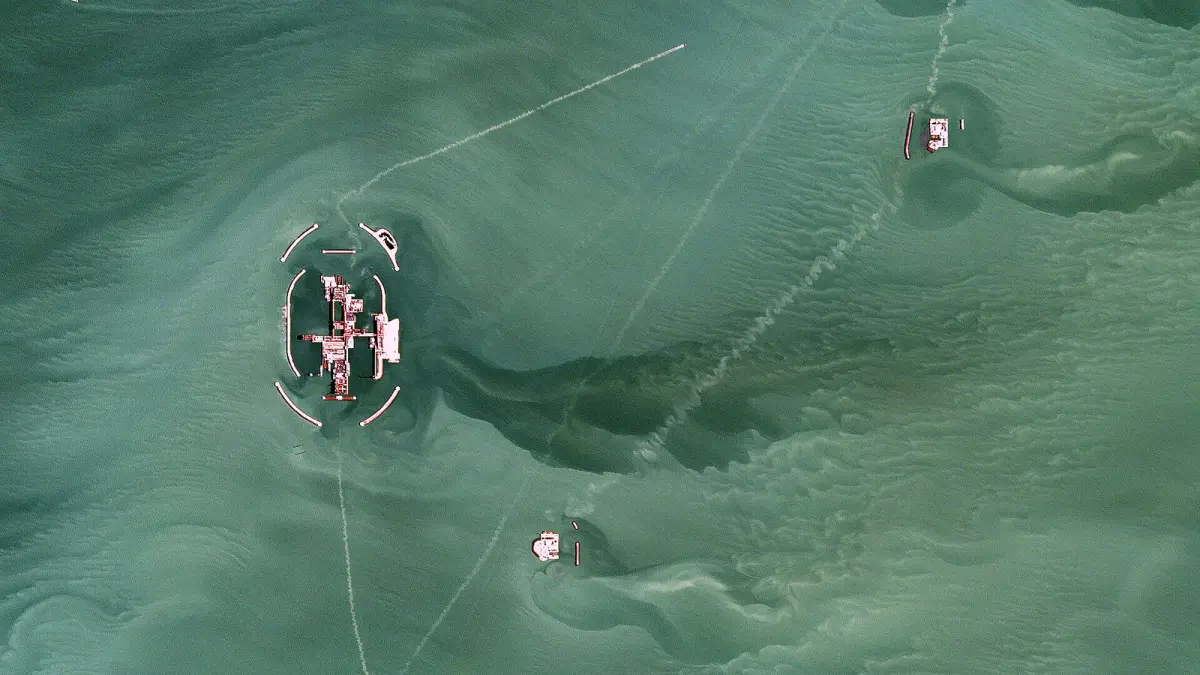
Atyrau, 25 November. The Atyrau Regional Court partly upheld an appeal by North Caspian Operating Company (NCOC), the operator of the Kashagan field, in the case over the recovery of an environmental fine of 2.36 trillion tenge.
The court declared unlawful and overturned one order of the bailiff — that of 30 July 2026, prohibiting the debtor from performing certain actions. This was reported on 24 November by Interfax-Kazakhstan, which examined the court’s ruling of 17 November.
The fine itself is not affected by this decision: the appeal was about how it is being recovered. At first instance NCOC had sought to have five orders of the state bailiff overturned. These are the orders to open enforcement proceedings and to seize real estate of 21 July, to seize vehicles of 22 July, and two bans on performing certain actions — of 23 and 30 July. The Specialised Interdistrict Administrative Court of Atyrau Region on 23 September rejected the company’s claim. The appeal court overturned the last of the five orders. The agency distributes the full text of its report by subscription. The open part of it names only this order; it does not say what actions the order prohibited.
Recovery began on 21 July: the enforcement document was issued by the Atyrau Region Department of Ecology. At that time NCOC’s property and vehicles were seized and the company was barred from actions in the electronic notary system, while its bank accounts were not seized. The proceedings were suspended on 7 September while the materials were in court and resumed on 29 September, after the refusal at first instance, Interfax wrote. The operator’s debt, according to data from the outlet Vlast, is 2,356,293,268,036 tenge.
The fine grew out of an inspection in 2022. The Atyrau Region Department of Ecology on 8 November 2022 ordered preventive control at NCOC’s facilities, and on 13 December it issued a notice to eliminate violations. These documents are named in a court decision that the outlet Kursiv examined in 2023. The inspection, according to Interfax, showed that the company had placed more than 1.2 million tonnes of sulphur above the permitted norm. Sulphur is obtained when oil and gas are cleaned of hydrogen sulphide and is stored on open sites known as sulphur pads.
The company spent several years contesting the results of the inspection in the courts. The Atyrau Regional Court on 19 June 2026 upheld the decision on the fine, and the deadline for voluntary payment expired on 20 July, the outlet Informburo.kz reported.
Kashagan is being developed by a consortium of seven companies. According to Interfax, the national company KazMunayGas holds 16.877%, Shell, TotalEnergies, Eni and ExxonMobil 16.807% each, China’s CNPC 8.333% and Japan’s Inpex 7.563%.
In parallel the dispute is continuing abroad. As Vlast wrote, in February 2026 the developers of Kashagan turned to international arbitration, and in July NCOC said that the arbitration tribunal had barred Kazakhstan from enforcing the fine until the end of the proceedings. The Ministry of Justice replied that an interim measure of a foreign commercial arbitration tribunal does not prevent the enforcement of a judicial act that has entered into force. The company itself insists that it handles sulphur in accordance with the law. This dispute should not be confused with another arbitration, over costs at Kashagan: in October, according to Bloomberg, it rejected Kazakhstan’s claims for $12 billion of $20 billion.
What it means: The appeal court corrected the bailiff on one point and did not touch the main thing: the fine of 2.36 trillion tenge remains in force. In September the court of first instance refused the company on every count; now the regional court has agreed with NCOC on one of the contested orders. This does not affect the amount of the debt.
What we know now: The fine is in force, and enforcement proceedings were resumed on 29 September. The ban of 30 July has been overturned; the agency does not report that the seizures of real estate and vehicles have been lifted. NCOC’s shareholders are continuing the dispute over the fine itself in international arbitration.
Background: Kashagan is an offshore field in the Kazakh sector of the Caspian Sea; its oil is exported as part of the CPC Blend grade through the Caspian Pipeline Consortium. In October the Bloomberg agency reported that ExxonMobil had opposed a proposal by other members of the consortium to settle the environmental dispute for about $5.2 billion.
We have also reported on how an arbitration tribunal rejected Kazakhstan’s Kashagan claims for $12 billion of $20 billion and how the Ministry of Ecology changed its sulphur storage methodology amid the dispute with NCOC.



