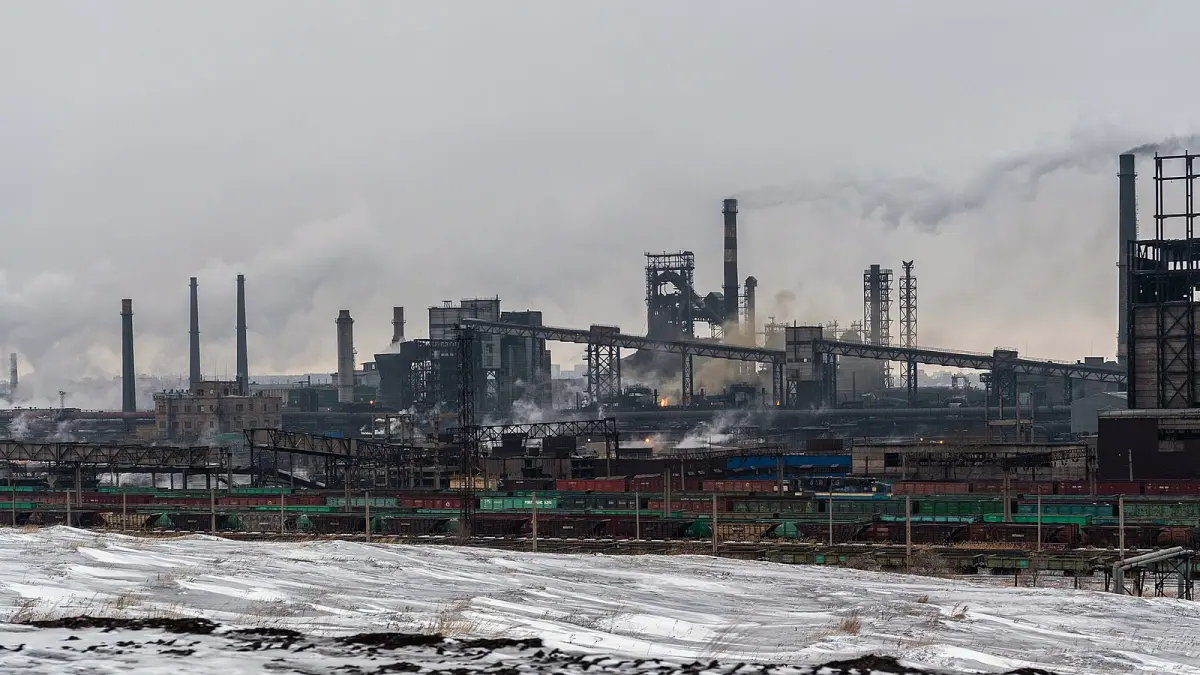
Temirtau, 2 November. President Kassym-Jomart Tokayev rode the restored tram in Temirtau, toured the converter shop of Qarmet and two of the plant’s construction sites: coke batteries No. 8 and No. 9 and a section-rolling complex that will produce rebar of classes A600 and A1000, Akorda reported.
The tram service, Akorda’s statement says, was restored by Qarmet in 2024: more than 1 million rides have been made since then, 30 kilometres of track have been replaced and restored and 8 cars bought. The President rode along Respublika Avenue to the Inzhenernaya stop. The trams have electronic payment, and the ride is free for Qarmet employees and veterans. At a meeting with the workforce Tokayev said: “I have just ridden the tram and approved this initiative. I think a good thing has been done for the residents of Temirtau,” Akorda reports.
In the converter shop, the key link of steelmaking, the President was shown how liquid iron from the blast furnace turns into steel and goes to continuous casting machines and rolling mills. In 2024 the shells of converters No. 1 and No. 2 were replaced, and some processes are being switched to natural gas. Qarmet board chairman Andrey Lavrentyev reported that by the end of 2026 the plant plans to produce 4 million tonnes of steel, 3.6 million tonnes of coal and 3.9 million tonnes of iron ore concentrate. More than 2.7 billion dollars has been invested since the company began work. Qarmet, according to Akorda, remains the only integrated mining and metals complex in Central Asia with its own coal, ore and energy base: it employs about 35,000 people, over 14,000 of them at the Temirtau plant.
Coke batteries No. 8 and No. 9 are among Qarmet’s largest investment projects: construction of this scale has not been carried out at the plant for several decades. The general technology partner is ACRE Coking & Refractory Engineering Consulting Corporation. The design capacity of the two batteries is 1.5 million tonnes of dry coke a year, with 54 ovens in each and chambers 7.6 metres high. They will replace capacity built in the 1960s and 1970s and, as noted, make the supply of the blast-furnace shop with its own coke more reliable. Start-up is planned for 2027; the project will form the basis of Kazakhstan’s first coal-chemical complex.
At the site of the new section-rolling complex the President was told that the shop, with a capacity of more than 540,000 tonnes of products a year, will make high-strength construction rebar of classes A600 and A1000, as well as angles, channels and other metal products. The technology partner is the Chinese engineering company CERI, and the complex includes a reheating furnace with a throughput of up to 100 tonnes of metal an hour. The main equipment is now being installed, with commissioning set for the end of 2026. According to Akorda, the project should reduce the domestic market’s dependence on imports and widen Qarmet’s opportunities in construction, including the building of nuclear power plants.
The total volume of Qarmet’s investment programme is 3.5 billion dollars. Four new projects are under way at the Temirtau plant: coke batteries No. 8 and No. 9, the section-rolling complex, a galvanising and polymer-coating line, and a casting-and-rolling complex. By 2028 the company intends to reach 5 million tonnes of steel, 9 million tonnes of coal and 5 million tonnes of iron ore concentrate.
What it means: Of what the President was shown, two projects are still under construction, and dates are named for them: the section-rolling complex with A600 and A1000 rebar at the end of 2026 and the coke batteries in 2027. The tram and the shop after repairs already work.
Who benefits: According to Akorda, the section-rolling complex will let Qarmet increase output of sections, displace part of imports on the domestic market and enter the construction segment, including nuclear plants; the coke batteries give the plant its own coke for the blast furnaces.
Background: Tokayev visited the plant on 14 August 2024 and promised to come every year; Qarmet then reported projects worth more than 3.5 billion dollars, reported in 2024.



