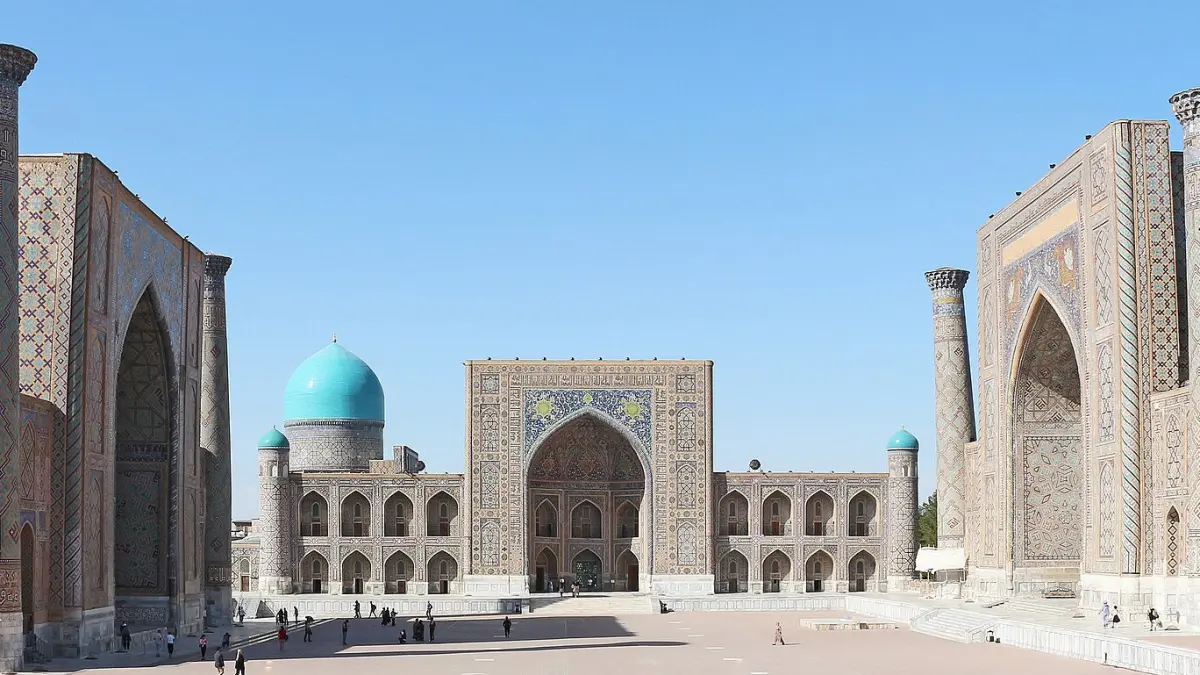
On Monday, 19 October, the foreign ministers of Kazakhstan, Kyrgyzstan, Tajikistan, Turkmenistan and Uzbekistan meet US Secretary of State Marco Rubio in Samarkand in the C5+1 format [1][2]. It is Rubio's first trip to Central Asia [3][14]; the State Department and the Secretary himself speak of a delegation of more than 200 representatives of American business [1][3].
The meeting is taking place in the city where the format began working at ministerial level eleven years ago, which makes it a good moment to look at what C5+1 is, why Washington needed it and where Kazakhstan fits in.
What is known about the meeting
The State Department announced the trip on 13 October: in Samarkand Rubio takes part in the C5+1 Ministerial and holds bilateral engagements with senior officials from all five countries, Uzbekistan, Kazakhstan, Tajikistan, Turkmenistan and the Kyrgyz Republic [1]. The department calls the visit historic and promises a "new era" of commercial cooperation; after Samarkand the Secretary flies on to India [1].
According to Uzbekistan's foreign ministry, on the same day Uzbek Foreign Minister Bakhtiyor Saidov and Rubio hold the first round of a dialogue on an enhanced strategic partnership, with meetings with US and regional business planned on the sidelines [2]. The programme also includes a session of the American-Uzbek Business and Investment Council with Uzbek President Shavkat Mirziyoyev [3][14]. Sergio Gor, the US President's special envoy for South and Central Asia, said back in September that the focus would be on regional economic ties, energy security and joint solutions to regional issues [2]. Ulysmedia, citing Uzbek media, lists the expected topics more broadly: trade, investment, critical minerals, transport links and regional security [3].
At Samarkand airport the Secretary was met by Saida Mirziyoyeva, head of the Uzbek Presidential Administration, and Foreign Minister Bakhtiyor Saidov, together with Sergio Gor and US Ambassador Jonathan Henick [4]. In September Gor spoke of a delegation of representatives of more than 100 companies; by the landing in Samarkand the count had reached more than 200 business leaders.
Where C5+1 came from
The name is simple: C stands for Central Asia, 5 for its five states and +1 for an outside partner that talks to the region as a group rather than to each country separately. In 2015 AFP remarked that the new format's name was hardly exotic [5]. The Americans did not invent the scheme: the honour usually goes to Japan, which has held a "Central Asia + Japan" dialogue since 2004, but it was Washington that turned it into a model others later followed [6].
The American version has a Kazakh back story. According to historian S. Frederick Starr, as recounted by The Times of Central Asia, in 2013 Kazakhstan's ambassador to the US, Kairat Umarov, after consulting Astana, suggested to Assistant Secretary of State Nisha Biswal a regular mechanism for consultations between Washington and the governments of the region; Biswal backed the idea and Secretary of State John Kerry approved it [7]. At first the participation of Afghanistan, that is a C6+1 format, was also discussed, but in the end it was left outside the mechanism [7].
The six ministers first met on 26 September 2015 in New York, on the sidelines of the UN General Assembly, and on 1 November 2015 they gathered in Samarkand [7]. Kerry then became the first Secretary of State to visit all five countries of the region in a single trip [6][8]. Samarkand was chosen in 2015 because Islam Karimov wanted the meeting held there, and eleven years later the ministers are back in the same city.
Ministerial meetings then followed almost every year: Washington (2016), New York (2017 and 2019), Tashkent and online (2020), online (2021), New York (2022), Astana (2023), New York (2024) [9]. The format was raised to presidential level for the first time in New York in 2023, and in November 2025 Donald Trump hosted the five presidents at the White House [7].
Note. C5+1 is a diplomatic platform of the United States and the five Central Asian states: Kazakhstan, Kyrgyzstan, Tajikistan, Turkmenistan and Uzbekistan. Meetings are held at foreign-minister level and, since 2023, at presidential level as well. The first ministerial meeting took place on 26 September 2015 in New York, the first in the region on 1 November 2015 in Samarkand [7][9].
What the United States is looking for
The State Department describes C5+1 as a platform that promotes "a more peaceful and prosperous future" for the United States and the countries of Central Asia, and presents the visit itself above all as a business trip [1]. The Times of Central Asia calls the format Washington's principal mechanism for engaging Central Asia as a region; over ten years its agenda has grown from ministerial meetings to trade, security, connectivity, energy and critical minerals [7].
The last term deserves an explanation. In American usage, critical minerals are those the economy and national security cannot do without and whose supply chains are vulnerable to disruption. That is how the US Energy Act of 2020 defines them, and the official list is kept by the US Geological Survey, which in 2022 published a list of 50 items [10]. For a region rich in metals, this means that talk of "minerals" at C5+1 meetings is talk about the region's place in supply chains whose very vulnerability is what makes these minerals "critical".
The neighbours are not silent either
Central Asia has more than one interlocutor these days. On the eve of the Samarkand meeting, on 18 October, Chinese Premier Li Qiang said China was ready to strengthen the alignment of development strategies with Uzbekistan and to deepen cooperation in energy, resources, artificial intelligence and modern agriculture [11]. The same day he promised high-quality implementation of the China–Kyrgyzstan–Uzbekistan railway project [12]. Russia gathers its Central Asian partners in formats of its own: the first Russia–Central Asia summit was held in Astana in October 2022 [6].
The "five plus a partner" scheme works both ways: each major partner gets the same five as interlocutors, and the countries of the region get a chance to talk to it together.
What it means for Kazakhstan
Kazakhstan is not a guest in this story: according to Starr, the idea of the mechanism was born at the Kazakh embassy in Washington, and in 2023 Astana hosted the C5+1 ministerial meeting [7][9]. In Samarkand Kazakhstan's foreign minister takes part in the joint meeting [2][13], and the State Department promises bilateral engagements with senior officials of all five countries, Kazakhstan included [1].
The results of the meeting, any joint documents and possible deals had not been announced at the time of publication. The meeting can be judged by what the declared topics turn into: a joint statement by the ministers, contracts for American companies or new working groups on minerals and transport.
List of sources used
- US Department of State: "Secretary Rubio's Travel to Samarkand, Mumbai, and Jamnagar", 13.10.2026
- Gazeta.uz: "Визит госсекретаря США Марко Рубио в Самарканд ожидается 19 октября", 16.10.2026
- Ulysmedia: on Rubio's arrival in Samarkand, 18.10.2026
- UzDaily: "US Secretary of State Marco Rubio Arrives in Uzbekistan", 18.10.2026
- The Peninsula (AFP): "Notorious Uzbek leader welcomes Kerry to Silk Road citadel", 01.11.2015
- The Diplomat: "Will We Soon See a Central Asia-US Leaders' Summit?", 2023
- The Times of Central Asia: "How Kazakhstan Initiated C5+1", 27.09.2026
- The Diplomat: "US Secretary of State to Visit All Five Central Asian States", 2015
- The Diplomat: "US Congressional Representatives Urge Trump to Host a C5+1 Leaders Summit, Soon", 2025
- US Geological Survey: "U.S. Geological Survey Releases 2022 List of Critical Minerals"
- Xinhua: Li Qiang on cooperation with Uzbekistan, 18.10.2026
- Xinhua: Li Qiang on the China–Kyrgyzstan–Uzbekistan railway, 18.10.2026
- Kazakhstan Today: "В Узбекистане пройдет встреча глав МИД стран Центральной Азии и США в формате C5+1", 18.10.2026
- BES.media: "Госсекретарь США Марко Рубио прилетел в Самарканд", 18.10.2026
Artificial intelligence was used in preparing this material.