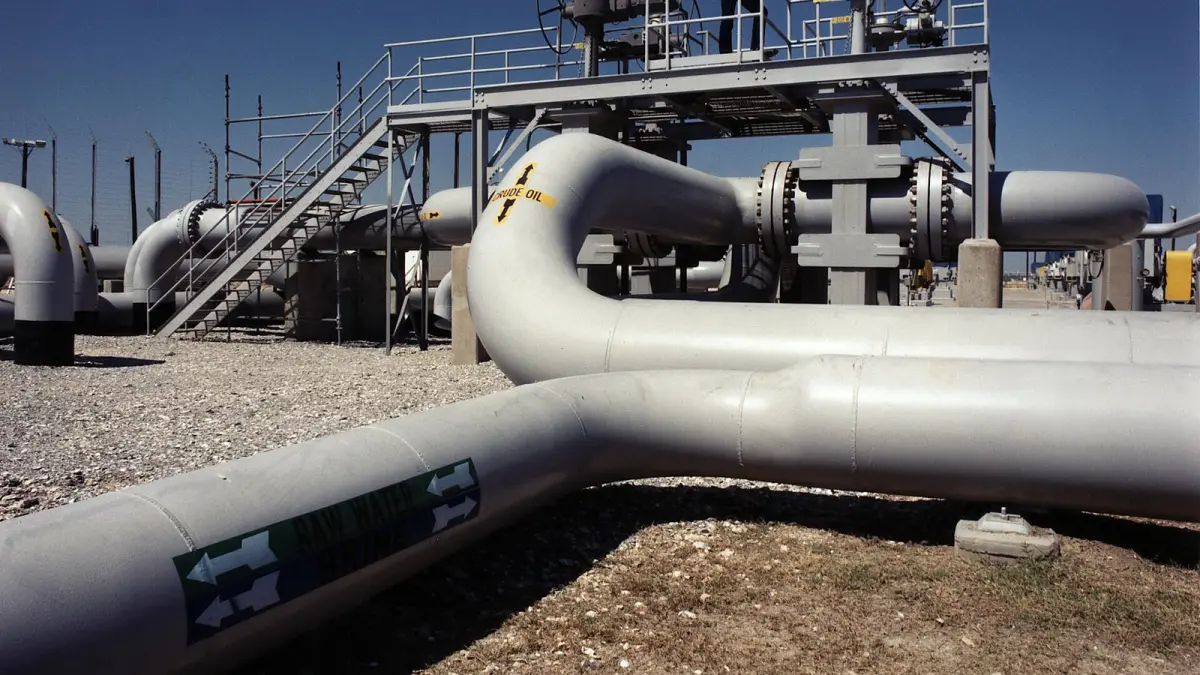
Washington, 26 October. Stocks in the US Strategic Petroleum Reserve fell to 282.6 million barrels in the week ending 23 October, the lowest level since October 1982, the US Department of Energy said; a week earlier, according to Energy Information Administration (EIA) data, the reserve held 282.7 million barrels.
The Strategic Petroleum Reserve is the government's emergency stock of crude oil, which the authorities release onto the market when supplies are disrupted. The EIA's weekly series shows how it was drawn down during the war in the Gulf. Before the war began on 28 February, and until 20 March, it held 415.4 million barrels. Releases started in late March and were fastest in May and June, when the reserve lost 5–10 million barrels a week: 392.7 million on 1 May, 325.7 million on 26 June. The pace then slowed: in September the reserve lost less than a million barrels a week, and in October between zero and 0.8 million. In all, about 133 million barrels, almost a third of the stock, have left the reserve since the war began. The drawdown, according to Investing.com, stems from a US commitment to release 172 million barrels.
In other words, the "lowest since 1982" is not a new collapse but the continuation of a slow descent: the reserve dropped below 300 million barrels in early August, and now almost every week sets a new record, a fraction of a million barrels below the last. In October 1982 the reserve held about 280 million barrels, according to Izvestia.
The oil market meanwhile remains near six-month highs, although it began the week lower. According to Reuters, by 19:37 Kazakhstan time on 26 October, December Brent futures had fallen 1.7% to $114.70 a barrel and WTI 2.5% to $100.71, as the market reacted to Qatari mediators travelling to Tehran and to preparations for a meeting of Saudi Arabia, Turkey and Pakistan with Iranian officials. By the evening Brent had climbed back to $117.21: the Houthis said they had struck pumping stations on Saudi Arabia's East-West oil pipeline and Riyadh airport.
What it means: America's emergency stock has lost almost a third in eight months of war, but it is now being drawn down slowly: the main release came in spring and early summer, and the reserve is barely being tapped now. The safety cushion against new disruptions is thinner than before the war.
Who benefits: US fuel consumers, since oil from the reserve added supply to the domestic market in spring and summer. Oil exporters, including Kazakhstan, benefit directly from high Brent: the Kazakh CPC Blend grade, shipped through the Caspian Pipeline Consortium (Tengiz, Kashagan, Karachaganak), is sold at prices linked to Brent. At the same time, the shrunken reserve means the United States has less room to bring prices down in a new spike.
Background: As Reuters reported, October 2026 was the worst month for attacks on commercial ships in the Strait of Hormuz and nearby waters since 2017, when the Washington Institute for Near East Policy began keeping such records.
We have also reported that India's BPCL will sharply cut purchases of Russian oil in November.


