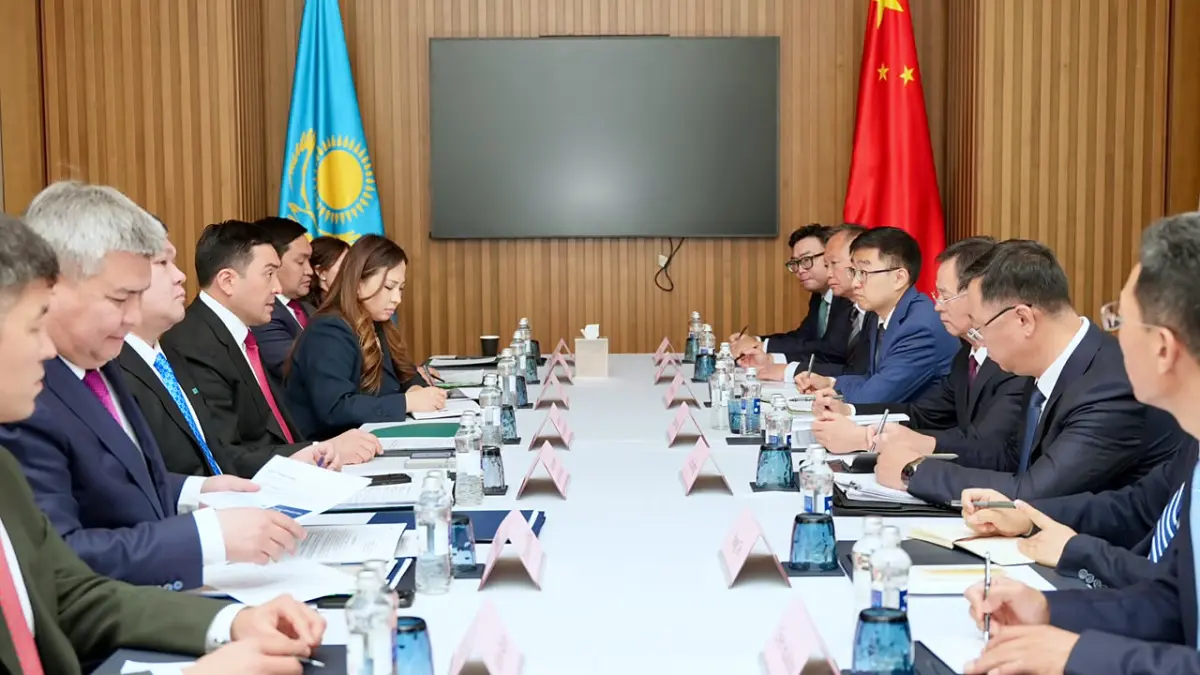
Astana, 27 October. First Deputy Prime Minister Nurlybek Nalibayev chaired in Astana the fifth meeting of the working group on Kazakh-Chinese oil and gas cooperation, attended by Zhou Xinhuai, president of China National Petroleum Corporation (CNPC); the sides discussed higher oil supplies, pipeline capacity, extending existing subsoil use contracts and expanding the Shymkent oil refinery, the Prime Minister's press office said.
Energy Minister Yerlan Akkenzhenov and the heads of both countries' national oil and gas companies took part. Besides refining, the agenda covered exploration, gas cooperation, petrochemicals and "new energy". The sides looked separately at how to extend existing contracts and settle issues arising in joint projects; the government did not say which contracts or terms were meant. Summing up, Nalibayev called for faster joint projects and timely delivery on what had been agreed.
On the same day Akkenzhenov held a separate meeting with Zhou Xinhuai. Its main topic, according to the Energy Ministry, was the plan to expand PetroKazakhstan Oil Products (PKOP), which owns the Shymkent refinery, from 6 to 12 million tonnes of crude a year. The ministry recalled that during the Head of State's visit to China in autumn 2025 the sides agreed to treat the project as a stand-alone initiative. The meeting covered its current status and next steps, as well as contractual obligations, local content and staff training. Akkenzhenov called CNPC one of Kazakhstan's key strategic partners for more than 30 years.
The Shymkent plant is one of the country's three large refineries, alongside Atyrau and Pavlodar, and supplies fuel to southern Kazakhstan. Doubling its capacity also means more crude at the inlet: a week earlier KMG and CNPC agreed to design an expansion of the pipelines that feed the plant. Neither the government nor the ministry has named a completion date or a cost.
What it means: Kazakhstan and CNPC are moving from the general 2025 understanding on expanding the Shymkent refinery to practical steps, while also discussing extensions of production contracts. For the country this is about its own petrol and diesel fuel in the south; for CNPC, about keeping its place in Kazakh projects for years to come.
Who benefits: The domestic fuel market: if the plant doubles in size, the country can refine more of its own crude instead of importing products. CNPC, co-owner of the plant and a partner in upstream projects, whose position in Kazakhstan extended contracts would preserve. Kazakh contractors and service companies are promised a share through local content requirements, though the ministry gives no figures.
Background: The Shymkent refinery processes 6 million tonnes of crude a year. The Kazakh-Chinese oil and gas working group met for the fifth time; joint projects of the two countries span exploration, production, transport and refining of hydrocarbons.
We have also reported that KMG and CNPC will design an expansion of the pipelines to the Shymkent refinery.


