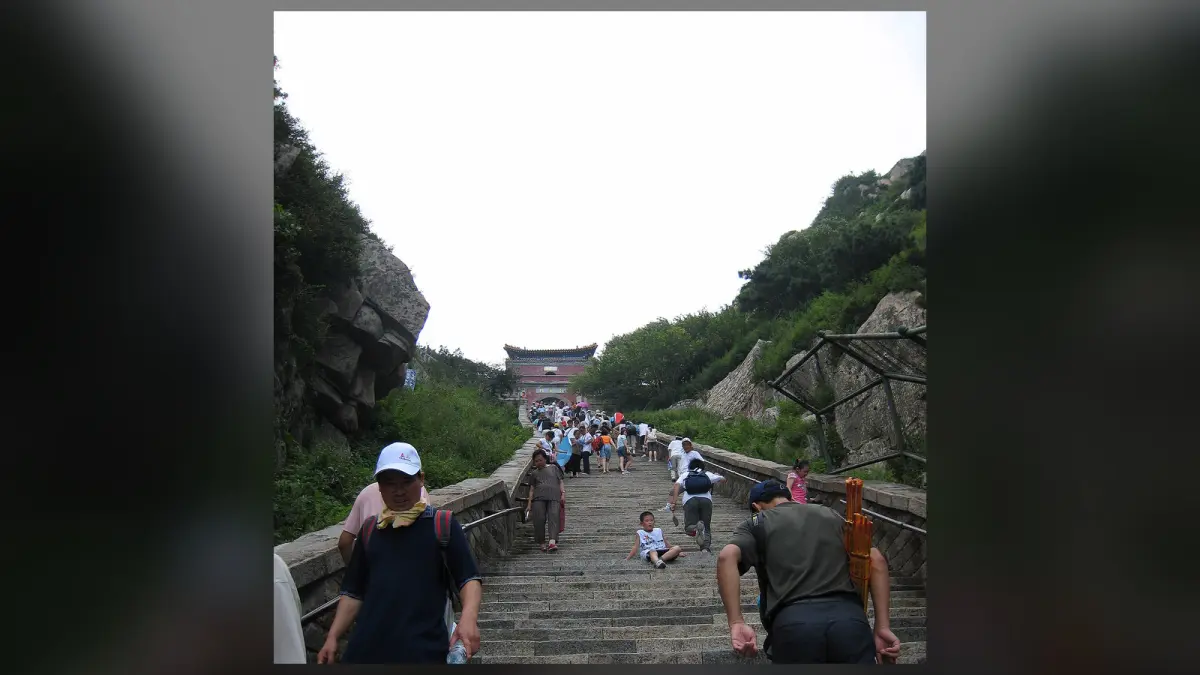
Tai’An, 29 October. Four-legged robots have run the qualifying rounds of the first CMG World Robot Mount Tai Competition, held by China Media Group on Mount Tai in China’s Shandong province; the final is scheduled for 2 November, and the course from Hongmen gate to Zhongtianmen gate covers 3.8 km and more than 3,100 stone steps.
The programme has four events: a humanoid robot race, a legged robot race, a legged robot load-carrying race and an all-terrain scouting challenge. Qualifying on 26 October took place in rain on slippery steps; the best four-legged robot, made by Zhishen Technology, completed the course in about an hour, while the humanoid race was cancelled because of the rain for safety reasons. Qualifying results will set the starting order for the final. In the load-carrying event, wheeled-legged robots carried boxes and carts of goods up the steps near Hongmen gate, and tourists stopped to film them on their phones.
The organisers call the mountain a “natural extreme testing ground”: unlike a flat hall, here a robot has to keep its balance on uneven steps with changing gradients. Participants, according to Global Times, paid special attention to heat dissipation: a continuous climb under load heats the joint motors heavily. Alongside the competition, Tai’an is hosting an expo and meetings of companies, universities and investors on embodied intelligence — the term for AI that controls a robot’s body in the physical world.
What it means: Chinese robotics has taken testing out of the laboratory onto one of the country’s most visited mountains: the competition checks whether machines can work on real terrain rather than a prepared site.
Who benefits: Robot makers gain an open testing ground and a showcase for investors. The city of Tai’an gains a new industry and tourist interest. Porters on the mountain may find their work eased by robots, but, as Chinese media wrote as early as 2024, robots can replace only part of it.
Background: Mount Tai is one of China’s five sacred mountains and a UNESCO World Heritage site since 1987; goods and rubbish have been carried along its trails on human backs for centuries. The mountain generates about 24,000 tonnes of waste a year. Tests of robot dogs carrying up to 40 kg of rubbish began here in October 2024, and in summer 2026 a robot porter started permanent work, carrying water up and rubbish down under the Smart Mount Tai programme.


