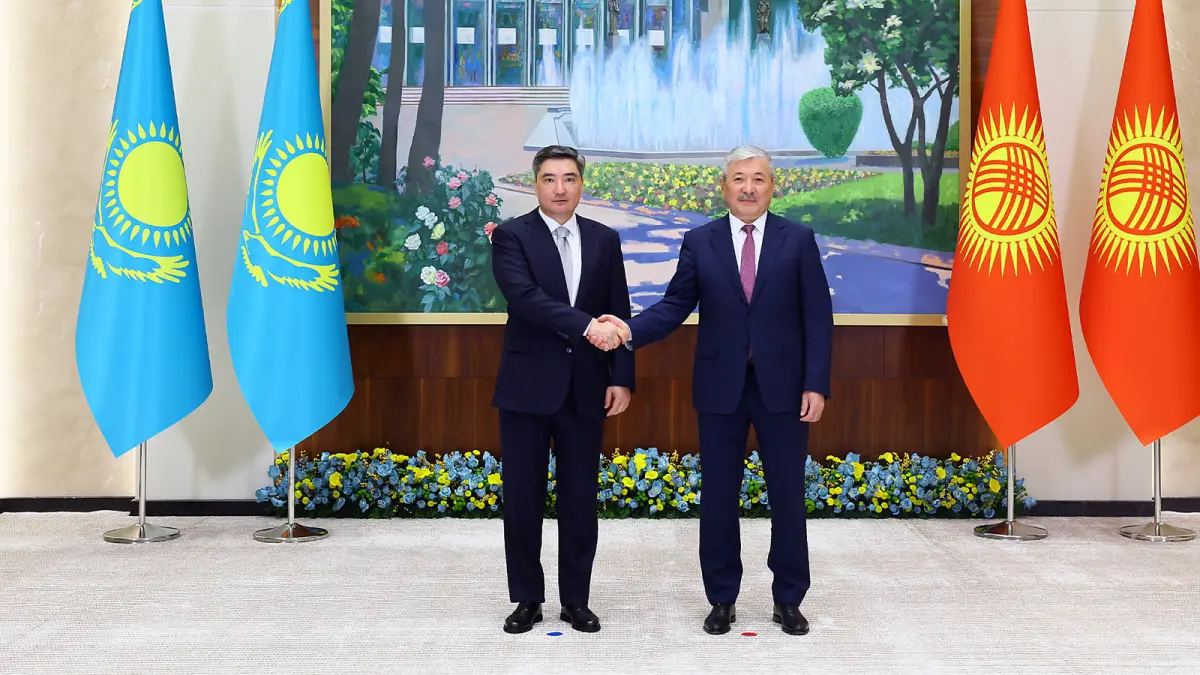
Bishkek, 30 October. Kazakh Prime Minister Olzhas Bektenov and Kyrgyz Cabinet Chairman Adylbek Kasymaliev held the 14th meeting of the intergovernmental council in Bishkek and signed its protocol; the goal is to raise trade to 3 billion dollars, and the key project is a cross-border industrial trade and logistics complex in Zhambyl region, the government said.
Trade between the two countries grew by 33% to 2.4 billion dollars in 2025 and by another 20% since the start of 2026. In January–August it amounted to 1.75 billion dollars, said Trade and Integration Minister Arman Shakkaliev. Trade in agricultural products grew by 41.5% to more than 500 million dollars in 2025; under a road map Kazakhstan wants to supply Kyrgyzstan with more grain, oilseeds, oilcake, sunflower oil and ice cream. Electronic exchange of road haulage permits has been introduced at the border, the number of permits is to rise to 5,000, and 8 road checkpoints are being upgraded. Regular flights rose by 19% to 19 a week.
On the eve of the meeting the heads of government took part in the Second Forum of Interregional Cooperation. Zhambyl region, home to 7 of the 8 checkpoints on the 1,200 km common border and more than a thousand companies with Kyrgyz participation, was named a hub of cross-border trade. Rail freight between the countries rose by 8.3% to 5.1 million tonnes in nine months; mutual tourist flows exceeded 4 million people. Documents were signed on twinning Almaty and Bishkek and other regions. Water resources — exchange of hydrometeorological data and interstate water facilities — space, digitalisation and AI were also discussed.
In parallel, a technical meeting of Kazakhstan, Kyrgyzstan and Uzbekistan supported by the World Bank was held in Istanbul on the 1,860 MW Kambarata-1 hydropower plant on the Naryn river. Kazakhstan was represented by Deputy Energy Minister Yerzhan Yertayev and Deputy Minister of Water Resources and Irrigation Arsen Zhakanbayev. What decisions were taken was not reported.
What it means: Trade with Kyrgyzstan is growing faster than with most neighbours, and the governments are moving it from shuttle trade to joint logistics and production on the border.
Who benefits: Kazakh exporters of food and oil products gain a larger market. Hauliers gain more permits and faster borders. For Kazakhstan and Uzbekistan downstream on the Naryn and Syr Darya, Kambarata-1 should provide regulated summer water flow; for Kyrgyzstan, electricity.
Background: The intergovernmental council is an annual meeting of the two heads of government; the 13th meeting was held in Astana in November 2025. The 3-billion-dollar target was set by Presidents Tokayev and Sadyr Japarov. The three countries agreed to build Kambarata-1 jointly in 2025.
We have also reported that Bektenov flew to Bishkek for the Kazakhstan–Kyrgyzstan intergovernmental council.



