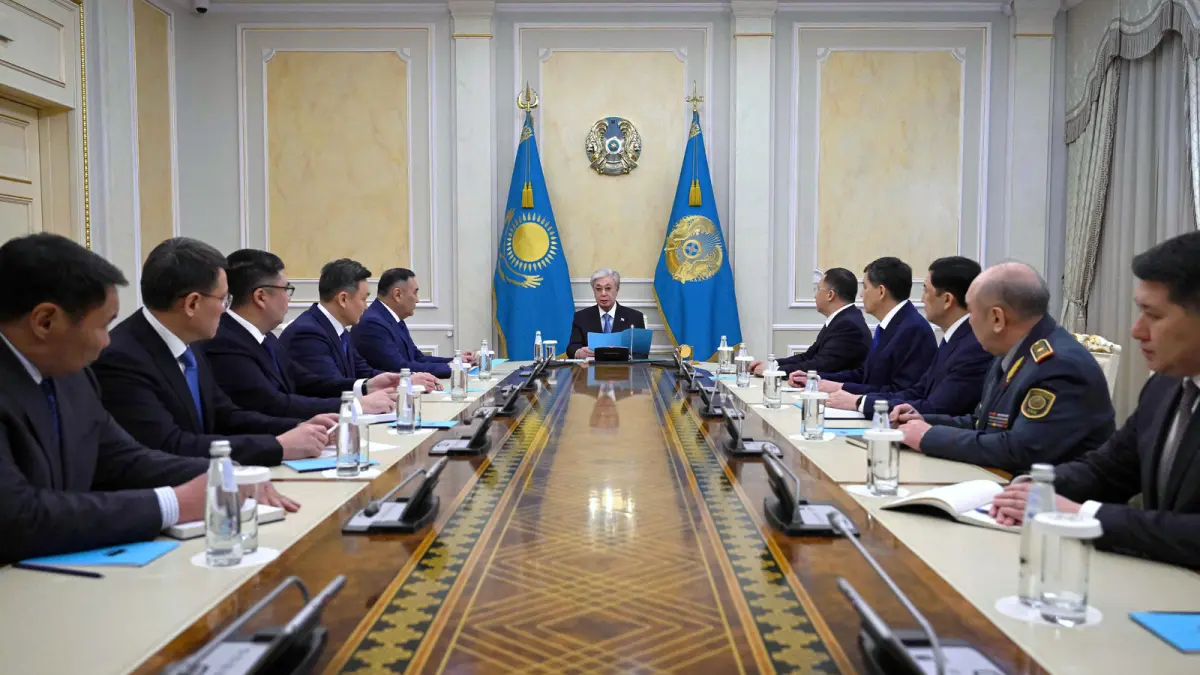
Monday began with a personnel decision: the National Security Committee got a new chairman five days after its service detained the heads of Samruk-Kazyna and KTZ. Then the President received the energy minister, and the statisticians released figures that show how the country’s economy is changing: less oil is being produced than a year ago, energy goods other than crude oil have to be bought abroad, and fewer and fewer people are buying homes. The Kurultai, meanwhile, unveiled the first bill in whose drafting artificial intelligence took part.
The day in figures
- 5
power plants left in the “red zone” - 77.9 million tonnes
oil and condensate produced in January–October - −$787.3 million
balance of trade in energy goods excluding crude oil over nine months - 31,864
home sale and purchase deals in October - 595
cases of illegally fitted extra fuel tanks stopped
According to Akorda, the Bureau of National Statistics and the Interior Ministry
- 5
A change at the KNB
The decrees appeared on the Akorda website shortly after eleven: Yermek Sagimbayev was relieved of his post as chairman of the National Security Committee (KNB), and his place was taken by deputy chairman Marat Irmenov. Irmenov has served in the national security bodies since 1996 and previously headed the committee’s departments in Aktobe and Zhambyl regions and in Almaty. The decree gives no reasons, and a few hours later they were set out by Aibek Smadiyarov, Adviser to the President – Press Secretary of the President. The official wording is a transfer to other work and a rotation for the sake of reforming the special service. But the press secretary then wrote more: the President “also took into account the detention of those involved in the corruption incident”, in his opinion “the security forces made miscalculations”, and a disciplinary penalty was imposed on Interior Minister Yerzhan Sadenov.
The phrasing is careful. Akorda expresses no doubts about the case itself: “the corrupt nature of the case of the heads of the Samruk-Kazyna fund and the Kazakhstan Temir Zholy company is beyond doubt”, and the President “was aware of the investigation from the outset”. The complaint, it turns out, is not that the detentions happened, but how they were carried out; what exactly the miscalculations were has not been disclosed. As recently as Friday, November 13, President Kassym-Jomart Tokayev received Sagimbayev with a report, and at a Security Council meeting the same day he sharply criticised the work of KTZ. We reported on the detention of Nurlan Zhakupov and Yelzhas Otynshiyev on November 12, and on the instruction to propose measures against corruption in state companies by November 24 a day later.
Introducing the new chairman, the President named as priorities the principle of “Law and Order”, the protection of national interests in the economy and the fight against corruption, including in the implementation of priority state programmes. The task of reforming the system of national security bodies, for which, according to the official version, the rotation was needed in the first place, now rests with Irmenov.
Energy: a stable winter, a worrying balance
Energy Minister Yerlan Akkenzhenov told the President that the heating season is running smoothly in all regions, that 384 billion tenge has been allocated for repairs at power plants, and that five plants remain in the “red zone”, where equipment is most worn. According to Government data cited by Kazinform, there were 19 of them in 2024. Gasification is expected to reach 64.5% by the end of the year, and the road to the target of 80% by 2035 is still long: the figure adds only tenths of a percentage point a year.
The figures from the Bureau of National Statistics released the same day show the other side of the report. Oil output, including gas condensate, came to 77.9 million tonnes over ten months, 6.8% less than a year earlier. October looks better – 8.6 million tonnes and up 6.5% on October 2025 – but this is Karachaganak returning after scheduled maintenance, not a turnaround. To reach the 96 million tonnes the minister expects for the year, more than 9 million tonnes a month must be produced in November and December. Tengiz, Kashagan and Karachaganak ship oil through the CPC pipeline as CPC Blend, so every tonne not produced counts against both exports and the budget.
Refineries, meanwhile, are adding output: petrol and diesel fuel production in October was almost one and a half times higher than a year earlier. And yet foreign trade shows a crack. According to the bureau’s tables, excluding crude oil Kazakhstan imported $787.3 million more energy goods than it exported over nine months, and 82.2% of these imports came from Russia. The analytical channel Tradereport was the first to draw attention to this; by its calculation, the country has become a net importer of such goods for the first time since at least 2010. As the channel explains, gas goes to gasification and reinjection, the power sector cannot keep up with demand, and refinery fuel stays at home. Crude oil still more than covers this deficit, but on its own it accounts for almost half of all exports.
Fewer people are buying homes
Home sale and purchase deals registered in October numbered 31,864, 10% fewer than in September and 22.8% fewer than a year earlier. This is the fourth consecutive month of decline, and the gap with last year has more than tripled since July. The capital fell furthest: in Astana there were 41.6% fewer deals than in October 2025. The bureau gives no reasons; experts and market participants quoted by Nationalbusiness point to falling real incomes, more expensive subsidised mortgages and fewer purchases made with pension savings.
The same market is the target of rules that the Ministry of Trade and Integration is working on together with Kurultai deputies. The Government considered a separate law on estate agents unnecessary; instead there will be a mandatory list of contract terms, a professional standard and self-regulation. What matters most for buyers is that a commission cannot be demanded from someone who did not order an estate agent’s services, and that the client must know in advance whose side the intermediary is on.
The Kurultai and the machine
Deputy Chair of the Kurultai Dinara Zakiyeva said at the first Government Hour ever held in the Kurultai that the draft law “On the Digital and Information Safety of Children” was the first developed in the AI-Quryltai environment. The legal model took part in both the analysis and the drafting of the text, and each of the more than 120 amendments was then checked by deputies and lawyers. The draft itself changes the rules for digital services: games and apps must be labelled and pass state verification, otherwise a child will not see or download them, and children will get ID cards with a photograph. Which body will check the games and when the law could take effect have not yet been announced. Two days earlier we reported on amendments that ban children under 16 from registering on social networks: the Kurultai’s agenda on children is coming together into a whole package.
The border, fuel tanks and sugar
Since the start of the year the police have stopped 595 cases of illegally fitted extra fuel tanks with a total volume of 159.5 tonnes; two thirds of them were in Zhambyl Region, from which roads lead to Kyrgyzstan. In July the count had stood at 255. Fuel may be taken out of the country by car only in the standard tank and once a day: the ban has been extended until May 22, 2027.
On the other side of the same border, Kyrgyzstan’s Cabinet of Ministers banned imports of white sugar for six months, including from Eurasian Economic Union countries, and therefore from Kazakhstan. The reason is that imports over seven months grew 4.06 times, and the neighbours decided to support their two sugar plants. The ban does not affect the transit of Kazakh sugar through Kyrgyzstan. Russia objected to the measure while it was still a draft, calling it a violation of the union’s rules; Astana has not yet stated its position.
Football without a win
Kazakhstan’s national team ended the Nations League with a 2–2 draw against Slovakia at the Astana Arena, having led twice and conceded in the fifth minute of stoppage time. The team finishes with three points from three draws and three defeats, and last place in the group. There is no relegation: after the tournament reform Kazakhstan remain in League C. We previewed the match the day before, and Kazakhstan Football Federation general secretary Scott Mann promised to sum up the team’s performance at a press conference on November 17.



