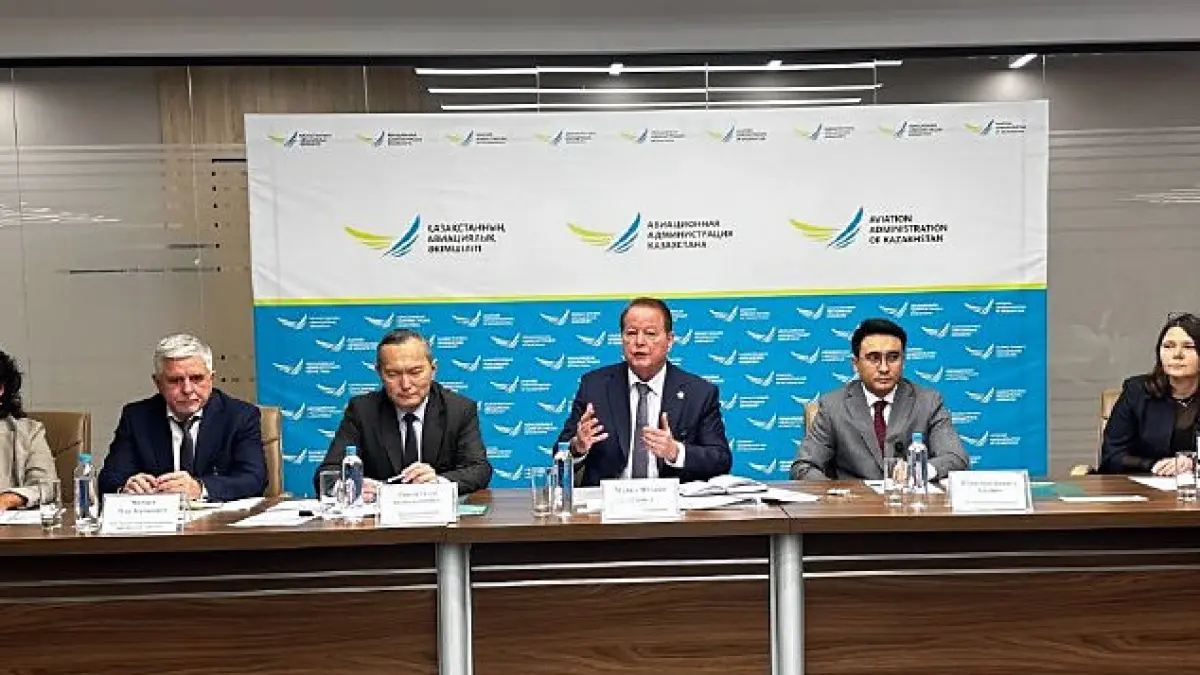
Astana, 22 November. The Aviation Administration of Kazakhstan (AAK) has held an industry workshop on how to prepare the country’s aviation for wider use of Jet A-1 fuel, the Civil Aviation Committee of the Ministry of Transport said.
It brought together representatives of government bodies, aviation fuel suppliers, oil refining, airports and independent experts.
Participants discussed the state of production of the TS-1 and RT grades of jet fuel. These grades follow a standard adopted in the former Soviet countries, while Jet A-1 is the main grade of aviation fuel in international practice. They also talked about the prospects for Jet A-1, updating national standards and the readiness of airports for the new grade. Separately they discussed fuel quality at every stage — from production, transport and storage to fuelling the aircraft — as well as laboratory checks, risk management and staff training. Sustainable aviation fuel (SAF), made from renewable feedstock, also came up, as did the legal requirements for storage and fuelling, including liability for breaches.
AAK chief executive Michael Daniel listed the tasks: to ensure the availability and uninterrupted supply of high-quality aviation fuel meeting international specifications, to prepare the industry for Jet A-1, to revise national standards and to tighten quality control along the whole supply chain. “We must ensure that the development of the aviation fuel supply system supports the growth of our aviation sector without compromising safety,” he said.
The workshop was organised by the independent petroleum product testing centre ORGANIC with the support of AAK. The statement gives no timetable for switching to Jet A-1 and no volumes that would be needed.
What it means: Kazakhstan, which wants to become the region’s aviation hub, is discussing a move to the international grade of jet fuel. For now this is a conversation about standards, laboratories and storage, not a decision with a date.
Who benefits: Airports and foreign airlines, if more fuel of the international grade becomes available in Kazakhstan. Refiners and suppliers face costs: updated standards and quality control cover the whole chain from the refinery to the aircraft wing.
Background: The Aviation Administration of Kazakhstan is the aviation regulator that oversees flight safety and airworthiness. On the same day the Civil Aviation Committee reported memoranda with Algeria and Jordan, and the day before the Ministry of Transport agreed on the opening in Kazakhstan of a branch of the US Kent State University to train pilots and controllers.
We have also reported on how Kent State University will open a branch in Kazakhstan for pilots and controllers.



