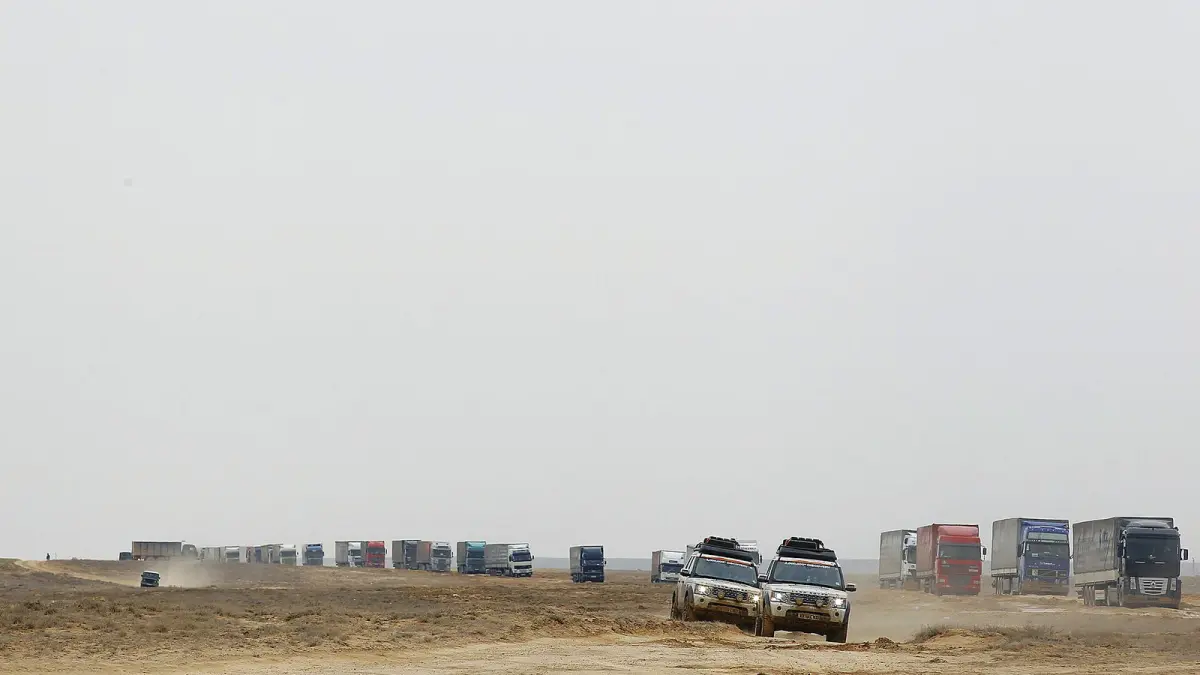
Tashkent / Turkestan, 21 November. By November 2026, 3,130 lorries a day were passing through checkpoints on the Kazakh-Uzbek border, compared with 1,165 in 2021, Husan Tangriev, head of the information service of Uzbekistan’s Customs Committee, said in reply to a request from Kun.uz.
Most of this traffic, he said, is transit through both countries.
The question was prompted by queues at the main road crossing between the countries, Bauyrzhan Konysbayev in the Turkestan region, which adjoins the Yallama post on the Uzbek side. In early November drivers spoke of a 25-kilometre tailback and waits of up to three days, and by 13 November, according to Kazinform reports, the queue had reached 40 kilometres, Kun.uz recounted.
Kazakhstan’s State Revenue Committee attributed the queues at the time to growing traffic. In the first ten months of 2026 the number of vehicles crossing the border between the two countries rose by 16.2% to almost 742,000, and 321,000 vehicles passed through Bauyrzhan Konysbayev, 21% more than a year earlier. The checkpoint is designed for a thousand vehicles a day but in practice handles up to 1,500. In November an average of 740 lorries a day left for Uzbekistan through it, up from 603 in September. The committee also pointed to the electronic queue: some carriers arrive without booking a slot in advance, register at the border and then have to wait their turn. On the morning of 3 November, according to the committee, 130 slots were still free in the system.
The Kazakh side also linked the pressure to the situation around Iran. Because of restrictions on traditional trade routes, Iranian and international carriers are moving more goods by road, and part of the cargo from Iran travels along the southern route through Turkmenistan, Uzbekistan and Kazakhstan, the committee noted. To relieve Bauyrzhan Konysbayev, the authorities planned to divert some vehicles to the Atameken, Kazygurt and Tazhen checkpoints.
Uzbek customs takes a calmer view. According to Tangriev, the checkpoints on both sides are working normally, and the state revenue department of the Turkestan region publishes queue data every day. At 9:00 on 20 November there were 100 lorries waiting at Bauyrzhan Konysbayev, and given that the pair of posts handles more than 1,500 vehicles a day, the committee considers this normal. Tangriev linked the growth in transit to the switch of the Khorgos checkpoint on Kazakhstan’s border with China to round-the-clock operation: Chinese goods are now imported faster, and more cargo moves on through Uzbekistan to Turkmenistan, Tajikistan and other countries. The customs services of the two countries, he said, constantly exchange information to prevent queues.
What it means: The congestion on the Kazakh-Uzbek border has grown out of transit: in five years the daily flow of lorries through the two countries’ posts has risen 2.7 times. It is being driven by the round-the-clock Khorgos crossing on the Chinese border and by the southern route now used for cargo from Iran, while the border posts were built for earlier volumes.
What to do: According to the State Revenue Committee, the longest waits are faced by carriers who did not book a place in the electronic queue before arriving at the border. The authorities are diverting some vehicles from Bauyrzhan Konysbayev to the Atameken, Kazygurt and Tazhen checkpoints.
Background: In mid-November Uzbekistan’s Customs Committee said it was negotiating with Kazakhstan and Kyrgyzstan on joint customs control under the One Stop principle at selected border posts. The agency named three possible options but has not chosen one or set a timetable.
We have also reported that Uzbekistan proposed joint customs control to Kazakhstan and Kyrgyzstan.



