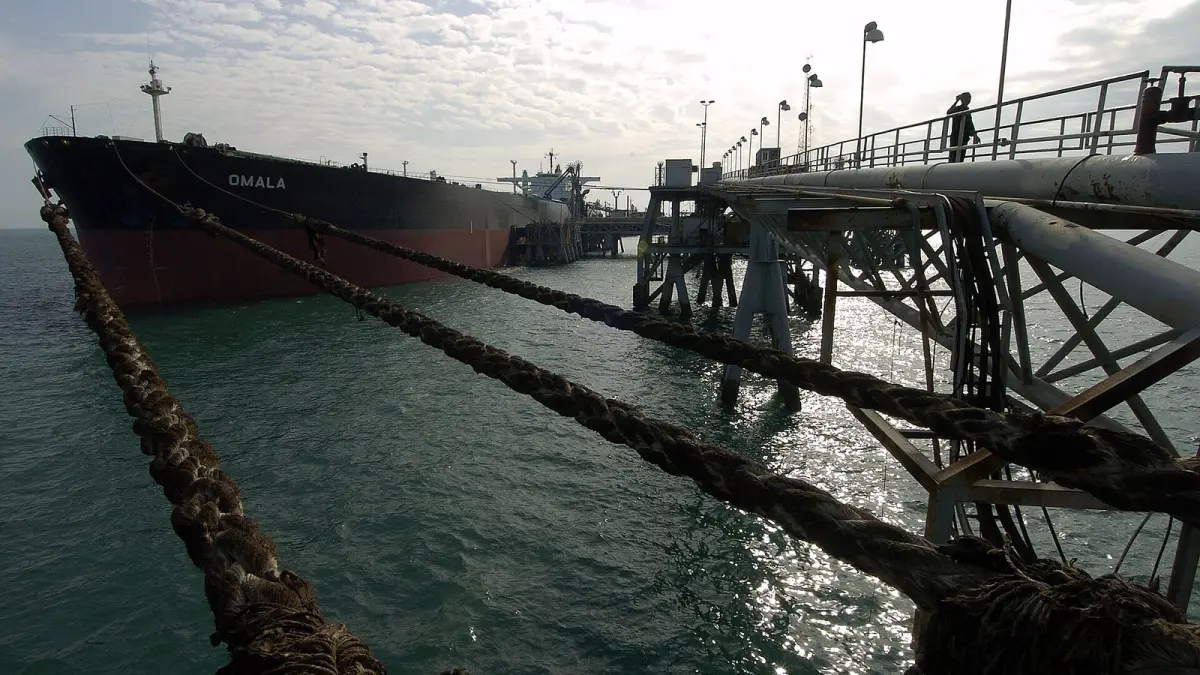
Tehran / Washington, 23 November. Two supertankers struck naval mines near the Strait of Hormuz and were brought to a halt, the Navy of Iran’s Islamic Revolutionary Guard Corps (IRGC) said on 22 November in a statement carried by Iran’s Fars news agency.
On the same day US President Donald Trump told Fox News he was inclined to resume strikes on Iran after the New Year if negotiations failed to produce a deal.
The IRGC Navy named two locations, north of Ghanam Island and east of the Strait of Hormuz, without specifying which vessel struck a mine where. According to the IRGC, the tankers were sailing on “unauthorised routes” and ignored its navigation instructions. The statement gave no vessel names, casualty figures or details of the damage. The Iranian Army’s Navy issued a separate statement: two tankers that had “violated the navigation regime” caught fire after hitting a mine east of the strait in the first half of 22 November, the IRNA agency reported. According to the Iranian military, the vessels entered a restricted zone ignoring warnings and with their navigation and automatic identification systems switched off.
The UK Maritime Trade Operations centre (UKMTO) reported that evening an incident involving a tanker and military forces in the Gulf of Oman off Iran’s south-eastern coast. UKMTO gave no details and said an investigation was under way. A day earlier, on Saturday, Bahrain accused Iran of striking a civilian industrial site, while Tehran said it had shot down a US drone.
Trump, according to Fox News, said indirect talks with Tehran were continuing but without progress, and called the Iranian negotiators “professional tap dancers”. He warned that Iranian vessels trying to breach the naval blockade of Iran’s ports would be attacked and sunk. Iran’s Foreign Minister Abbas Araghchi said the same day that the question of reopening the Strait of Hormuz would not arise until Tehran’s demands were met, and that Iran remained ready both to negotiate and to defend itself.
A large share of the world’s seaborne oil trade passes through the Strait of Hormuz, which links the Persian Gulf with the Gulf of Oman, and reports of mines there have pushed prices up more than once. For Kazakhstan this bears directly on the budget: CPC Blend export crude, shipped through the Caspian Pipeline Consortium (CPC), is sold at a price linked to Brent. The war is also changing land routes. In November Kazakhstan’s State Revenue Committee linked queues on the border with Uzbekistan in part to Iranian cargo switching to the southern route through Turkmenistan, Uzbekistan and Kazakhstan.
What it means: The Strait of Hormuz remains the war’s main flashpoint: Iran is mining the approaches and declaring routes off limits, while the United States maintains a blockade of Iranian ports. The deadline Trump named — after the New Year — ties the threat of new strikes to the negotiating calendar for the first time.
What we know now: The names of the tankers, their flags, the number of casualties and the extent of the damage have not been reported; UKMTO is investigating the incident in the Gulf of Oman. According to Trump, indirect talks between the United States and Iran are continuing.
Background: The war began in February 2026, when the United States and Israel launched strikes on Iran and Tehran responded by attacking Israel and US bases in the region. In June the sides signed a framework agreement to end hostilities, but talks stalled over safe navigation through Hormuz, and since July fighting has flared intermittently, Anadolu recalls.
We have also reported that Brent rose above $117 after the IRGC spoke of mines in Hormuz and that the IRGC reported another tanker hitting a mine.



