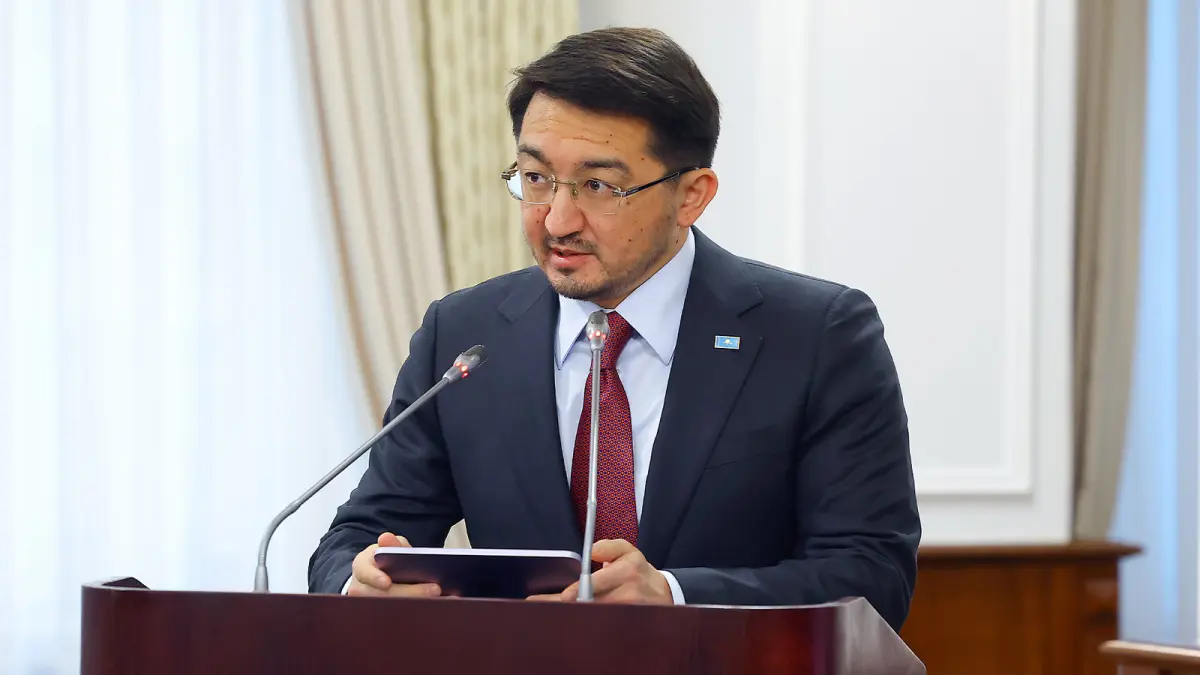
Astana, 24 November. Kazakhstan plans to take its KazSat-2 communications satellite, whose service life is coming to an end, out of orbit by the end of 2026, Deputy Prime Minister and Minister of Artificial Intelligence and Digital Development Zhaslan Madiyev said at a briefing at the government.
Its load is already being transferred to the second national satellite, KazSat-3.
"Today we are transferring KazSat-2's load to KazSat-3, because we plan to take this satellite out of orbit by the end of the year, as its service life is already coming to an end. And we are starting a new project called KazSat-3R, which will replace the KazSat-3 satellite in 2029," Zakon.kz quoted the minister as saying. Both spacecraft, according to Madiyev, provide communications for rural settlements and state bodies and are used for television broadcasting.
KazSat-2 has worked longer than it was designed to. The spacecraft was launched from Baikonur into geostationary orbit on 16 July 2011; it was built for the Republican Space Communications Centre JSC (RCSC) by the Khrunichev State Space Research and Production Centre and Italy's Thales Alenia Space. The satellite's active life was designed for 12.25 years and its technical life for 14.5 years, the RCSC website states. Its coverage area includes Kazakhstan, the countries of Central Asia and the central part of Russia.
KazSat-2's mission was due to end in early 2024. At that time the RCSC, together with the manufacturer, analysed the spacecraft's condition and extended its operation until December 2026. "It has a sufficient amount of fuel. Everything is fine with electricity and power," RCSC deputy chairman of the management board Vasily Leonov explained in April 2024.
Once KazSat-2 is taken out of orbit, the country will be left with one communications satellite of its own. KazSat-3 was launched into geostationary orbit on 28 April 2014, and its active life is 15 years. Its replacement is being prepared in advance: in July 2026 the government allocated 10.4 billion tenge from its reserve for building the KazSat-3R satellite, because KazSat-3's planned service life ends in 2029.
Journalists asked the minister whether the country would become dependent on foreign satellite companies. Madiyev replied that ground stations of foreign operators are built with national security requirements in mind and that Kazakhstan is not giving up its own satellites. "Depending on the purposes for which these satellites are used, both Kazakh satellites and foreign providers of this service will be used," Kursiv quoted him as saying.
What it means: From the end of the year until KazSat-3R appears, national satellite communications will rest on a single spacecraft. Part of the work, as the minister said, will be taken over by foreign operators, but their ground stations must be located inside the country and meet national security requirements.
Who benefits: The minister promises users of satellite communications a benefit from competition: "The appearance of a number of such operators should put pressure on the price and push them to improve quality," Madiyev said. He did not say how the move from KazSat-2 to KazSat-3 will affect prices for telecom operators and TV channels.
Background: OneWeb and Starlink currently operate in Kazakhstan, while Shanghai Spacecom and Amazon Leo are building ground stations and, as the ministry expects, will start providing services in 2027. In autumn 2023 KazSat-3 already lost contact with ground stations because its batteries had discharged, and satellite TV and radio broadcasting and data transmission were temporarily cut off in the country, Kursiv reminds readers.
We have also reported that Amazon LEO and Shanghai Spacecom will come to Kazakhstan in 2027.



