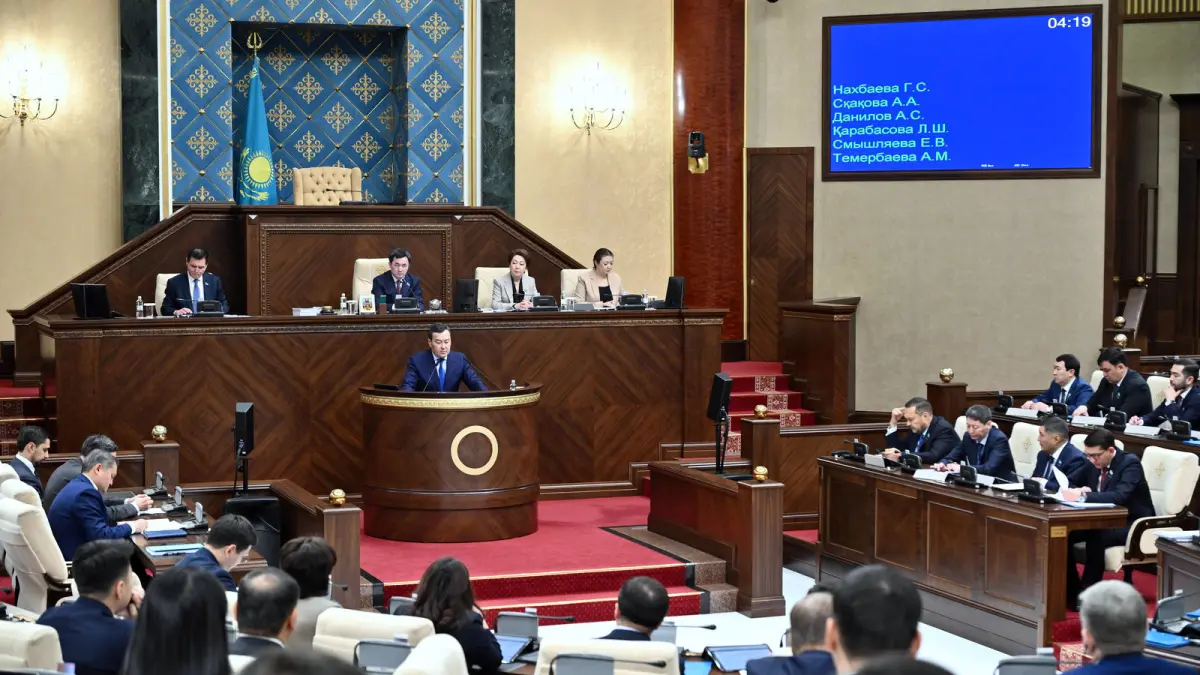
Astana, 25 November. The Kurultai at a plenary sitting approved at first reading two bills on energy saving and improving energy efficiency, the parliament’s press service said.
One amends the sectoral laws, the other the Code of Administrative Offences. The amendments extend control over energy use to schools, hospitals and kindergartens and halve the consumption threshold at which a large enterprise concludes an agreement on saving energy.
The bills were presented by deputy Arman Kalykov, a member of the committee on regional and infrastructure development and one of the authors of the amendments. The main aim, according to him, is to reduce the energy intensity of gross domestic product (GDP), that is, the energy used per unit of what the country produces. “Based on the results of 2025, the energy intensity of GDP decreased by 4% compared with the 2021 level. At the same time, the pace achieved is not enough: the energy intensity of Kazakhstan’s GDP is roughly 2 times higher than the world average and exceeds the figures of the countries of the Organisation for Economic Co-operation and Development by 3.6 times,” Kalykov said. Final consumption of energy resources in 2025 was 10.8% higher than in 2021, and one of the main consumers is buildings: state, commercial and residential.
The current law “On Energy Saving and Improving Energy Efficiency” was adopted in 2012 and, according to the deputy, is aimed above all at large industrial and energy enterprises. One of its instruments is the State Energy Register. This is a body of information on consumers that use 1,500 tonnes of coal equivalent or more a year, as well as on state institutions, companies with state participation and natural monopolies. Coal equivalent is a notional unit used to compare the heating value of different types of fuel. Consumers of 1,500 tonnes or more, apart from state institutions, undergo a mandatory energy audit at least once every 5 years — a survey that shows how much energy can be saved.
The amendments, according to the Kurultai’s statement, change several rules. The state will begin to check how reliable, complete and timely the information submitted to the register is. The consumption threshold at which entities in the register are “obliged to conclude agreements” on energy saving is lowered from 100,000 to 50,000 tonnes of coal equivalent a year. In the current law such an agreement is concluded “on a voluntary basis”: the enterprise undertakes to reduce its specific energy consumption per unit of output by at least 15% within 5 years. Kalykov, in an interview with Zakon.kz on the eve of the sitting, estimated that the number of enterprises covered by this rule would rise from about 50 to 100.
For budget organisations, rules for monitoring energy consumption are being introduced, and those that do not comply with the standards will be put on a separate list. Through the register, Kalykov said, another 5,000 socially significant facilities will be examined in depth and recommendations will be prepared on how to improve their energy efficiency. Monitoring of the standards in state institutions at local level is being entrusted to the akims of towns of district significance, villages, settlements and rural districts. Deputy Dinara Raikhanova asked whether rural akims were ready for the new powers. Vice Minister of Industry and Construction Kuandyk Kazhkenov replied that the monitoring would be documentary and that the institutions were few: “If we take towns of district significance, about 17 state institutions, in rural districts 4.”
The amendments propose looking to energy service companies for the money to modernise buildings. Under the law these are firms that carry out energy-saving work at their own expense or with borrowed funds; the customer, as Kalykov explained, pays them out of the savings obtained. The bill takes energy service companies out of the scope of public procurement legislation, and deputy Nurzhan Niyazaliyev asked why a separate procedure was needed. “Energy service companies, at the expense of their own funds and the investment they attract, modernise a facility, ensure savings of energy resources and thereby receive the corresponding remuneration during the term of the contract, that is, up to 6 years,” Kazhkenov explained. The contractor, according to him, will be chosen on the basis of technological solutions and the savings achieved, and not only on price.
Requirements for energy auditors are being tightened: an organisation that conducts an energy audit must hold the necessary equipment by right of ownership. The concept of an energy-efficient apartment building is also being clarified. The second bill, according to Kalykov, introduces administrative liability for purchasing goods, works and services that do not meet energy efficiency requirements; officials and non-profit organisations will be held liable. The amounts of the fines were not named at the sitting. The day before, the deputy said that the current sanctions are largely retained and that a warning will come before a fine.
The bill itself, according to Kalykov, had been initiated earlier, by deputies of the Mazhilis, the lower house of the previous parliament. A second reading lies ahead; its date is not given in the Kurultai’s statement. At the same sitting deputies also approved at first reading amendments on healthcare that introduce the concepts of “medical tourism” and “medical tourist” into legislation.
What it means: The 2012 law was addressed above all to industry. Now the rules on saving energy reach the state’s own buildings — schools, hospitals and kindergartens — and large consumers that previously fell short of the threshold. Insulation and automation are to be paid for by private companies, which will recoup their investment from what is saved.
Who benefits: Energy service and energy audit companies: the new requirements, according to Kalykov, may bring back demand for their services. The budget: the deputy puts the savings in the public sector at about 157,000 tonnes of coal equivalent, or roughly 11 billion tenge a year. For enterprises that consume between 50,000 and 100,000 tonnes of coal equivalent the amendments add obligations; business, according to the deputy, fears a growing regulatory burden.
Background: The Kurultai is Kazakhstan’s unicameral parliament, elected on 23 August 2026. Its Bureau set the agenda of the sitting on 23 November; the same document says the bills were drafted to implement the President’s Address of 1 September 2023, “Economic Course of a Just Kazakhstan”. About 80% of the country’s electricity and heat, according to Kalykov, is generated by burning coal.
We have also reported on how the Kurultai was to consider amendments on transplants and medical data.



