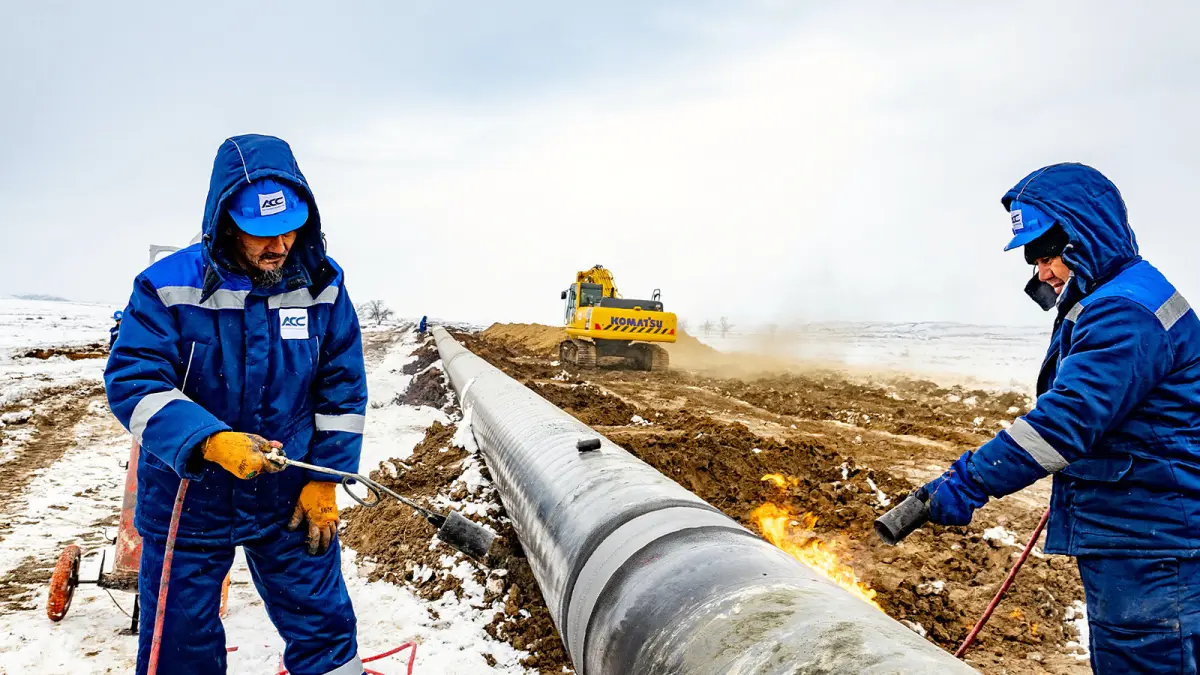
Astana, 25 November. The Government of Kazakhstan has allocated 37.4 billion tenge for feeder gas pipelines and gas distribution networks in six districts of Zhetysu Region, the government’s press service said.
The money was taken from the Infrastructure Development Fund under the People’s Construction programme; gas is due to reach about 100 settlements that are home to more than 183,000 people.
Most of the sum, more than 27 billion tenge, will go on connecting 84 villages to the Taldykorgan–Usharal trunk gas pipeline. The pipeline itself was completed in 2025; now 2,700 km of distribution networks have to be laid from it for 133,900 residents of three districts. In Alakol District this means 1,115 km of networks and 28 villages that are home to 61,200 people. In Sarkan District 893 km will be built for 19 settlements (35,700 residents), and in Aksu District 767 km for 37 villages (36,900 residents). Contracts for construction and installation work are now being concluded; the work is due to start at the end of 2026 and finish in 2028.
A further sum of more than 10.3 billion tenge has been allocated for completing 16 carry-over projects, that is, construction already under way. Their total length is about 576 km, they are expected to be commissioned by the end of 2026, and 49,400 people will receive gas. In Panfilov District 503.6 km of networks are being built in 12 villages that are home to 45,300 people. In Karatal District 37.5 km of gas pipelines are being laid in three villages, and in Yeskeldi District 34.5 km in the village of Zhalgyzagash.
Zhetysu Region was formed by a presidential decree of 3 May 2022 from eight districts of Almaty Region and the cities of Taldykorgan and Tekeli; six of those districts are included in the current project. Before the region was formed, according to the government, natural gas was available in only five settlements, including Taldykorgan. Now 115 villages and towns that are home to 468,500 people, or 67.4% of the region’s population, have gas. By the end of 2026, after the carry-over projects are handed over, the number of such settlements should rise to 126, coverage should exceed 518,000 people and the gasification rate should reach 74%. Under the regional gasification scheme with an outlook to 2030, 210 of the region’s 356 settlements are due to receive gas.
Nationwide, the gasification rate, according to Ministry of Energy data quoted by the government, is 64.2% against 62.4% in 2025: 13.1 million people have access to natural gas. By the end of the year the figure is planned to reach 64.5%. By 2035, on the President’s instruction, it should reach 80% through gas supply projects for the northern and eastern regions.
For comparison: about 6.5 trillion tenge from the National Fund is intended for the whole of People’s Construction up to the end of 2029, and 37.4 billion tenge is roughly 0.6% of that sum. The Infrastructure Development Fund, from which the money was allocated, is replenished by transfers from the National Fund and other receipts. The rules for its use were approved by the finance minister in an order of 11 August 2026, Zakon.kz wrote. By 4 November, 262 projects worth 1.5 trillion tenge had been approved through the fund, including 67 heat and gas supply projects worth 136 billion tenge, First Deputy Prime Minister Nurlybek Nalibayev reported. The government’s statement does not say whether the Zhetysu projects are among them.
What it means: The trunk pipeline to Usharal has been ready since 2025, but gas reaches homes only through distribution networks, and it is for these that the money has been allocated. The bulk of the work — 2,700 km of networks in three districts — is scheduled to run until 2028. The increase by the end of 2026, from 67.4% to 74%, will come from projects started earlier.
Who benefits: Residents of about 100 settlements to which gas will be brought. The government also names general consequences: less coal will be burned, the burden on the environment will fall, and conditions for small and medium-sized businesses will appear in rural areas. Contractors with which contracts for construction and installation work are being concluded; the statement does not say who they are.
Background: The President announced the People’s Construction programme in his Address on 28 October and said at the same time that gas and clean drinking water would be brought to many settlements. The headline of the government’s statement — “Build, and build again” — echoes words from the same Address.
We have also reported on how 262 projects worth 1.5 trillion tenge were approved under the People’s Construction programme.



