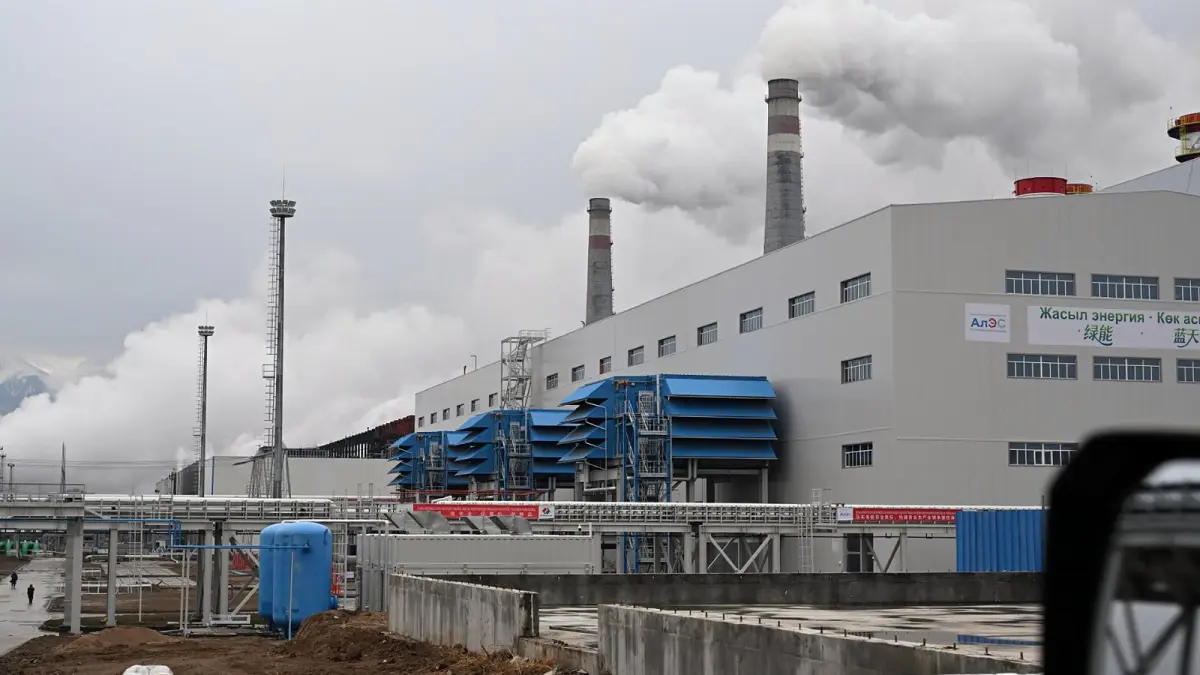
The Saturday before the local council (maslikhat) elections is free of campaigning but not of news. The Government reported on the modernisation of Almaty’s two combined heat and power plants and openly named an obstacle at one of them. The Interior Ministry told students and university leaders not to hide violence. Artificial intelligence was discussed in three places at once: in Moscow, at a regional hackathon and at KazNU. The capital is clearing snow, motorways in the west and east have reopened, and more than 100 tonnes of meat have been brought to Astana for the weekend.
The day in figures
- 97%
completion of Almaty CHP-2’s switch to gas - 4,940
private homes in Karaganda that can now connect to gas - 566
offences among students since the start of the academic year - 1,521
solutions submitted at Decentrathon 6.0 - 1,400
machines clearing snow in Astana
Data from the Government, the Energy Ministry, the Interior Ministry, the AI and Digital Development Ministry and the Astana city administration
- 97%
Almaty’s two plants: one nearly ready, the other stuck in the ground
First Deputy Prime Minister Nurlybek Nalibayev toured both Almaty plants that Samruk-Energy is converting to gas, and the Government reported the results in figures. CHP-2 is 97% complete: installation is ending, commissioning is under way, and full connection of the equipment is planned before 25 December. As we reported, the plant is due to deliver its first electricity to the grid as early as 30 November.
The picture at CHP-3 is different. Reconstruction is continuing, and afterwards the plant’s electrical capacity is expected to reach 543.6 MW, but site preparation for the second power unit is complicated by the engineering and geological conditions of the soil and the dismantling of units still in operation. The Government writes that these factors are preventing a faster move to construction and installation work. Nalibayev ordered that the schedule be kept and noted that the project is under the President’s control. The statement gives no new timeline for CHP-3.
Gas has also reached Karaganda’s private housing. The Energy Ministry said that 201 km of gas pipelines have been completed in the Taugul and Kungei neighbourhoods: 4,940 homes, a school, five kindergartens and two medical facilities can now connect. Under the ministry’s plan, the share of the country’s population with gas will reach 64.5% by the end of the year.
Universities: police in dormitories and a demand not to stay silent
The Interior Ministry addressed two audiences at once. Students were urged to report violence, bullying, threats and extortion to the police, and Kuralai Karina, deputy chair of the Administrative Police Committee, told university leaders plainly that it is unacceptable to put an institution’s reputation above young people’s safety. Police officers have been assigned to dormitories, and universities have introduced round-the-clock duty by their security services. Since the start of the academic year, according to the ministry, 566 offences have been stopped among students, most of them violations of migration law and smoking in prohibited places.
The ministry does not say what prompted the address. But in November BES.media reported the deaths of two students of Al-Farabi Kazakh National University (KazNU): Almaty police opened a criminal case over the death of a first-year student and detained a suspect, and from 17 to 20 November an interagency working group inspected the university’s dormitories.
AI: Moscow, nineteen cities and a newspaper archive
At the AI Journey conference in Moscow, the first Kazakh–Russian dialogue of state agencies on introducing AI took place, the Ministry of Artificial Intelligence and Digital Development said. It was opened by First Vice Minister Rostislav Konyashkin for Kazakhstan and by Deputy Prime Minister Dmitry Chernyshenko and Digital Development Minister Maksut Shadayev for Russia; vice ministers of health, finance, transport, education, science and industry discussed using AI in their sectors. “When assessing AI projects, we focus on concrete changes: shorter timeframes, a lighter workload for specialists and services that are convenient for people,” Konyashkin said.
At home the same topic was discussed in practical terms. The Decentrathon 6.0 hackathon, held simultaneously in 19 cities at the end of October, announced its results: 54 teams that won the regional rounds received 500,000 tenge each, and in total participants submitted 1,521 solutions over two days. The tasks were practical: checking a game’s translation into Kazakh, an AI assistant for customer support and faster fine-tuning of language models. And KazNU scientists launched AI-QazMedia, a Kazakh-language model for journalists: its database holds about 300,000 articles, including some from the archives of national newspapers, and it can summarise a long text, pick out its main points and gather data into a table.
Snow, roads and meat for the weekend
After overnight snowfall, more than 1,400 machines and over 3,300 workers have been clearing Astana since the morning; more than 1,000 cubic metres of snow were taken to dumping sites overnight. By midday KazAvtoZhol had reopened closed motorway sections in Aktobe, Atyrau, West Kazakhstan and East Kazakhstan regions. Kazhydromet again forecasts ice, wind and blizzards for the capital in the coming days.
For those who do venture out, the Ministry of Trade and Integration says that more than 100 tonnes of meat from farms in Akmola, Abai, Pavlodar, Karaganda, North Kazakhstan, Kostanay and other regions have been brought to the Sogym-FEST fair in Astana on 28 and 29 November. Beef there starts at 3,300 tenge per kilogram, horse meat at 3,500 and mutton at 3,700. The fair is open from 09:00 to 19:00 at four venues.
Next door: marriage at 17 is almost always allowed
In Kyrgyzstan, the ombudsman’s office discussed a report on early marriage with state agencies. According to the report’s data cited by 24.kg, from 2024 to August 2026 local commissions received 315 applications to lower the marriage age to 17 and approved 94% of them, sometimes for reasons such as a grandmother’s wish to see her granddaughter’s wedding. The authors propose a single marriage age of 18 with no exceptions and a ban on the religious nikah ceremony before civil registration.
What lies ahead
On Sunday, 29 November, Kazakhstan elects members of its local councils. On 30 November CHP-2 is due to deliver its first electricity to the grid, and full connection of its equipment is planned before 25 December.



