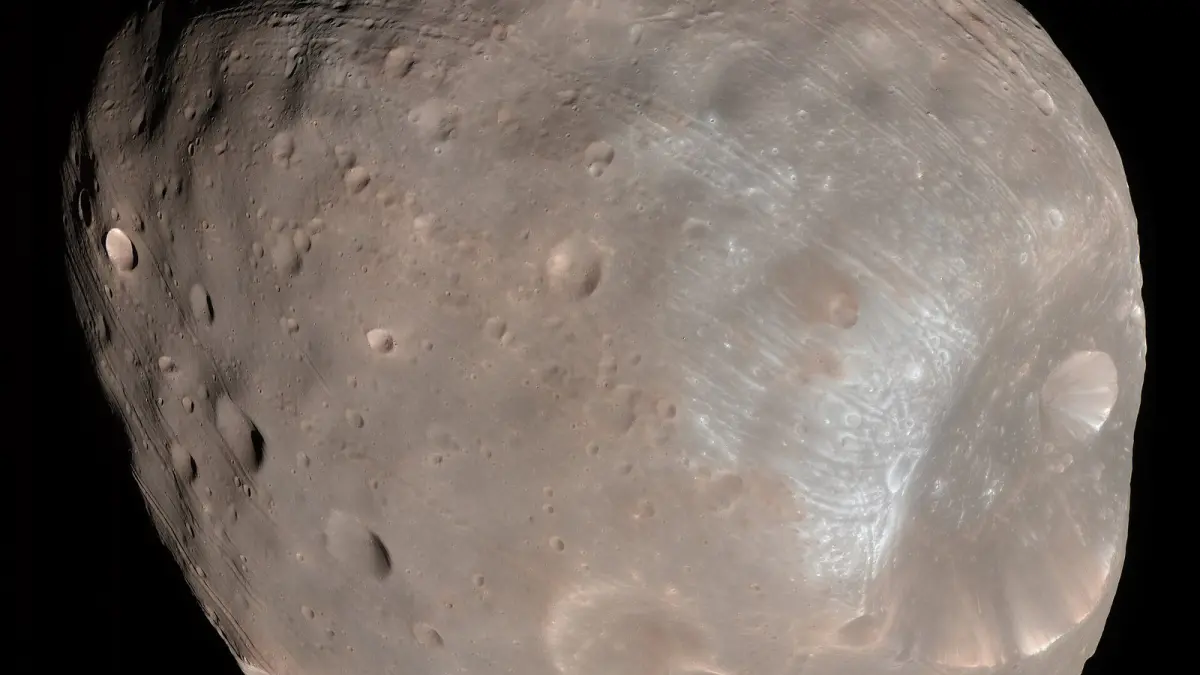
Tanegashima, 20 October. A Japanese H3 rocket lifted off from the Tanegashima Space Center and sent the MMX spacecraft towards the moons of Mars, Phobos and Deimos; it is due to bring samples of their soil, dust and rocks back to Earth for the first time, in 2031.
Lift-off was at 4:41 a.m. Japan time. One hour and 11 minutes later, after two firings of the second-stage engine, the spacecraft, weighing about 4.5 tonnes, separated and continued on its own. If all goes to plan, it will enter orbit around Mars in September 2027 and move in step with Phobos.
The mission is called MMX (Martian Moons eXploration). The spacecraft will drop a small rover onto Phobos and then land itself to collect samples robotically. The main goal is to find out whether Phobos and Deimos formed after a large body struck Mars early in the history of the solar system or are asteroids that once passed close to the planet and were captured by its gravity.
The moons of Mars are much smaller than ours: Phobos is about 27 km across at its widest and Deimos less than half that; both are irregularly shaped and look like asteroids. "One of the most intriguing questions about Phobos and Deimos is simply why these two little moons are there in the first place," said Thomas Statler, who helped oversee the development of two NASA instruments on board. The samples, he said, will show whether Phobos material is closer to asteroids or to debris from a collision with Mars.
The spacecraft will spend three years in orbit around Mars, studying the chemical and mineral composition of Phobos, assessing whether the moon could serve as a staging base for future astronauts and, in early 2029, dropping a rover onto its surface weighing about 25 kg and built by the German and French space agencies. The rover has no braking rockets: Phobos's gravity is a thousand times weaker than Earth's, so it is expected to bounce gently on the surface, right itself and start work. It carries cameras for navigation and imaging the soil and a laser instrument to identify minerals.
Sources give different costs for the mission: France 24 puts it at $578 million, CBS News at $350 million.
Background: No one has yet brought samples back from Phobos or Deimos; scientists hope they will shed light on how the moons of Mars formed and even on the origins of life.
List of sources used: CBS News, France 24
Artificial intelligence was used in preparing this material.