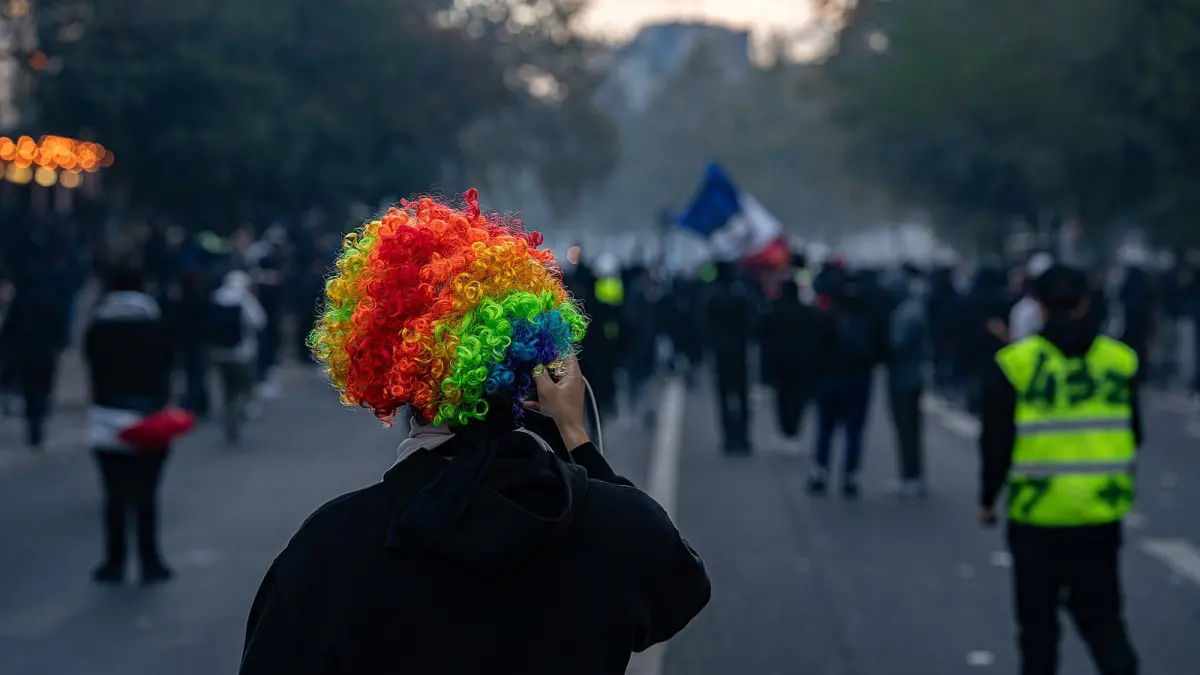
On Saturday, 31 October, France held its third Saturday of protests in a row: hundreds of thousands took to the streets, while in Germany the youth movement “GenZ regelt!” staged rallies that in places ended in the evening in clashes with police [1][5]. In Poland Prime Minister Donald Tusk spoke in the evening, while President Karol Nawrocki held talks with the parties but found no compromise [11][14]. In Istanbul Volodymyr Zelensky and Recep Tayyip Erdogan agreed to work on a grain corridor across the Black Sea, and US Secretary of State Marco Rubio said in Atlanta that Washington was studying the Turkish proposal [17][18]. A separate thread of the day is the FBI’s statement on who is behind the theft from Binance [22].
Day of 31 October in the world
- 320,000
protesters in France on Saturday, according to France’s Interior Ministry - about 500,000
according to the organisers - 550,000 and 410,000
the ministry’s estimates for 17 and 24 October - about 120,000
participants in the “GenZ regelt!” rallies, according to the organisers - more than 6 billion dollars
stolen from Binance, according to the FBI
From the issue’s materials
- 320,000
France: a smaller protest, the same dispute over numbers
The Interior Ministry put the number of participants in Saturday’s rallies at 320,000, of whom 70,000 were in Paris; the organisers, a coalition of school and student organisations and unions, say almost half a million, of whom 200,000 were in Paris [1][3]. It was the third Saturday of protests in a row: according to the ministry, 410,000 turned out on 24 October and 550,000 on 17 October [1]. By police decision the main march in Paris took place outside the centre, to reduce the risk of disorder near government buildings and tourist sites; the decision followed a last-minute court dispute [27]. Participants are protesting against rising prices, for better conditions in schools and against police violence [1][28].
Clashes were local. Police used tear gas in Paris and Lyon, and on the outskirts of Paris people in black masks pried up paving stones and threw them at police; an incendiary device was also thrown at the officers, the AFP agency reported [3]. The ministry said that radical elements tried to break away from the columns in Bordeaux, Toulouse, Lyon and Marseille but were stopped by the security forces [1]. The number of detainees does not add up: by 18:00 local time the ministry gave 296 [2], Al Jazeera wrote of at least 290 [3], and RT later reported more than 500, without citing the ministry [4]. The found sources contain no final figure from the ministry.
Interior Minister Laurent Nuñez had warned beforehand of a very high risk of disorder, especially after dark on Halloween [27]; about 70,000 police officers were deployed for the weekend [2]. Prime Minister Sébastien Lecornu met student unions during the week and is considering measures to reduce the cost of living [3].
Germany: the youth movement takes to the streets
In Germany the rallies were organised by the movement “GenZ regelt!” (“Gen Z will sort it out”), inspired by the protests in France and Italy [5]. It estimates the number of participants at about 120,000 [29]; more than 170,000 registered, but in several cities turnout was lower: in Cologne, according to police, noticeably fewer than the 15,000 who registered turned up [7]. Police estimates differ: according to police figures cited by AFP, there were about 5,000 people in Berlin and 8,000 in Frankfurt [6], while AP gives about 2,700 in Berlin, 1,800 in Munich and 1,000 in Frankfurt [7]. The sources do not explain the difference.
Placards read “Time for resistance” and “Merz must go”, referring to Chancellor Friedrich Merz [6]. Participants demanded more money for education [5]; according to Anadolu, students also protested against cuts in social spending and against plans to revive compulsory military service [10]. During the day the rallies were, in police words, “very peaceful”; in the evening in Frankfurt, Hamburg and Cologne police used water cannon after fireworks, stones and bottles were thrown at them, several officers were injured, and AFP reported looting of shops in Frankfurt [5][8]. The organisers reject violence and do not admit extremist groups to their rallies [5]. In Berlin a separate rally not organised by the movement took place in the evening: eggs and bottles were thrown at police [6]. TASS relays a Berlin police message on X about more than 60 detainees and 27 injured officers; these figures are absent from the Western sources found at the time of preparation [9].
Poland: Tusk’s address and the president’s reply
To recall how the crisis began: on the evening of 30 October the judge Anna Korwin-Piotrowska announced the suspension of the powers of the president of the Constitutional Tribunal, Bogdan Święczkowski, and took charge of the court; some call this a coup, others the restoration of the rule of law [15]. On Saturday evening Tusk gave a televised address: in his words, the rule of law differs from the law of the jungle [12]. He said that in some matters there can be no compromise, that the court in the form imposed by Law and Justice was not a genuine court, and that the government must ensure security and conditions for the court to work [14]. He accused Law and Justice and President Nawrocki of sabotaging the renewal of the Tribunal [13][16], and said it was no coincidence that their position finds support on the Russian side: he cited former Russian president Dmitry Medvedev, who called what is happening a constitutional coup [14].
On Saturday Nawrocki held cross-party consultations, but there was no visible breakthrough [12][14]. Tusk reproached him for joining Friday evening’s protests and forcing his way into the court building [14]. The president’s senior aide Zbigniew Bogucki replied by calling the prime minister a pathological liar who is setting Poland ablaze [14]. The found sources contain no legal assessment that would classify the events as a coup or as the restoration of the law; a detailed analysis of the sides’ positions is in our analysis of 31 October [15]. We reported earlier that a general assembly of the Tribunal’s judges has been called for 3 November [15].
Istanbul and Atlanta: the grain corridor
On Saturday, International Black Sea Day, Zelensky and Erdogan held a joint press conference in Istanbul: Zelensky said they had agreed to work on a grain corridor in the Black Sea [17][18]. Erdogan called attacks on civilian vessels unacceptable whoever carries them out, and said an agreement on the issue would give fresh impetus to efforts for a lasting peace [18]. In Atlanta, after the G20 foreign ministers’ meeting, Rubio said the United States was studying Türkiye’s proposal on Black Sea grain shipments [17]; in his words, this threatens food and, in part, energy security, and the issue does not resolve the war but removes one separate, particular part of it [18].
What the issue was before: the “Black Sea Grain Initiative”, a humanitarian maritime corridor for exporting food and fertiliser from three Ukrainian ports, appeared in July 2022 by agreement of the UN and Türkiye with Russia and Ukraine [19]. Russia quit the deal in July 2023 [26]. Türkiye and Ukraine signed a free-trade agreement on 1 February 2026, and it is in force, Xinhua writes [19]. No timing or terms of the new corridor appear in any of the reports found. TASS relays that Donald Trump will invite Zelensky to the G20 summit near Miami in December [20]; Anadolu reports that, according to Trump, a peace deal on Ukraine could be close before that summit [21].
Binance: the FBI names North Korea
A separate thread of the day is the FBI alert of 31 October: North Korea is behind the theft of more than 6 billion dollars in virtual assets from Binance; the loot is being converted mainly into ether, and the FBI expects it to be laundered further through decentralised finance and instant-swap services [22][23]. Details and the timing of Binance’s withdrawals are in the issue’s news item. We wrote on 30–31 October about how the story developed: about the North Korean trail and the engineer’s laptop [25] and about the 6.34 billion dollars set aside to cover losses [24].
What remains unknown
There is no final figure for detainees in France, and estimates of the turnout in Germany differ many times over. It is unknown whether the rallies will recur next weekend, and how the Polish standoff will end. There are no timing or terms for the new grain corridor. For Binance there is no confirmation that withdrawals are open.



