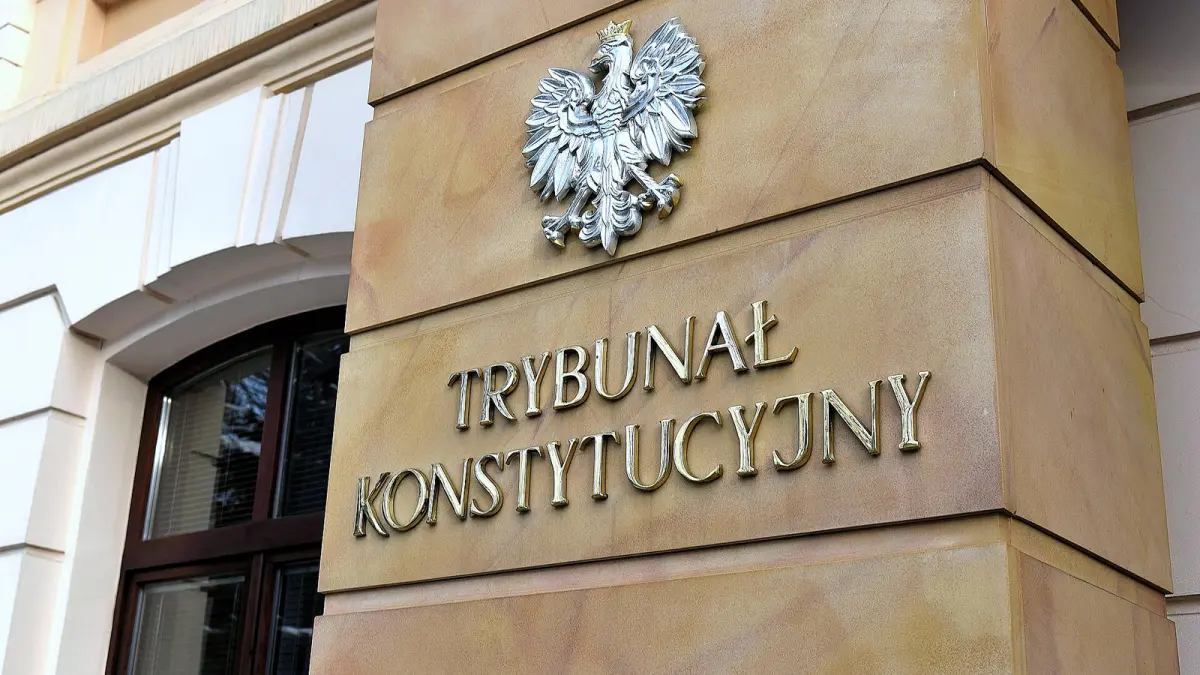
The events at Poland’s Constitutional Tribunal in the night to 31 October are called a coup d’état (in Polish, zamach stanu) by the Tribunal itself, by the opposition Law and Justice and Confederation parties and by a number of other right-wing politicians [2][26][32]. Donald Tusk’s government speaks of restoring the legal order, and Justice Minister Waldemar Żurek replies that the real “zamach” on the Tribunal happened many years ago [2][25][32]. There is no independent verdict: lawyers assess differently the grounds cited by judge Anna Korwin-Piotrowska, who suspended the Tribunal’s president [2][24][31].
Poland, 30–31 October
- 15
judges on the Tribunal’s bench - 8
judges elected by the Sejm in 2026 - 5 of 8
not sworn in by the president - 7
judges who entered the Tribunal building under the protection of the security service - 1 month
the period for which the president and his deputy were suspended - 3 November
the day set for the general assembly of judges - Since 2015
the dispute over the Tribunal has lasted
Based on the issue’s materials
- 15
What happened. A group of judges elected by the present Sejm entered the building under the protection of the State Protection Service and announced the suspension of the court’s president. President Karol Nawrocki cut short a state visit, came to the building and called what happened a forcible takeover of a constitutional body [1][2][6]. On Saturday consultations at the president’s office went ahead without representatives of Tusk’s party, and the opposition announced a vote of no confidence in the government [8][10][37]. Below are facts rather than labels: what exactly happened, how it came to this, who says “coup” and why, what each side’s arguments rest on and what remains unknown.
What happened over two days
On Friday evening, 30 October, judge Anna Korwin-Piotrowska, whom the Sejm elected in 2026 but whom the president did not swear in, announced that she had suspended the Tribunal’s president Bogdan Święczkowski for failing to perform his duties properly and had taken over leadership as the judge with the longest experience [2]. A short notice appeared on the Tribunal’s website about a break in the activities of Święczkowski and his deputy Bartłomiej Sochański, citing article 130 of the law on common courts: under it the president of a court or the justice minister may immediately suspend a judge caught in the act of committing an offence [2]. In Korwin-Piotrowska’s version, Święczkowski blocked judges from taking up their work and allowed irregularities in the assignment of cases [2]. Justice Minister and Prosecutor General Waldemar Żurek simultaneously delivered five motions to the Tribunal to lift immunity: four concern Święczkowski and the fifth Sochański [25]. The documents, he said, were delivered to the Tribunal’s longest-serving judge, that is, Korwin-Piotrowska [2].
Korwin-Piotrowska names as grounds for the suspension that Święczkowski did not convene the general assembly of judges on the budget, did not admit five new judges to cases, made political statements and let politicians into the building [30]. She later declared his order on days off ineffective, suspended most of the Tribunal’s staff on full pay and recommended that judges work outside the building; she also named a possible threat to the health or life of judges and staff as a reason [29][36].
Tribunal spokeswoman Weronika Ścibor said that seven judges elected this year entered the building accompanied by officers of the State Protection Service (SOP, subordinate to the interior minister), through a gate leading from the prime minister’s chancellery rather than the main entrance, where protesters had gathered [2]. Sochański was not let onto the grounds; police stopped Święczkowski from entering after his supporters cut the fence with a power tool [2]. Police, Anadolu reports, said they themselves did not enter the building [6]. The Tribunal’s account on the social network X called what happened an unlawful takeover of its website, said Święczkowski remains president and Korwin-Piotrowska is not a judge, and added that everyone taking part in these actions is committing the crime of a coup d’état [2].
Jarosław Kaczyński, leader of the opposition Law and Justice party, speaking outside the building, said that from that day Poland had become a police state, and from there it is a straight path to authoritarianism [2]. The First President of the Supreme Court, Zbigniew Kapiński, called what was happening an undoubted coup [2]. Tusk wrote on X that restoring the rule of law is the authorities’ duty, that it is a difficult and sometimes painful process after years of lawlessness, and that it requires decisive action [2].
Nawrocki was flying to Senegal on a state visit but ordered his plane to turn around [2][4]. On his return he met Kapiński and came to the building at about one in the morning [1][6]. In videos published by the new judge Maciej Berek, a close associate of Tusk, the president can be seen pushing his way in past Korwin-Piotrowska [1]. Presidential aide Marcin Przydacz claims that Korwin-Piotrowska and another judge, Krystian Markiewicz, breached the head of state’s inviolability; Berek replies that it was the president himself who barged into the judge with great force [1]. In another recording Nawrocki tells the judges they are not judges of the Tribunal and climbs the stairs accompanied by guards [1]. According to CNN, he also helped the suspended president Święczkowski enter the building [7]. At about five in the morning he left; the statement read by the head of his office, Paweł Szefernaker, speaks of a violation of the constitutional order and a forcible takeover of a constitutional body [1][12]. The president called for the forces of coercion sent to the Tribunal’s grounds by the government to be withdrawn and let the deputy president Sochański into the building [28]. Korwin-Piotrowska told Polsat News that the president barged into her at the entrance and did not answer her greeting [29].
On Saturday Nawrocki announced urgent consultations with parliamentary groups, citing a threat to internal security [6]. Deputy Prime Minister, Defence Minister and leader of the agrarian PSL party Władysław Kosiniak-Kamysz and Deputy Sejm Speaker Piotr Zgorzelski met the president first; representatives of Tusk’s Civic Coalition, according to reports, did not come [1][10]. Szymon Hołownia, leader of Poland 2050, is also taking part and urged Tusk to sit down at the table, but said the night’s events were a shame for Poland and that trying to fix the Tribunal by force would only hasten its downfall [1]. After meeting Nawrocki he named a “reset” of the Tribunal as a possible scenario: in his words, the Tribunal in its present form cannot be saved and must be either abolished or rebuilt; in his assessment the constitution has not been broken [27]. The Left refused: its Sejm leader Anna-Maria Żukowska wrote that one cannot accept the invitation of someone who is himself responsible for the situation around the Tribunal [1]. Żurek said talks about the situation at the Tribunal, including with Sochański, had been held, but no compromise had been reached [11]. Law and Justice and Confederation are taking part in the consultations [32][37]. According to the prime minister’s chancellery, Tusk will address the nation on Saturday at 20:00 Warsaw time; the content of the address was unknown at the time of checking [35]. According to CNN, three protesters were detained overnight [7]. TASS writes of four detainees: three entered the court’s grounds and one insulted police, while RT reports a man with a knife, a gas pistol and drugs among the protesters [18][19]. The Polish tabloids Super Express and Goniec also write about a man with a knife; Super Express describes him as 30 years old and says he hit a woman. Official confirmation from the police could not be found in the sources available [32][33].
In the evening former prime minister Mateusz Morawiecki, now leader of the party Development Plus, announced that a constructive motion of no confidence in Tusk’s government is being tabled and proposed a technical government led by former Sejm Speaker Marek Jurek, to stay in place until elections [8][33][37]. Hołownia said after meeting the president that the proposal will not find a majority [27]. Under Poland’s constitution a no-confidence vote is constructive: a candidate for prime minister must be named at the same time. Korwin-Piotrowska announced she would convene a general assembly of judges on 3 November; Święczkowski said he and the other judges would seek to regain control of the Tribunal [3].
Coup or restoring the legal order: who calls it what
The word “coup” (in Polish zamach stanu) is a weapon of both sides in this dispute, so it matters who says it. The Tribunal’s account on X declared that everyone taking part in the actions is committing the crime of a coup d’état [2][31]. Former justice minister Zbigniew Ziobro called what is happening an open criminal attack on the constitutional order [26]. One of the Confederation’s leaders, Sławomir Mentzen, wrote that everything Tusk is doing with the Tribunal is obvious lawlessness and probably simply a coup [26]. Former president Andrzej Duda called Tusk’s people a gang of thugs who had attacked a constitutional body [38]. The First President of the Supreme Court, Kapiński, also speaks of an undoubted coup [2].
The government side objects. Tusk writes that restoring the rule of law is the authorities’ duty and that there is no other way [25]. Żurek said at a press conference that the attack on the Tribunal was carried out years ago, when three stand-in judges were sworn in at night, and that talk of a coup is heard now, when the Tribunal is to be rebuilt [32]. Ruling-coalition representative Jan Grabiec cited examples of real coups d’état to show the difference [26]. Hołownia believes the constitution has not been broken, but that the night’s events will not help heal the Tribunal [27].
Mainstream Polish media use neutral words — “crisis”, “suspension”, “takeover of leadership” — and quote both sides [24][25][31]. The word “coup” stands in the headlines of right-wing outlets such as wPolityce and Nasza Polska [34][38]. According to TVN24, lawyers assess the legal grounds for the suspension ambiguously [24]. A constitutional lawyer in Rzeczpospolita writes that Święczkowski remains president and that Korwin-Piotrowska’s orders have no legal effect [31]. Professor Matczak, a critic of Law and Justice’s reforms, calls the basis for the suspension non-existent [2]. No legal opinions that classify what happened as a coup were found in the sources available: for now it is an assessment by politicians and the Tribunal itself.
What the Constitutional Tribunal is and why it arouses such passions
The Tribunal is a body that checks whether laws comply with the constitution: its finding can make a norm invalid. In Poland it has 15 judges, they are elected by parliament, and they take their oath before the president [2]. The word “tribunal” itself came from Latin (tribunal, the raised platform on which Roman magistrates sat); in Polish state law the name became attached to the constitutional court. The oath became the bottleneck of the whole story: the Sejm elects, but without an oath in the president’s presence, in the view of the president and the Tribunal’s present leadership, a judge does not take office, whereas in the view of the government and the Venice Commission the oath is merely a ceremony [3][9].
What happens to laws, taxes and public services depends on who leads the Tribunal and how: when rulings are not published and state bodies argue about their force, uncertainty grows for citizens and business alike [3].
How it began: 2015–2023
The crisis began in June 2015: the outgoing coalition of Civic Platform and the PSL changed the law and managed to elect five judges before the October elections; President Andrzej Duda refused to accept their oaths [3]. After Law and Justice won, the new Sejm declared the earlier choice invalid and on 2 December elected five others; Duda accepted the oath [3]. The next day the Tribunal ruled that three of the earlier elections were lawful and two were not, and that the president must without delay accept the oaths of properly elected judges [3]. Three seats were thus lawfully filled, and the judges elected to them at Law and Justice’s choice, Mariusz Muszyński, Henryk Cioch and Lech Morawski, came to be called stand-in judges [3].
Law and Justice changed the Tribunal’s rules of work: how cases are heard, the number of judges needed for a sitting, voting thresholds [3]. In March 2016 the Tribunal ruled the first part of the changes unconstitutional; the government of Beata Szydło refused to publish the ruling, citing a breach of procedure [3]. In December 2016 Julia Przyłębska became president and the stand-ins were allowed to work [3]. Critics said the Tribunal had come under political control; Law and Justice maintained that it was restoring the institution and reforming justice [3]. In 2021 the European Court of Human Rights found that the Tribunal’s composition, including Muszyński’s participation, did not meet the requirement of a tribunal established by law, and the Polish Tribunal in the same year issued rulings challenging the primacy of certain EU law provisions on the judiciary [3][5]. In 2022–2023 divisions emerged within the Tribunal: several judges considered Przyłębska’s six-year term as president to have expired, while she held that she could lead until the end of her nine-year term as a judge [3].
Tusk’s coalition tries to reverse it: 2023–2025
After the October 2023 election Tusk made restoring the rule of law a central priority [3]. In March 2024 the Sejm adopted a resolution questioning the status of the three stand-ins and Przyłębska’s authority to lead the Tribunal. In September two bills followed on the election of judges and the institution’s functioning, but Duda referred both to the Tribunal itself for review, and they did not take effect [3]. In December 2024 Duda appointed Bogdan Święczkowski, a former national prosecutor and close associate of Zbigniew Ziobro, as president [3]. The government restricted the publication of the Tribunal’s rulings in the Journal of Laws, citing doubts about its composition; the Tribunal’s leadership called this unlawful [3].
In February 2025 Święczkowski accused Tusk and other senior officials of forming an organised criminal group in order to carry out a coup; the Prosecutor General’s Office then opened an investigation, and Tusk answered with a video of himself playing table tennis [15]. On 1 June 2025 Nawrocki won the presidential election with 50.89% of the vote against Tusk’s candidate Rafał Trzaskowski [14]. Tusk asked for a vote of confidence and won it, 243 votes to 210 [13]. Nawrocki took office on 6 August and warned in advance that the government should expect strong resistance from the presidential palace [13].
2026: the oath that is missing
In March 2026 the Sejm elected six judges to replace those whose terms were ending: Krystian Markiewicz, Anna Korwin-Piotrowska, Maciej Taborowski, Magdalena Bentkowska, Marcin Dziurda and Dariusz Szostek [3]. Nawrocki accepted the oaths of Bentkowska and Szostek but refused the other four, citing the election procedure, in particular deadlines and the requirement for individual votes, and noting that the president is not obliged to accept elections automatically [3]. The government objected that the Sejm elects and the president cannot block an election [3]. On 9 April the four judges took their oaths before a notary in parliament and sent the documents to the president’s office; it and Święczkowski rejected them, holding that the oath must be taken in the president’s presence [3]. Święczkowski did not accept the judges even when the European Court of Human Rights in May applied an interim measure: the Polish authorities must not obstruct the four judges from taking up their duties; he declared that the Strasbourg court has no such authority [2][3]. The Council of Europe’s Venice Commission said the president’s role in the oath should be ceremonial and that a refusal or delay should not prevent a judge from taking office [3][9]. On 12 May the Tribunal ruled in case K 3/26 that the president is not obliged to accept every election and must be physically present at the oath [3].
In 2026 the Sejm elected eight judges; Nawrocki did not swear in five of them [1][2]. On 14 October Maciej Berek, whom Tusk has called his right-hand man, also took his oath in the Sejm; the president was not at the ceremony [1]. Święczkowski refused to recognise oaths taken without the president and did not let the elected judges sit on cases [3]. A day before these events, on 29 October, Tusk accused Kaczyński of trying to take Poland out of the EU after his speech on possible exit talks [22].
Whose arguments are stronger on the merits
The government and the Sejm rely on the fact that parliament elects judges and that the presidential oath is by its nature ceremonial; this position was supported by the Venice Commission, and the European Court of Human Rights demanded that judges not be obstructed from taking office [3][9]. The government side explains the aim thus: to let the majority of duly elected judges make the Tribunal work again [9]. The other side cites the Tribunal’s ruling in case K 3/26, the requirement of the president’s personal presence and the claim that suspending the president has no legal basis; Nawrocki and Kapiński do not recognise those they call usurpers of power in the Tribunal [3][11].
Independent voices paint a more complex picture. Marcin Matczak, a prominent constitutional-law scholar and critic of Law and Justice’s judicial reforms, wrote that Święczkowski is the worst possible president of the Tribunal, but that the suspension has no legal basis, for many reasons: the justice minister oversees common courts, not the Tribunal [2]. Hołownia believes Święczkowski, together with Law and Justice’s appointees, turned the Tribunal into a caricature, but that forcing it to work by force would only hasten its downfall [1]. Euronews’ assessment: the crisis has long been not about posts but about the separation of powers, judicial independence and the force of constitutional rulings [3].
Reactions outside Poland
US ambassador to Poland Tom Rose wrote on X that this is an unprecedented confrontation over how the government uses state power, and that the last thing Poland needs is a confrontation that turns into something much worse [17][24]. Foreign Minister Radosław Sikorski said the police action was needed to restore the court’s work [16]. Poland’s ambassadors to Romania and China, Paweł Soloch and Jakub Kumoch, resigned over the events in the country [24]. British politicians Nigel Farage and Liz Truss and the Dutch politician Geert Wilders condemned what is happening [9]. Russian state media present the events as a “decisive step by Brussels taken by Tusk” and predict the introduction of a state of emergency; there is no independent confirmation of these assessments [20][21]. An official reaction by EU institutions as of the evening of 31 October could not be found in the sources available.
A correction to our morning review
In the review of the world on 30 October we wrote about the first hours of the crisis and about TASS and RT reports [23]. Four details are corrected here. Nawrocki refused the oath not of three judges out of six but of four out of the six elected in March, and over the whole of 2026 of five out of eight [1][3]. The judges, in the Tribunal’s account, were taken into the building by officers of the State Protection Service; police said they themselves did not go inside [2][6]. The president and his deputy were suspended for one month by Korwin-Piotrowska’s order, not by a decision of the Tribunal itself [3]. The resignation of the ambassadors, which in the morning only TASS and RBC reported, was confirmed by Warsaw’s TVN24: they are Paweł Soloch (Romania) and Jakub Kumoch (China) [24].
What remains unknown
The outcome of the consultations at the president’s office as of the evening of 31 October, and the content of Tusk’s evening address, are not given in the reports found. It is unknown what consequences the suspension of Święczkowski and Sochański has: the Tribunal does not recognise it, nor does the president, while the Tribunal’s website, according to reports, has passed under Korwin-Piotrowska’s control and police guard the entrances to the building [1][11]. It is unclear what the general assembly of judges will decide on 3 November, whether immunities will be lifted and whether the no-confidence proposal will find support in the Sejm: Hołownia believes it will not find a majority, while in June 2025 the government won confidence by 243 votes to 210 [13][27]. It is unknown how EU institutions will react: the dispute over the Tribunal is tied to both Polish politics and the country’s relations with the Union.



