The world day of 30 October came down to three stories that at first sight are unconnected. In Warsaw police entered the building of the Constitutional Tribunal, and the court suddenly had two leaderships [1][2]. On American exchanges the sell-off in technology stocks went on: a day earlier Alphabet had lived through the worst day in its history [3][4]. And in Atlanta, at the G20 foreign ministers’ meeting, Sergey Lavrov described the Russia–US agreement on diesel fuel as a reason not for rejoicing but for sober assessment [5][6]. The common backdrop is the US congressional elections on 3 November [7].
30 October in the world
- more than 12%
fall in Alphabet shares on 29 October - more than 500 billion dollars
Alphabet’s one-day loss of market value - about 29%
fall in Intel shares on 30 October - more than 2 trillion dollars
what Nasdaq-100 could lose in October by Reuters’ calculation - 6.35 dollars
average price of diesel in the US per gallon
Based on the issue’s materials
- more than 12%
Warsaw: a court with two leaderships
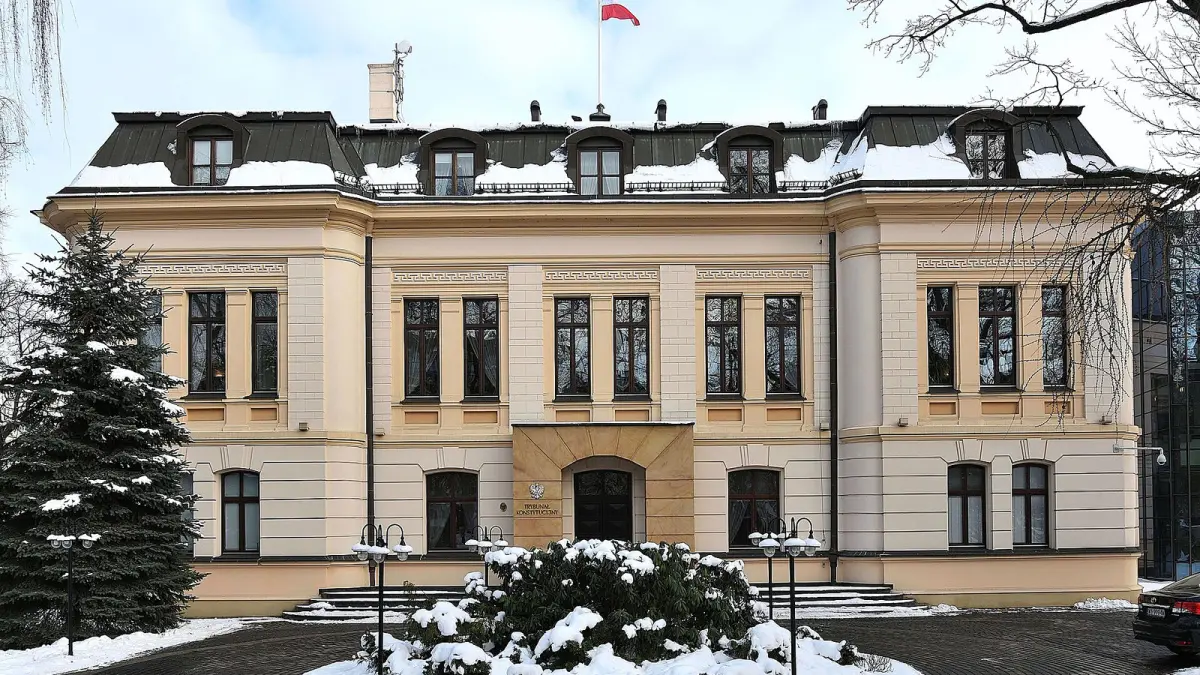
On Friday police entered the building of the Constitutional Tribunal in Warsaw after incidents outside the court; according to police, dangerous objects were thrown at officers [1]. A notice appeared on the tribunal’s website that its president Bogdan Święczkowski and his deputy Bartłomiej Sochański had been suspended [1][2]. The tribunal itself, on the social network X, called what happened a coup d’état and said that its website had been unlawfully seized; in its version Święczkowski remains president [2][8].
The suspension orders, according to reports, were issued by judge Anna Korwin-Piotrowska: the Sejm elected her in March 2026, but President Karol Nawrocki refused to swear her in over alleged flaws in the election procedure [1][9]. She has now been placed at the head of the tribunal, while the tribunal itself has stated that she is not a judge [2]. Justice Minister and Prosecutor General Waldemar Żurek said he is asking for the immunity of Święczkowski and Sochański to be lifted [2].
The government of Donald Tusk regards what happened as restoring legality: he wrote on X that this is the duty of the authorities, and in another statement spoke of correcting the lawlessness of previous governments [1][10]. The leader of the opposition Law and Justice party, Jarosław Kaczyński, called what is happening a coup against the tribunal and urged Nawrocki to intervene [8]. Foreign Minister Radosław Sikorski said the police action was needed to restore the court’s work, and the US ambassador to Poland urged the parties to show restraint [11][12].
President Nawrocki turned his plane, which was heading to Senegal, around over southern Spain and returned to Warsaw [9]. According to TASS, citing the head of his office, Szefernaker, he entered the court building, outside which a protest is under way, on Saturday night [13]. Supporters of Law and Justice were called to gather at the tribunal [14]. Poland’s ambassador to China, Jakub Kumoch, resigned; Sikorski responded by calling the end of his mission unprofessional [8]. According to TASS, the ambassador to Romania also resigned, but there is no independent confirmation of that yet [15].
The dispute is not new. The present judges were appointed by the previous Law and Justice government, which ruled in 2015–2023 [8], and Tusk’s coalition has argued since late 2023 that the court must be rebuilt [9]. This year Nawrocki refused to swear in three of the six judges elected by parliament. Święczkowski, who under Law and Justice was a deputy justice minister, did not let the judges chosen by the current majority start work, and the long-running dispute has effectively paralysed the court [29]. In February 2025 he accused Tusk and other senior officials of forming an organised criminal group to carry out a coup, after which the Prosecutor General’s Office opened an investigation; Tusk answered with a video of himself playing table tennis [16]. Now the dispute has moved from statements to the court building and the police.
Market: from earnings to the question of payback on AI
The sell-off began with Alphabet’s earnings. After the quarterly report the company’s shares fell more than 10% after the close of trading on 28 October: net profit was 26.2 billion dollars, 25% less than a year earlier, while revenue rose to 127.6 billion [3]. At the close on 29 October the shares had lost more than 12%, the company’s worst day, and market value fell by more than 500 billion dollars, from 3.973 to 3.448 trillion [4][17].
On 30 October the pressure moved to other companies. Intel shares fell almost 30%; by Reuters’ estimate, the company lost more than 137 billion dollars of market value in a day [4]. Amazon’s free cash flow over 12 months was minus 42.4 billion dollars against a background of big investments in AI [4]. By midday the Nasdaq-100 index was down 3.19%, the S&P 500 down 1.6% and the Nasdaq Composite down 2.86%; shares of crypto-linked companies fell after the report of the Binance hack [18]. By Reuters’ calculation, the Nasdaq-100 was at risk of ending October with a loss of more than 2 trillion dollars [19].
Doubts about spending on AI have arisen before. In February 2026 shares of the biggest technology companies fell after Amazon, Microsoft, Google and Meta announced plans to spend about 660 billion dollars on AI in 2026 [20]. Now, as Ekonomichna Pravda writes, investors doubt that this spending will pay off [4]. By Bloomberg’s estimate, the fall may make it harder for technology companies to raise capital and worsen the prospects of Anthropic’s large stock-market listing [4].
Washington before 3 November: diesel, Lavrov and missiles for Ukraine
The congressional elections on 3 November will decide whether Republicans keep their thin majority; diesel in the US, as Reuters notes, is close to record prices [7]. On 9–10 October, after a conversation with Vladimir Putin, Donald Trump announced that Russia would immediately supply more than 300,000 tonnes of diesel, another 500,000 in November and then 1 million tonnes; the US Treasury issued a licence to import Russian diesel until 7 April [7]. The law of 16 September had obliged the president to impose tariffs on the main buyers of Russian oil and gas, and the AP called the deal an unexpected reversal. A group of senators from both parties demanded that the decision be cancelled [21].
Prices did not fall: according to the WSJ, citing the American Automobile Association, after the deal was announced diesel rose by another seven cents, to 6.35 dollars a gallon [22]. Reuters recalls that it has risen about 70% since 28 February, when the US and Israel began the war with Iran [23]. In Atlanta Lavrov said Russia would support proposals like the diesel deal, but “enthusiastic reviews” should be treated soberly, and no real shifts in relations with the US are yet visible [5][6]. He added that Russia has no ban on selling fuel to anyone, and how the US copes with its own restrictions is its own problem [24].
At the same time the US State Department approved the possible sale to Ukraine of 500 Patriot PAC-3 missiles and related equipment for 2.1 billion dollars [25]. Thus Washington has at once allowed imports of Russian diesel and approved arms deliveries to Ukraine.
Binance: what we have already written
The Binance hack remained the backdrop of the day: crypto-linked shares fell on the exchanges [18]. We wrote about how the story developed on 30 October. Those are materials on the damage estimate of 6.36 billion dollars and the North Korean trail [26], on the National Bank’s statement that Kazakhstan’s crypto reserve was not affected [27], and the review of 29 October in the world [28]. New data on the 6.34 billion dollars Binance has set aside to cover losses are in this issue’s news item.
What remains unknown
As of the morning of 31 October the sources found contain no legal verdict: the sides call what is happening a “coup” and a “restoration of the law”. It is unknown how the requests to lift immunity and the general assembly of judges called by Korwin-Piotrowska will end [30]. On the market it is not yet visible whether the fall in Alphabet and Intel is a one-off reaction to earnings or the start of a longer revision of expectations about AI. On the diesel deal, it remains to see how deliveries go and what the 3 November election decides.



