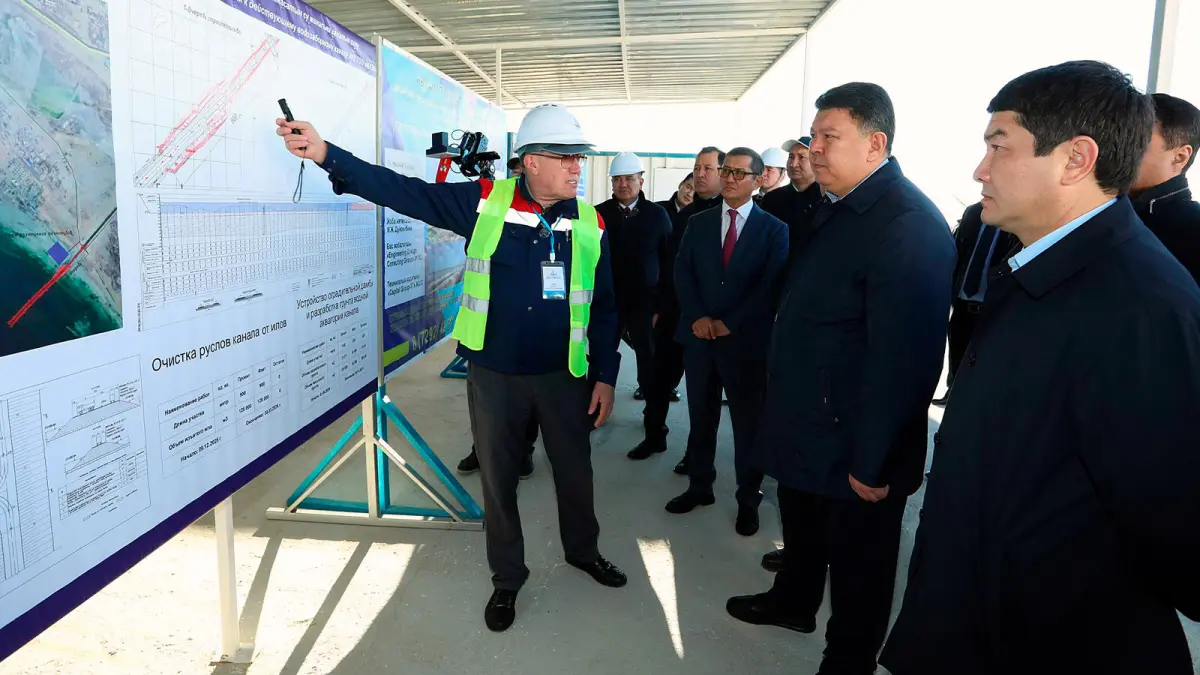
Aktau, 30 October. The falling level of the Caspian Sea poses risks to the stable operation of the Mangistau Atomic Energy Complex (MAEK), on which Aktau’s electricity and heat supply depends, so the water intake canals of CHP-1 and CHP-2 are being deepened and extended, the government said after Deputy Prime Minister Kanat Bozumbayev’s trip to Mangistau region.
Bozumbayev visited the Kaspiy desalination plant, whose capacity rose to 40,000 m³ a day after an expansion in 2025: it supplies drinking water to Aktau’s upper districts and villages in the Munaily and Karakiya districts. Wear of the heating networks of the Kaspiy Zhylu, Su Arnasy company is 65%, water pipes 58% and sewers 69%. Under the national project to modernise the energy and utilities sectors, more than 41 km of heating networks are being rebuilt for 21.8 billion tenge by 2027. Aktau’s heat capacity shortfall is 130 Gcal/h; a new boiler house for six districts is being built for 48 billion tenge.
The meeting reviewed the development master plan for Mangistau region — projects in logistics, industry, maritime infrastructure, agriculture and tourism. The government did not name the cost or timing of the work on the water intake canals.
What it means: The shallowing of the Caspian has turned from an environmental topic into an engineering threat: whether Aktau has electricity, heat and desalinated water depends directly on the sea level.
Who benefits: Aktau residents gain uninterrupted heat and power if the canals are deepened in time. Contractors gain dredging and utility modernisation orders. The budget will have to pay for the consequences of shallowing, which will grow with it.
Background: MAEK was built in Soviet times around the BN-350 fast-neutron reactor, which was shut down in 1999; today the complex runs on gas but still uses seawater for cooling and desalination. The Caspian level has been falling since the mid-2000s; scientists link this to reduced Volga flow and increased evaporation.



