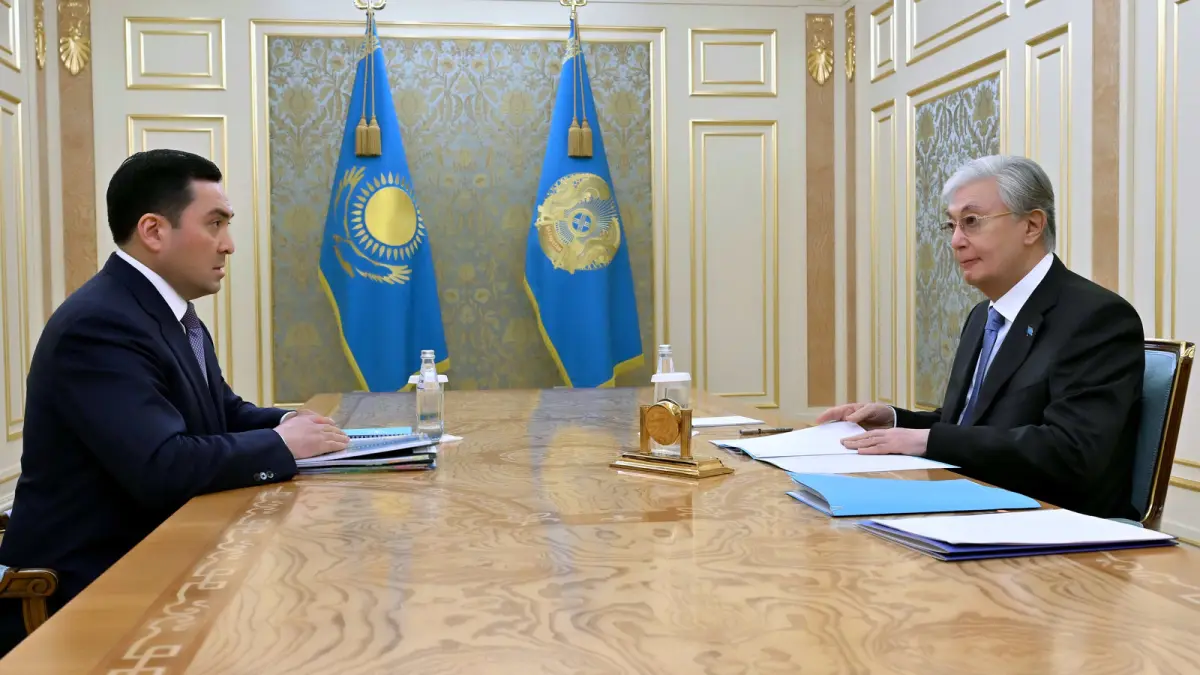
Astana, November 16. Energy Minister Yerlan Akkenzhenov reported to President Kassym-Jomart Tokayev on November 16 that the heating season was running smoothly in all regions and that the number of power plants in the “red zone” of risk had fallen to five, Akorda said.
The minister presented the results of the fuel and energy sector for ten months and plans for the period ahead.
According to the minister’s report, funding for the repair campaign at power plants has been increased to 384 billion tenge. Main equipment and networks have been repaired, and wear at combined heat and power plants (CHPs) has been reduced. The Energy Ministry uses the term “red zone” for plants with the highest risk of breakdowns because of worn-out equipment. According to Government data cited by Kazinform, there were 19 CHPs in it in 2024. Over the same period the number of plants in the “yellow” zone rose to 19 from 11, and in the “green” zone to 14 from 7. The number of technical failures during the heating season fell by 32%, from 1,469 in the 2023–2024 season to 1,004 in the 2025–2026 season.
Electricity generation over ten months rose by 2.3% to 102.4 billion kWh. Oil refining increased by 4.7%, and total stocks of fuels and lubricants rose to 1.2 million tonnes. Domestic bitumen, of which 1.1 million tonnes was produced, fully covered the country’s domestic needs, according to the minister. Projects to expand the Shymkent refinery to 12 million tonnes a year and to build a new petrochemical complex in Atyrau Region are moving forward.
In the gas sector, the level of gasification of the population is expected to reach 64.5% by the end of the year, with 13.2 million people having access to gas. For comparison, as of January 1, 2026, as Akkenzhenov said at a Government meeting in July, the gasification level stood at 64.2%, with gas available to 13.1 million people. The ministry intends to raise gasification to 80% by 2035. Gas processing plants are being built at Kashagan and in Zhanaozen, and EPC contracts (for engineering, procurement and construction) have been signed for projects at Karachaganak and for the second phase of Kashagan.
The ministry, according to the report, has begun updating the country’s unified energy balance to 2035, taking into account energy-intensive data centres and artificial intelligence: this task was set in the President’s Address. To boost geological exploration, 112 subsoil plots have been put up for electronic auctions – a number Akorda calls a record. The President was also told about the introduction of digital twins at fuel and energy facilities and about a single platform for monitoring coal supplies to 1.2 million consumers.
Following the meeting, Tokayev instructed that reliable power and heat supply to the population be ensured, that the stability of the fuel and coal markets be strictly monitored and that investment projects be implemented properly.
What it means: The minister’s report sums up the repair campaign at power plants ahead of winter: more money was allocated for repairs, and the number of the most breakdown-prone plants has fallen almost fourfold in two years. Gasification is adding little over the year – 0.3 percentage points and about 100,000 people – so the target of 80% by 2035 is still a long way off.
Who benefits: The repairs matter above all to residents of cities with CHPs: fewer worn-out plants mean less risk of breakdowns in winter. Higher oil refining, larger fuel stocks and home-produced bitumen reduce the domestic market’s dependence on imported fuel and road materials. What the repairs and gasification will cost consumers in tariffs, the Akorda statement does not say.
Background: The gas processing plant at Karachaganak, with a capacity of 5 billion cubic metres a year, is being built by a subsidiary of QazaqGaz; the EPC contract with a consortium of Hyundai Engineering and SICIM Kazakhstan was signed on November 12.
We have also reported on Tokayev being briefed on QazaqGaz’s readiness for the heating season, and on QazaqGaz signing an EPC contract for the gas processing plant at Karachaganak.



