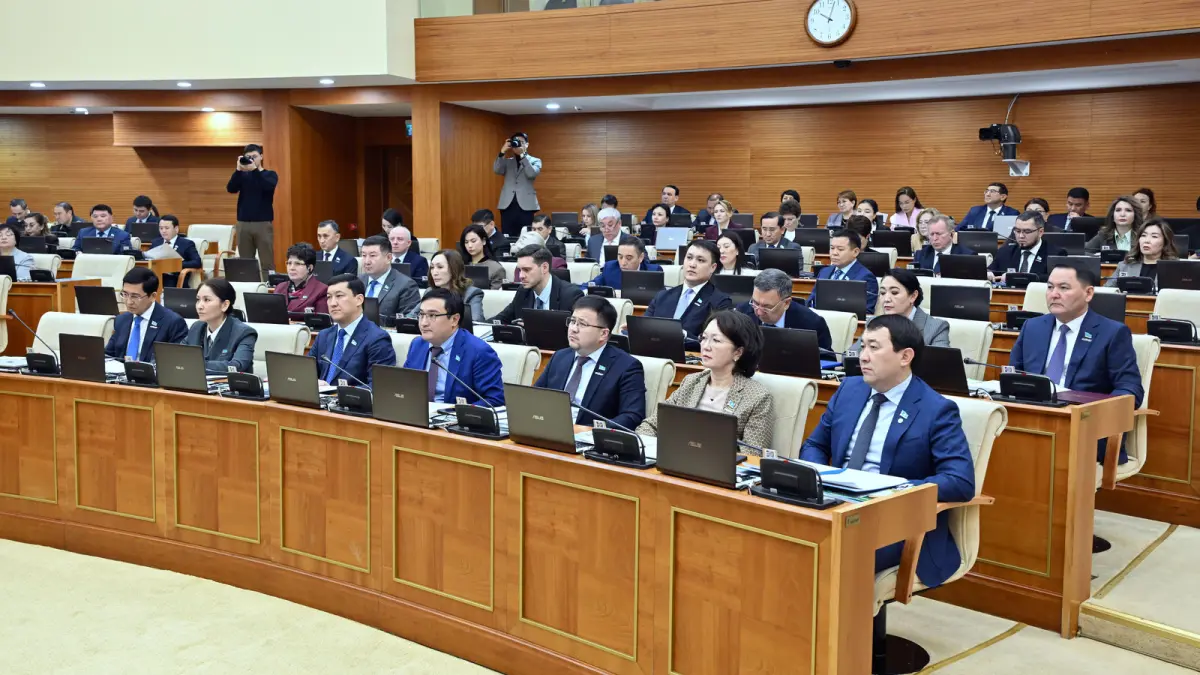
Astana, November 16. Following a Government Hour on the “Children of Kazakhstan” Concept, the Kurultai recommended that the Ministry of Education give school psychologists separate rooms for confidential work with children, draw up a map of the shortage of special education teachers and, by December 1, provide schooling for minors held in pre-trial detention centres.
The Ministry of Emergency Situations has been asked to identify every year the villages that have no safe places for children to relax by the water.
The deputies drew up the recommendations after the first Government Hour ever held in the Kurultai, at which Education Minister Zhuldyz Suleimenova reported on progress with the Concept for 2026–2030. The central government bodies responsible for implementing it are advised to discuss decisions in advance with the Children’s Rights Commissioner, the relevant Kurultai committee and civil society organisations, and to involve children and young people themselves in the discussion. They are also asked to assess every year how the measures taken have affected children’s quality of life, access to services and the gap between regions.
A separate set of proposals is addressed to the Ministry of Education. It is proposed to revise the child well-being index, separating objective socio-economic and educational indicators from criteria of a child’s psychological and social well-being. Deputy Sholpan Karinova asked about this at the Government Hour: the index includes the results of monitoring of educational achievement and the share of school leavers who reach the pass mark in the Unified National Test. Suleimenova replied that the index was approved by a Government order in 2022 and that the educational indicators have not changed since then. For children from families registered with the police, it is recommended to assign mentors from the regional commissions for women’s affairs and family and demographic policy, maslikhat deputies and business. The ministry is also instructed to draw up plans for opening clubs in houses of culture and village clubs, including in robotics and digital skills, and to repair institutions for orphans and special education institutions.
For children with special educational needs, a regional map of the need for special education teachers and a step-by-step plan to close the shortage are needed, and it is proposed to merge the data of the education and social protection systems in order to find children who do not attend school at all. According to Suleimenova, 237,000 such children are registered; about 10,000 are waiting for the findings of a psychological, medical and pedagogical consultation, and 11,000 special education teachers are working. The minister said the ministry was ready to support a review of pay for inclusive education teachers. Deputy Abbat Orisbayev asked the minister at the meeting about the shortage of school psychologists, their workload, pay and equipped rooms. Separately, the Kurultai proposed checking whether minors had been transferred to evening schools on justified grounds since January 2026, and finding out how many of them have returned to ordinary schools.
The Ministry of Health is advised to review the work of youth health centres and introduce in all schools and colleges a single programme on reproductive and mental health and the prevention of early pregnancy and violence, and to update the road map for palliative care for children. For children’s toys it is proposed to enshrine a psychological and pedagogical assessment in law and to oblige sellers to display safety certificates on digital platforms. The Ministry of Labour, together with the Ministry of AI and Digital Development, is instructed to complete a single digital route for the child and to tighten measures against illegal child labour, including forced begging. Deputy Labour Minister Bakhtiyar Zhazykpayev, answering deputy Meirkhat Kassymbayev, said that from May to August inspectors had checked about 8,000 organisations and found more than 1,600 violations, including cases of child labour.
The Interior Ministry, together with the akimats, is advised to make sure that video surveillance systems in educational institutions are connected to police operational control centres. The Ministry of Tourism and Sport is asked to work out small sports complexes for villages that have no sports facilities. The Ministry of Emergency Situations, besides looking for villages without safe beaches, is advised to take an inventory of bodies of water within a five-kilometre radius of settlements and, on that basis, to work out measures against accidents involving children on the water. The remaining recommendations went to the ministries of culture and information and of justice and to the akimats. Deputies’ questions at the Government Hour also included the pay of guardianship staff in Astana from the local budget, raised by Lyazzat Zhylkybayeva, and housing for orphans and the transparency of the waiting list for it, asked about by Nauryz Sailaubai.
What it means: The Kurultai has turned the discussion of the Concept into a targeted list of tasks for nine ministries and the akimats: from rooms for school psychologists and a map of the shortage of special needs teachers to a count of bodies of water near villages and video surveillance in schools. Some items have a deadline: schooling for children in pre-trial detention centres by December 1, 2026. The Kurultai did not say how binding these recommendations are for the ministries or how their implementation will be checked.
Who benefits: Above all children from vulnerable groups – those with special needs, from families registered with the police, orphans, teenagers in pre-trial detention, rural children without clubs and sports sections. The extra work and costs fall on the ministries and akimats, and toy manufacturers and sellers may be affected by a mandatory assessment. The sources give no estimates of the cost of the measures.
Background: The “Children of Kazakhstan” Concept for 2026–2030 was adopted at the beginning of the year on the President’s instructions. According to Deputy Chair of the Kurultai Dinara Zakiyeva, there are about 7 million children in the country, a third of the population, and the plan provides in particular for major repairs at 44 of the 111 institutions for children in difficult circumstances, orphans and children left without parental care. As a result of the Concept the child well-being index is to be raised to 68 points. At the same Government Hour the Kurultai presented a bill on children’s digital safety, the first written on the AI-Quryltai platform.
We have also reported on the Kurultai drafting a bill with the AI-Quryltai platform for the first time and on the Kurultai considering a ban on social media registration for children under 16.



