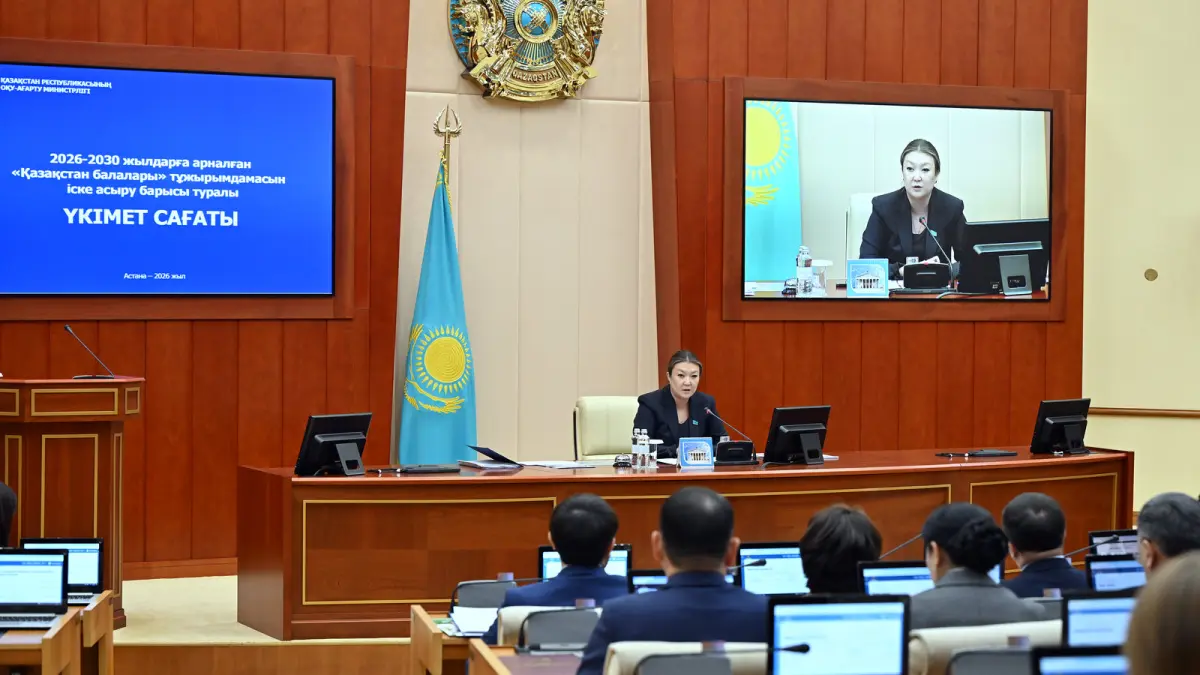
Astana, November 16. The draft law “On the Digital and Information Safety of Children” has become the first bill developed in the AI-Quryltai digital environment with built-in artificial intelligence, Deputy Chair of the Kurultai Dinara Zakiyeva said on November 16 at a Government Hour.
The document proposes labelling and verifying online games and apps, introducing parental control on all platforms and children’s ID cards with a photograph.
According to Zakiyeva, the platform has “the capacity for legal thinking”. The system analysed how well children are protected in the digital and information environment. As the Kurultai press service said, the analysis drew on big data, citizens’ appeals, problems raised by parents, experts and the public, a risk assessment and international experience. A specially trained legal model, drawing on a database of more than 800,000 legal acts, also took part for the first time in drafting the text of the bill itself. All proposals prepared with AI-Quryltai were then checked and refined by the deputies drafting the bill together with invited lawyers and experts in information and digital security. In all, more than 120 amendments were prepared.
The Kurultai listed separately what the bill proposes. Online games and other digital and information products must be labelled and carry a description of their content indicating the risks, including in-game purchases and the possibility of correspondence between users. Such products will be checked (verified) by an authorised state body; in case of violations, access to a product, app or game may be restricted, or it may be removed or blocked, and liability is introduced for non-compliance. The same approach is proposed for purchases by minors on marketplaces. “Parental control” on all digital platforms means filtering: a child will not be able to see or download unlabelled and unverified products, apps and games.
Children’s ID cards with a photograph are meant to reliably confirm a child’s identity. As the authors envisage, they will become the basis of a single digital support route for minors up to the age of 18, through which state support measures and the protection of children’s rights will be coordinated. Which body will be the authorised one, when the law could take effect and what the liability will be, the Kurultai statements do not say.
The bill is now being sent to the Government for its opinion, after which a Kurultai working group will continue refining it. It is one of three bills that deputies wrote to implement the “Children of Kazakhstan” Concept, adopted early this year on the President’s instructions. According to Zakiyeva, there are about 7 million children in Kazakhstan – a third of the country’s population.
What it means: The Kurultai has for the first time used its own AI system not only for analysis but also for drafting the text of a law. Final decisions, the Kurultai says, remain with people: every provision was checked by deputies and lawyers. The bill itself, if adopted, will change the rules for digital services: games and apps without labelling and state verification will become unavailable to children.
Who benefits: The bill, its authors say, protects children and gives parents a tool for control. The new obligations – labelling, verification, liability for violations – fall on platform owners, game and app developers and marketplaces. Their views are not given in the Kurultai statements.
Background: The Kurultai is Kazakhstan’s unicameral parliament. The Government Hour on November 16, devoted to the “Children of Kazakhstan” Concept for 2026–2030, was the first ever held in the Kurultai. Kazakhstan’s delegation presented the AI-Quryltai platform at the United Nations Office at Geneva on November 12: as the Kurultai describes it, local language models run in a closed loop, and materials prepared with AI are checked by specialists. Separately, the Kurultai is considering amendments on online platforms that ban children under 16 from registering on social networks.
We have also reported on the Kurultai considering a ban on social media registration for children under 16.



