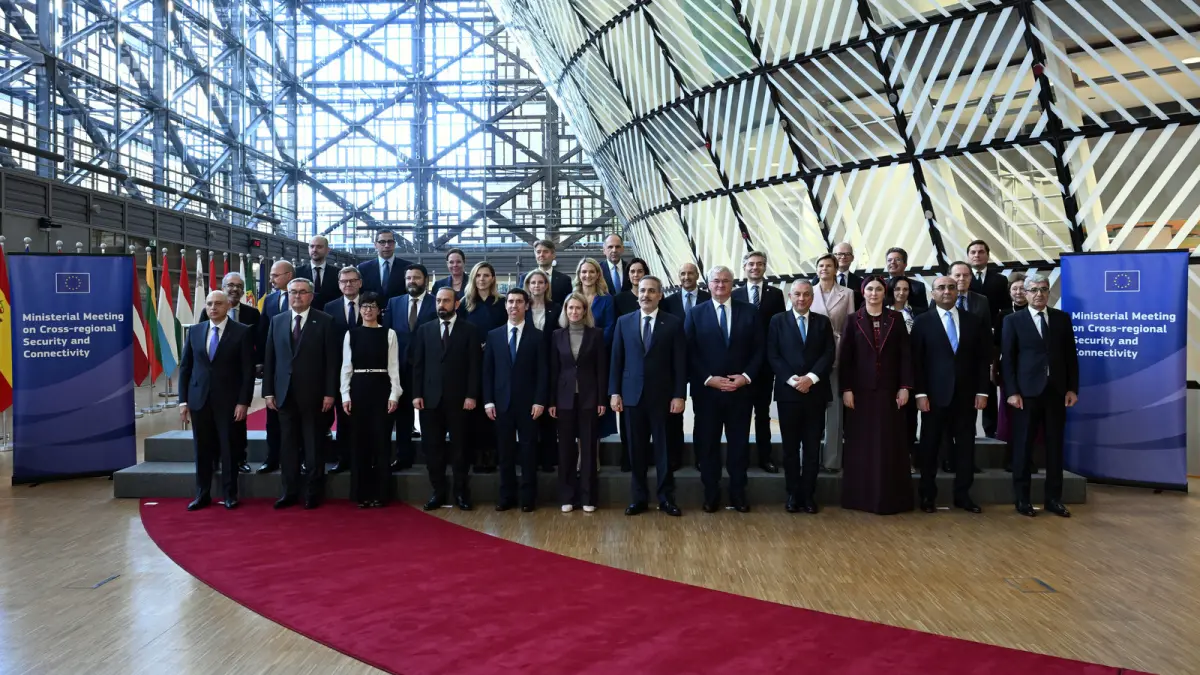
Astana, November 17. Kazakhstan’s Foreign Minister Mukhtar Tleuberdi discussed the safety of shipping in the Black Sea and the uninterrupted transport of oil via the Caspian Pipeline Consortium (CPC) system with Romania’s Foreign Minister Dan Neculăescu, Kazakhstan’s Ministry of Foreign Affairs said on November 17.
The ministers met in Brussels on November 16.
The talks took place on the sidelines of the second Ministerial Meeting on Interregional Connectivity and Security, convened by the European Union in Brussels. According to the ministry’s statement, the meeting “confirmed mutual interest in strengthening trade and economic ties and expanding bilateral cooperation in promising areas”. “Particular attention was paid to the safety of shipping in the Black Sea and to ensuring the uninterrupted transport of Kazakh oil via the Caspian Pipeline Consortium system,” the statement said.
The two sides agreed to hold the 18th meeting of the two countries’ intergovernmental commission in 2027. The meeting with Dan Neculăescu was one of eight bilateral meetings Mukhtar Tleuberdi held in Brussels: he also spoke with the foreign ministers of Germany, Latvia, Estonia, Ukraine, France, Croatia and Bulgaria.
For Romania this oil is its main raw material: after its supplies were suspended, Romania’s foreign minister said that the country receives more than 60% of the oil it needs from Kazakhstan. Kazakhstan’s former Foreign Minister Yermek Kosherbayev and Romania’s acting Foreign Minister Oana Țoiu condemned in a telephone conversation in August 2026 any actions that threaten CPC infrastructure.
What it means: For Romania, CPC oil is the basis of its refining; for Kazakhstan, Romania is one of the markets that tankers carrying CPC Blend reach across the Black Sea. The ministry singled out maritime safety as a separate topic in its statement, even though the meeting took place on the sidelines of a multilateral forum.
Who benefits: Stable supplies via the CPC matter both to Kazakhstan, which sells most of its oil through the consortium, and to Romania, whose refineries run on this oil. The ministry did not name any new agreements on protecting shipping.
Background: The Caspian Pipeline Consortium pumps oil from Tengiz to a marine terminal near Novorossiysk on the Black Sea; from there CPC Blend is shipped by tanker, including to Romania. The terminal’s operations were interrupted several times in 2026 after drone attacks. Kazakhstan and Romania will mark 35 years of diplomatic relations in July 2027.
We have also reported on oil output in 2026 that would have reached 101 million tonnes without the attacks on the CPC.



