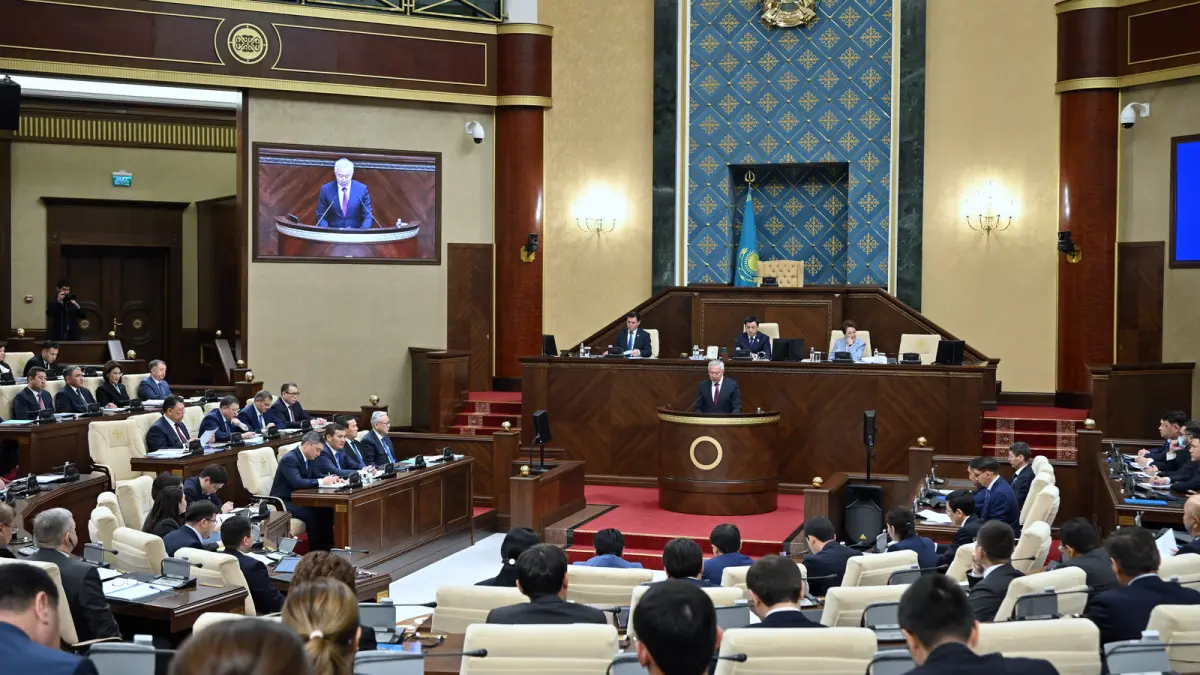
Astana, 18 November. The Kurultai, Kazakhstan’s parliament, on 18 November approved in the second reading and adopted in the third reading the law “On the Republican Budget for 2027–2029”, the Kurultai said in its official channel.
Budget 2027 in figures
- 19.9 trillion tenge
own revenue - 30.2 trillion tenge
spending - 4.43 trillion tenge
from the National Fund - 110 thousand tenge
minimum wage from 1 January 2027
Based on Kurultai data
- 19.9 trillion tenge
At the deputies’ initiative, 47 billion tenge for 52 regional infrastructure projects was added to the 2027 budget; 2027 spending has been revised to take account of the President’s instructions.
The Kurultai’s statements of 18 November do not give the final parameters of the law, but on 17 November, the day before, Olga Perepechina, chair of the Kurultai’s Committee on Finance and Budget, gave them in an interview that she gave to Zakon.kz and the Kurultai published. According to her, the republican budget’s own revenue in 2027 will be 19.9 trillion tenge and spending 30.2 trillion. The National Fund is to provide 4.43 trillion tenge: a guaranteed transfer of 2.43 trillion and a targeted one of 2 trillion. Together with other receipts, total receipts reach 25.4 trillion tenge, and the gap between them and spending is about 4.6 trillion tenge. By 2029 the government expects to cut it to 1 trillion, raising its own revenue to 23.4 trillion tenge. The Kurultai’s statements do not say whether these figures changed after the second reading.
From 1 January 2027, Perepechina said, the minimum wage is to rise from 85 to 110 thousand tenge: an increase of 25 thousand tenge, or 29.4%. It will affect about 370,000 public-sector workers, and 75.9 billion tenge is allocated for it. Another roughly 135 billion tenge a year in 2027–2029 is needed to raise pay for specialists of the district primary health care service (by up to 40%, depending on continuous length of service) and for supplements for psychologists and social workers. This will affect more than 77,000 medical workers. The republican budget provides 32 billion tenge for this (20 billion in addition, 12 billion by redistribution), and another 103 billion tenge comes from compulsory social health insurance funds.
For the “People’s Construction” programme, the draft budget for 2027–2029 provides a targeted transfer from the National Fund of 5 trillion tenge, of which 2 trillion in 2027. The money will go to a national science centre, multi-profile hospitals, perinatal centres, polyclinics, heating networks, boiler houses and power plants. Perepechina added that spending from the National Fund will be monitored by a broad-based special state commission: it will include heads of line agencies, Kurultai deputies, representatives of the People’s Council of Kazakhstan and public figures.
---
What it means: The law turns the President’s October Address into lines of spending: the minimum wage, pay supplements for doctors, “People’s Construction”. But it rests on transfers from the National Fund and on borrowing: the gap between receipts and spending remains about 4.6 trillion tenge. Perepechina herself said that the budget should not constantly rely on additional withdrawals from the National Fund and growth of state debt.
Who benefits: Public-sector workers paid less than 110 thousand tenge, medical workers of the district service, psychologists and social workers, regions receiving money for the 52 projects added at the deputies’ initiative, and builders of the “People’s Construction” facilities. According to Perepechina, the gap between spending and own revenue will be covered by National Fund transfers and borrowing; the deputies asked the government to reduce its dependence on transfers.
Background: The Kurultai approved the draft in the first reading in October. It is the second draft republican budget prepared under the rules of the new Budget Code, which, according to Perepechina, shifts the emphasis from distributing money among agencies to achieving results. The President named the increase of the minimum wage to 110 thousand tenge from 1 January 2027 in the Address: we wrote about it too.
We have also reported on the Akorda publishing the full text of the Address and confirming a minimum wage of 110 thousand tenge.



