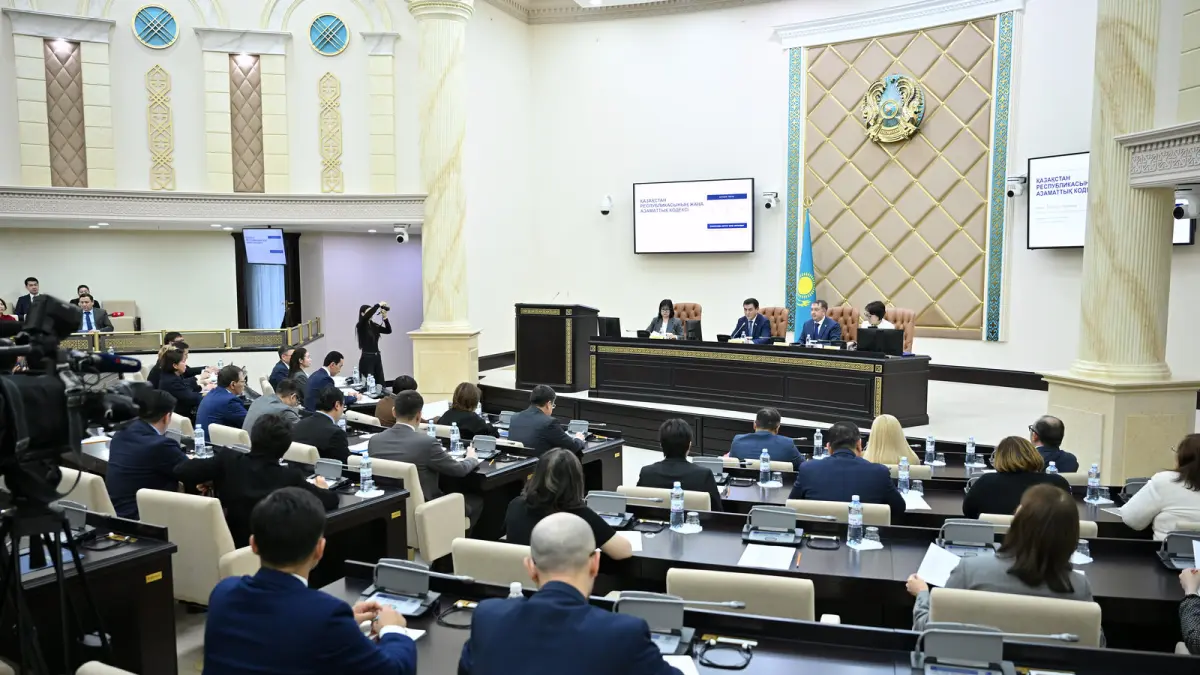
Tuesday evening in Kazakhstan was given over to drafts of big laws. In the Kurultai, the working group that is to write a new Civil Code met for the first time, a second group began rewriting the law on investment funds, and deputies set the first reading of amendments on organ donation and medical records for Wednesday. Meanwhile, ministries allowed oil and gas companies to spend a mandatory percentage on digitalisation, and an unwelcome bill for exporters arrived from Tashkent: Kazakh coal almost triples in price on its way to greenhouses.
The day in figures
- 35
members of the Kurultai working group on a new Civil Code - about 300
changes made to the current code over thirty years - 1%
of production costs oil and gas companies may now spend on digitalisation - $40 and $110
price of a tonne of Kazakh coal at Uzbek customs and at a greenhouse - 34.4 million tonnes
of oil carried by KazTransOil in nine months
According to the Kurultai, the Ministry of AI and Digital Development, Gazeta.uz, KASE
- 35
A code for the next thirty years
The current Civil Code was adopted in the 1990s, and over thirty years about 300 changes have been made to it, according to Unzila Shapak, chair of the Kurultai committee on constitutional legislation. On Tuesday evening a 35-member working group led by Nurlan Beknazarov, Deputy Chairman of the Kurultai, held its first meeting. It includes deputies, representatives of the Presidential Administration, the Supreme Court, the Prosecutor General’s Office, the Ministry of Justice, the Atameken chamber, the bar and notaries, and legal scholars.
Justice Minister Yerlan Sarsembayev put the scale briefly: buying a home, running a business, using digital platforms and inheritance are all civil law. As the main guidelines he named the protection of human rights, including in the digital environment, equal protection of all forms of property and freedom of contract while protecting the weaker party. On the sidelines, as reported by Zakon.kz, the minister added that the procedure by which the property of someone who dies without heirs goes to the state may also be reviewed. The work will move from general principles to sections, and proposals are already being accepted at
The same evening another working group, led by deputy Gulnaz Atamkulova, took up a new law on investment funds. Olzhas Kizatov, Deputy Chairman of the ARDFM, said the proposal is to allow funds in the form of LLPs and simple partnerships and to introduce umbrella funds with sub-funds and the master-feeder structure. Investors will be divided: anyone will be able to join reliable funds, but only qualified investors will be admitted to venture and private equity funds. Deputies asked the question that matters most to people, namely who answers if a fund goes bankrupt, but the parliament’s press service does not give the answer.
Wednesday in the Kurultai
At 10 a.m. today the Kurultai meets in plenary session. At first reading deputies will consider two packages of amendments on energy saving and a healthcare bill, as well as the ratification of the UN Convention against Cybercrime. The medical bill was explained in detail the day before by deputy Arman Dzhansengirov in an interview with Tengri Health. Living donors of a kidney or part of a liver could include not only full siblings but also first and second cousins, uncles or aunts, if they are tissue-compatible. Patients will see which doctor opened their electronic record and why. Local authorities will be able to pay patients’ travel to radiotherapy and proton therapy in Astana and Almaty. The law will for the first time call foreign patients medical tourists.
The energy-saving package targets budget organisations and residential buildings. One of its authors, deputy Arman Kalykov, gave figures that explain the urgency in an interview with Zakon.kz, which the Kurultai republished on its website. The share of buildings in heat consumption rose from 49.8% in 2021 to 63.9% in 2025, and the energy intensity of Kazakhstan’s economy, he said, is about 3.6 times higher than OECD requirements.
A percentage for digital
The Ministry of Artificial Intelligence and Digital Development and the Ministry of Energy approved by joint order rules that took effect on 22 November. Oil and gas companies were already obliged to give 1% of production costs to research every year. Now, as the digital ministry announced, this money can be directed wholly or partly to digital projects at their own sites, with contractors found among Kazakh IT companies through an Astana Hub tender. The size of the obligation does not change, even though the first reports managed to call the order a new duty. The percentage is the same, but it now has a second door through which it can be spent.
Oil throughput by pipeline is growing too. At a KASE Issuer Day, KazTransOil reported that in the first nine months of 2026 it carried 34.4 million tonnes of oil, up from 33.2 million tonnes a year earlier. Revenue from core operations rose to 279.5 billion tenge from 254.2 billion, and net profit was 39.9 billion tenge. Among its plans the company named expanding the capacity of the Kazakhstan–China route and raising supplies to domestic refineries.
Coal that gets dearer on the way
The southern neighbour has been a reminder that the export price is not yet the buyer’s price. At a meeting between greenhouse owners and officials in Tashkent, entrepreneur Khurshid Akhmedov said that Shubarkol coal clears customs at about $40 a tonne but reaches the farm at $110. He blames middlemen, a shortage of wagons and Uzbekistan’s own requirement to import coal only by rail: suppliers in nearby Chernyaevka are ready to load lorries at $32 a tonne, but road imports are closed. Gazeta.uz checked this against data from Kazakhstan’s Bureau of National Statistics: in nine months Kazakhstan sold Uzbekistan about 1.02 million tonnes of coal at an average of about $22.73 a tonne. These figures, the outlet notes, cover all coal supplies, not only Shubarkol, and exclude logistics to the consumer. In the north coal producers have a problem of their own: Russian Railways approves only part of the requests to carry coal to its ports.
Turlov’s move
The match for the world chess title has begun in Geneva, and its first ceremonial move was made by FIDE President Timur Turlov of Kazakhstan: 1.e4 for the Uzbek challenger Javokhir Sindarov. The first game against world champion Gukesh Dommaraju ended in a draw on move 38. Sindarov admitted he had deliberately started cautiously to settle in. The match is scheduled for up to 14 games, and the second is today at 7 p.m. Astana time. Kazakhstan, as we reported, is one of the organisers of the match.
What lies ahead
The WADA Executive Committee meets in Astana today, followed on Thursday by the agency’s Foundation Board, as we reported in advance. From Wednesday the Zhibek Zholy checkpoint on the border with Uzbekistan reopens after modernisation, while Kyrgyzstan’s Chaldybar post closes to vehicles. On Sunday, 29 November, Kazakhstan holds local council elections and OPEC+ ministers meet, with Kazakhstan’s production quota for 2027 depending on the outcome. New codes are not written quickly: deputies first have to agree on what the code itself should be, and only then on what each of its sections will say.



