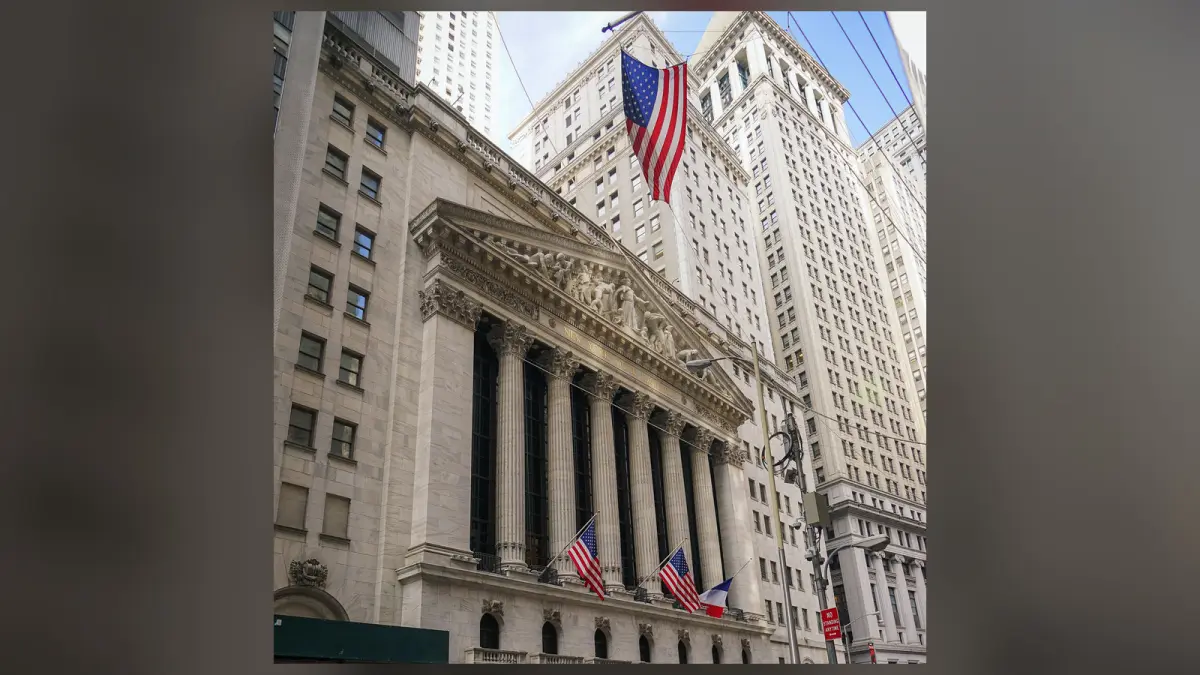
World markets took three blows at once in a single day: a sell-off of shares in companies tied to artificial intelligence, inflation above target and a list of new American tariffs. The same day Washington named fourteen economies against which it is preparing measures, in the Middle East there was another explosion near a tanker, and Ukraine’s Verkhovna Rada passed a law on cryptocurrencies.
The day in figures
- 4.6%
how far the Nasdaq fell at the start of trading, though it closed down 0.62% - 3.3%
annual core inflation in the US in October against the Fed’s 2% target - 14
economies on the list of the US Trade Representative - 271
votes for the crypto law in the Verkhovna Rada - 50
nautical miles west of Dubai, where an explosion occurred near a tanker
According to CNN, USTR, Decrypt, UKMTO and Anadolu
- 4.6%
The market: fear of AI and Fed rates
Trading on the New York Stock Exchange swung sharply on Wednesday. The Nasdaq Composite index, where technology companies are concentrated, fell 4.6% soon after the open but closed down only 0.62%. The Dow Jones index went from a drop of 1,100 points to a gain of 164 points, or 0.33%. In a single trading day fear managed to swell and all but run out of steam. According to CNN, investors’ money moved from the shares of AI companies into bonds, materials, real estate and energy.
There are two reasons, and together, in the words of Jamie Cox, managing partner of Harris Financial Group, they produce the sharp swings. The first is doubt about whether the huge spending on building capacity for artificial intelligence will pay off. Jensen Huang returned as chief executive of Nvidia on Monday, when the company’s board reinstated him. The market’s relief did not last long: Nvidia shares lost 3.9% on Wednesday, and the memory makers Sandisk and Micron 5.6% and 4.5%. Anthropic, the AI-model developer that recently went public, fell almost 10% on Wednesday but closed up a little over 1%; the day before, its shares had for the first time dropped below the offer price of $83.
The second reason is an American economy that is not cooling. Core inflation, excluding food and energy, was 3.3% over the year in October against the 2% target of the Federal Reserve (Fed), and the economy grew faster than expected last quarter. Traders have begun betting more often on a rate rise, and the next Fed meeting is set for 9 December. The National Bank of Kazakhstan will announce its base rate on 4 December, ahead of the American decision.
Tariffs: fourteen economies, and Kazakhstan is not one of them
US Trade Representative Jamieson Greer announced that, following investigations under Section 301 of the Trade Act of 1974, the actions of fourteen economies relate to structural excess production capacity, are unreasonable and burden American trade. The list includes China, the European Union, Singapore, Switzerland, Indonesia, Malaysia, Cambodia, Thailand, Korea, Vietnam, Taiwan, Bangladesh, Japan and India. The investigations also covered Mexico and Norway, but the Trade Representative did not take decisions on them.
So far these are proposals, not tariffs that have been imposed. For Bangladesh, for example, Washington proposes considering tariffs of up to 18% on all goods, taking into account Section 301 tariffs already in force and with exclusions for certain goods. For each of the fourteen economies the agency proposed its own measure, and the lists of excluded goods are given in the annexes to the notices in the Federal Register. Comments are accepted until 5 January 2027, and hearings are set for 25 January. Kazakhstan is not on this list. In Beijing, writes Ulysmedia, the accusations of overproduction were rejected and demand for Chinese goods was explained by competitive advantages.
Lukoil looks for a new owner
The consortium of American businessman Todd Boehly signed an agreement to buy Lukoil International, the company that holds Lukoil’s foreign assets. Closing the deal requires permission from the US Treasury, and, according to Reuters, this may take up to a year. According to two Reuters sources, the portfolio includes fields in Kazakhstan and Azerbaijan. Lukoil owns 13.5% of Karachaganak and 5% of Tengizchevroil, and KazMunayGas has a priority right to buy out these stakes; details are in a news story in our issue.
Hormuz, Gaza and Baghdad
The master of a tanker 50 nautical miles west of Dubai reported an explosion near the vessel and named an unidentified projectile as the cause, Anadolu reported, citing the United Kingdom Maritime Trade Operations (UKMTO) centre. All crew are unharmed, and there is no damage to the tanker or the environment. On Tuesday Iran’s Islamic Revolutionary Guard Corps said that tankers had been blown up by mines in the Strait of Hormuz; these publications contain no independent confirmation.
American envoy Jared Kushner urged Israel’s acting Prime Minister Benjamin Netanyahu to carry out the peace plan for Gaza, the Anadolu agency writes, citing Axios. Washington is seeking the deployment of stabilisation forces, the training of Palestinian police in Egypt and the bringing of mobile homes into the Strip. Iraq, according to a report by the same agency, has set talks with its Kurdish regional government for 1 December.
Ukraine: a law on cryptocurrencies
The Verkhovna Rada passed bill No. 10225-d at second reading and as a whole: 271 deputies voted for it. The cryptocurrency market will be legalised, and income from transactions with it will be taxed at 18% plus a 5% military levy from 1 July 2027; exchanging one crypto asset for another is not taxed. The National Bank of Ukraine will oversee stablecoins and the exchanges that convert cryptocurrency into money, and it will also be able to permit or ban the circulation of stablecoins. According to Yaroslav Zhelezniak, first deputy chair of the finance committee, the law will bring the budget about 15 billion hryvnias extra, or roughly $330 million. The law has to be signed by Ukrainian President Volodymyr Zelensky.
What lies ahead
Today in Geneva Javokhir Sindarov plays White in the third game of the world chess title match against India’s Gukesh Dommaraju, starting at 7 p.m. Astana time; after two games the score is 1–1. On Sunday, 29 November, OPEC+ ministers will meet to discuss output, the National Bank of Kazakhstan will announce its base rate on 4 December, and the US Federal Reserve on 9 December. The Lukoil deal has yet to win permission from the US Treasury, the tariffs have to get through hearings in January, and the market has to withstand both the fear of AI and the expectation of higher rates before the Fed meeting.



