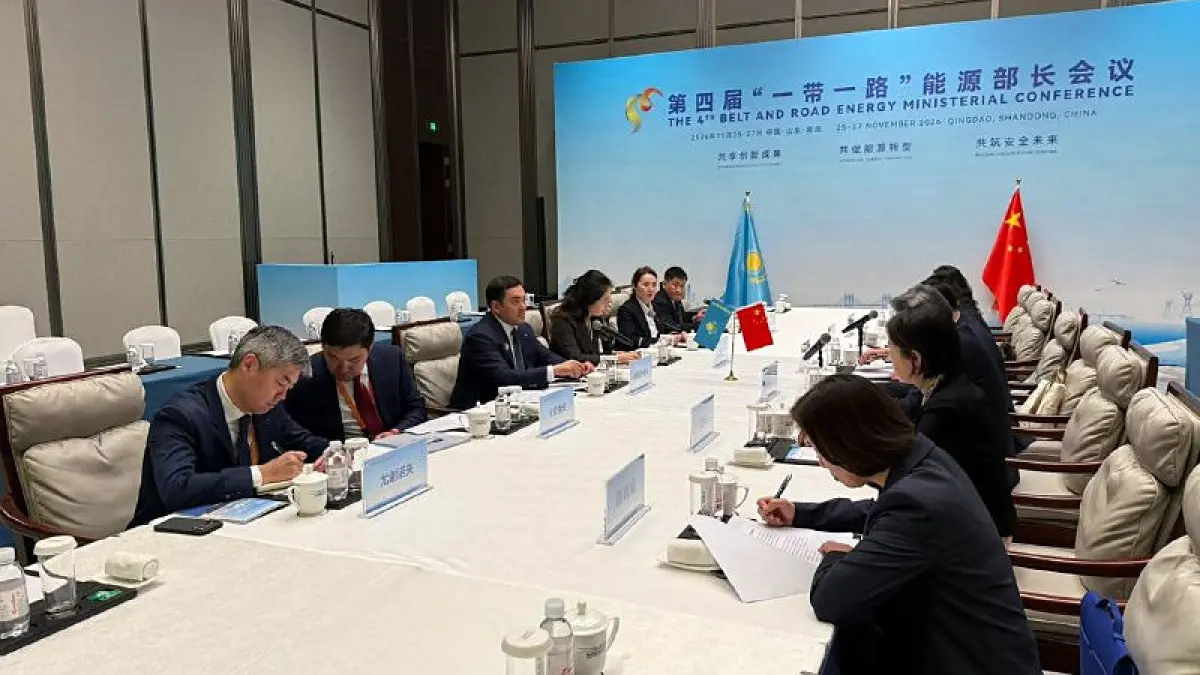
Qingdao, 26 November. Energy Minister Yerlan Akkenzhenov held talks in Qingdao with Wang Hongzhi, head of China’s National Energy Administration (NEA), and the two sides discussed moving the project to double the Shymkent oil refinery to the basic design stage, the Ministry of Energy reported.
The refinery’s capacity is to be raised from 6 to 12 million tonnes a year.
The ministry called the meeting the main event of the Kazakh delegation’s working visit to the 4th Belt and Road Energy Ministerial Conference. The National Energy Administration is the Chinese agency responsible for oil, gas, coal and electricity, which makes Wang Hongzhi Akkenzhenov’s direct counterpart.
The talks began with oil. According to the ministry, 9.5 million tonnes of crude were pumped through the Atasu–Alashankou pipeline, which carries Kazakh oil to China, in the first ten months of this year. The sides recalled long-term agreements that guarantee the loading of the pipeline system and transit to China until 2034.
The main joint priority in refining was named as the Shymkent refinery, which operates as PetroKazakhstan Oil Products (PKOP). The sides discussed completing the feasibility study and moving to front-end engineering design (FEED), the stage at which the technology and main equipment are chosen. The project was discussed in connection with the development of the Kazakhstan–China oil pipeline system.
“Kazakhstan and China are consistently developing cooperation in energy. Alongside reliable transportation of energy resources, we are focusing on deep processing of raw materials,” Akkenzhenov said. The minister listed the expansion of the refinery to 12 million tonnes, construction of a polyethylene plant, coal chemistry and “clean coal” technologies based on coal reserves of 33.6 billion tonnes.
In gas, the sides discussed gas transport infrastructure, the region’s transit potential and the coordination of cross-border routes. In renewable energy, where, according to the ministry, Kazakhstan’s share of renewables has reached 8.5%, they reviewed progress on projects under the intergovernmental agreement on solar and wind plants with a total capacity of 1.8 GW. They also discussed expanding the pool of joint green projects by another 1 GW.
The outcome of the talks sounds more modest than their agenda: the two chiefs agreed to “maintain constant working contact”. The ministry does not name any signed documents, the timing of basic design or the cost of the refinery expansion.
What it means: The plan to double the Shymkent refinery is moving from the feasibility study to an engineering project, and China is ready to take part. For Kazakhstan, it is a way to refine more oil at home rather than export it as crude.
Who benefits: The domestic fuel market: the expansion will add 6 million tonnes a year of refining in the south of the country. China, which gets guaranteed oil transit until 2034 and a role in Kazakhstan’s refining and green energy. Kazakhstan’s coal regions, if coal chemistry projects reach construction.
Background: The Shymkent refinery is one of Kazakhstan’s three large oil refineries, alongside those in Atyrau and Pavlodar; it is jointly owned by KazMunayGas and China’s CNPC. The Atasu–Alashankou pipeline is the section of the Kazakhstan–China system that runs to the border.
We have also reported that Akkenzhenov discussed petrochemicals and LNG with Chinese companies in Qingdao and that the Energy Ministry backed the idea of a joint research centre with Energy China at KazNU.



