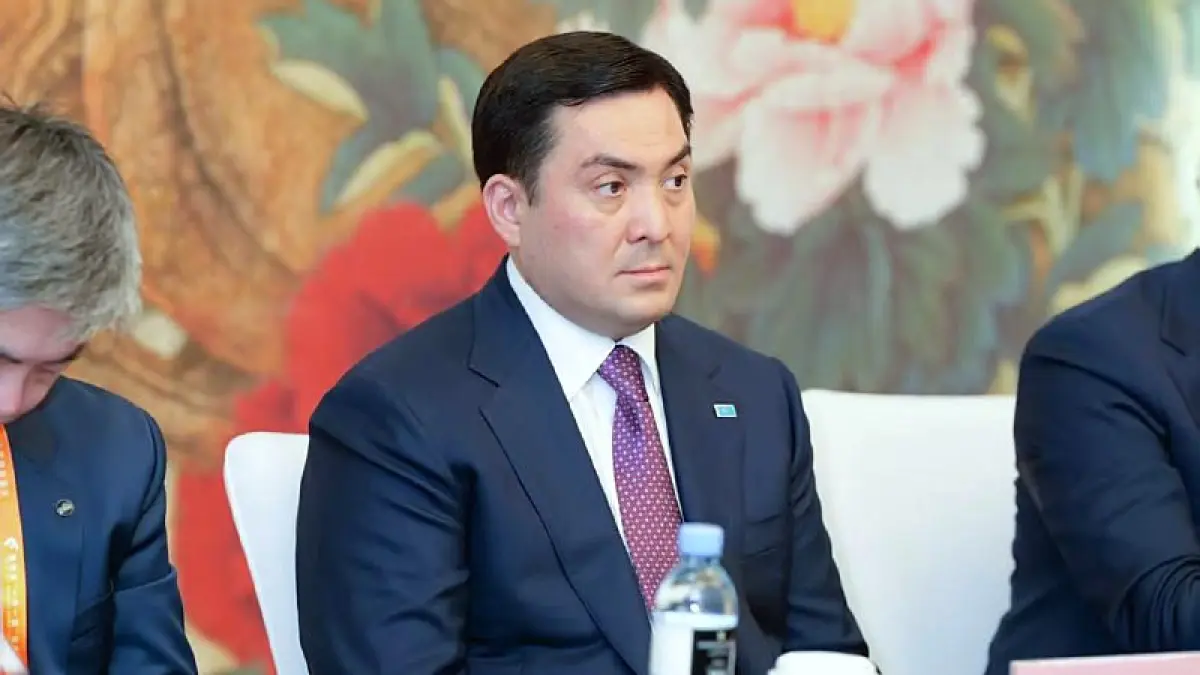
Qingdao, 26 November. Kazakhstan’s Minister of Energy Yerlan Akkenzhenov and Ni Zhen, chairman of the board of the Chinese corporation China Energy Engineering Group (Energy China), discussed setting up a joint research centre at Al-Farabi Kazakh National University (KazNU), the Ministry of Energy reported.
The Kazakh side supported the initiative.
The talks took place during the minister’s working visit to China. The main topic, according to the ministry, was the shift from building individual facilities to scientific and technical partnership. The centre at KazNU is to draw on the experience of Energy China’s institutes in feasibility studies for large projects, digitalisation of the power system and building industry databases. The sides also discussed hydrogen energy: at KazNU, the report says, the first hydrogen production unit in Kazakhstan has in effect already been launched.
The grid was discussed separately. The talk was of a 2 GW direct current power line along the Ekibastuz–Balkhash route: the Kazakh side, according to the ministry, has already done the calculations and prepared a feasibility study. Industrial energy storage systems were also discussed: key substations and connection points have been identified, and a bill on mechanisms for returning investment in storage has passed its first reading. Once the amendments are adopted, the sides are ready to move to joint projects.
“Today our partnership with Energy China is reaching a new level — joint scientific work, exchange of engineering competences and comprehensive planning of grid development,” Akkenzhenov said.
Energy China also spoke about projects it is already building in Kazakhstan. The company expects to connect the 300 MW Sauran solar power plant in Turkestan region to the grid ahead of schedule, by the end of the year. For a 500 MW wind power plant in Karaganda region, the parameters of the investment agreement are being finalised so that construction can start sooner.
On the same day Akkenzhenov met Yang Xian, chairman of the board of directors of the Shandong Kerui Group holding. The company offered technologies to restore production at idle wells and reduce water cut, that is, the share of water in the produced fluid, as well as to set up joint service crews and a plant to assemble coiled tubing and hydraulic fracturing equipment. The minister proposed starting with pilot tests: “The effectiveness of any technology must be confirmed in practice — in the specific geological conditions of each field.”
The minister’s trip is linked to the 4th Belt and Road Energy Ministerial Conference in Qingdao, hosted by China’s National Energy Administration. There Akkenzhenov noted that Kazakhstan produces about 100 million tonnes of oil and more than 60 billion cubic metres of gas. Following the plenary session, a Belt and Road Energy Partnership Steering Council was established and an “AI + Energy” working group was launched.
What it means: Kazakhstan is now negotiating with China not only about construction but also about science, calculations and technology: a research centre at a university, a direct current line across half the country and testing of Chinese methods at old fields. Much of this is still at the discussion stage, and the closest to reality is the early launch of Sauran.
Who benefits: The power system, which needs new lines and storage for balancing; KazNU, which gains access to Energy China’s engineering expertise; and oil producers with mature fields where output is falling. Chinese companies get new orders and a market for their equipment.
Background: Energy China is one of China’s largest engineering and construction companies in the energy sector. Mature fields are those where production has already passed its peak; enhanced oil recovery methods help extract more oil from them.
We have also reported that Akkenzhenov discussed petrochemicals and LNG with Chinese companies in Qingdao.



