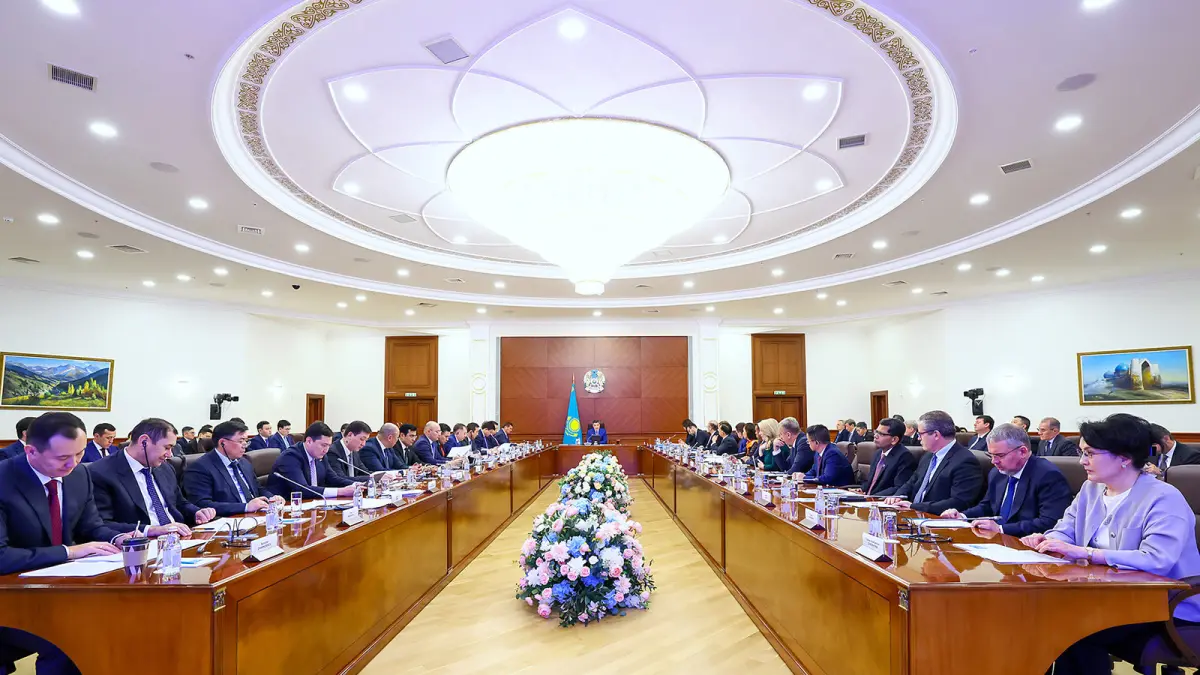
The second half of Thursday was marked by big building projects and big pipes. The Prime Minister invited foreign business into the People’s Construction programme. In Almaty the first gas turbine started work at CHP-2, the energy minister discussed oil and refining in China, and the Government showed what the programme looks like on the ground with a sports complex in Aktobe.
The evening in figures
- 6.5 trillion tenge
National Fund money for the People’s Construction programme until the end of 2029 - 557 MW
electrical capacity of CHP-2 after modernisation - 9.5 million tonnes
oil pumped through the Atasu–Alashankou pipeline in ten months - 18.8 billion tenge
the sports complex in Aktobe - 4 billion
eggs produced in ten months
According to the Government, the Ministry of Energy and the Ministry of Agriculture
- 6.5 trillion tenge
Building for ourselves and others
The main conversation of the day took place in the Government House. Olzhas Bektenov held an interim meeting of the Foreign Investors’ Council and, according to his press service, made the People’s Construction programme the main topic: around 6.5 trillion tenge from the National Fund has been earmarked for it until the end of 2029. Foreigners are expected to bring engineering solutions, standards and joint production of building materials.
Business came with its own list. EY talked about VAT refunds for exporters, Eni about pipeline inspections and emission quotas, Air Liquide about certificates and foreign specialists, Polpharma about a “green corridor” for medicines. Separate news for investors is the new support procedure: Kazakh Invest will be transferred to the Baiterek holding, and an investment court is planned in Alatau on the initiative of the Head of State. There are no decisions on the proposals yet, only instructions to review them; the construction drive itself is overseen by a state commission whose membership was approved the day before.
The Government used Aktobe to show what the programme looks like on the ground. A multi-purpose sports complex with a 5,000-seat arena and an Olympic pool is being built there, 18.8 billion tenge has been allocated for it from the Infrastructure Development Fund, and it is promised for February 2028. Since the start of the year 188 sports complexes have been under construction nationwide, and 69 are finished.
Gas for Almaty, oil for China
For Almaty residents the main news came towards evening. The Ministry of Energy reported that the first turbine of the Siemens Energy combined-cycle unit at CHP-2 had been put into operation, that the plant is due to supply electricity to the grid on 30 November, and that two more turbines are expected in December. The ministry promises that emissions will fall by more than 90%, from 37,100 to 2,700 tonnes a year, but only after the full switch to gas. Only yesterday Samruk-Energy named the same date for the first power supply.
In Qingdao Yerlan Akkenzhenov continued his talks with Chinese partners: earlier in the day we reported on the idea of a research centre with Energy China at KazNU. Separately, the minister met Wang Hongzhi, head of China’s National Energy Administration. The Atasu–Alashankou pipeline carried 9.5 million tonnes of oil in ten months, and transit to China is guaranteed by agreements until 2034. The Shymkent refinery was named as the main joint project: its capacity is to be doubled to 12 million tonnes, and the sides discussed moving from the feasibility study to basic design. The ministry gives no documents or deadlines.
Figures and neighbours
The Ministry of Agriculture, which had reported on farm exports during the day, added a more modest but more homely figure in the evening: in ten months the country produced more than 4 billion chicken eggs, 7.5% more than a year earlier. In East Kazakhstan, where local eggs cover only about 30% of residents, construction has begun on the Altai Qus poultry farm with a capacity of 150 million eggs a year.
Neighbouring Uzbekistan revealed details of a new stage of reforms the same day. According to Shavkat Mirziyoyev’s press service, by 2030 it wants to raise the middle class to 90% and the share of guaranteed loans to business from 1% to 12%. Tashkent has money for reforms: in the morning we reported that the World Bank had approved 800 million dollars for Uzbekistan.
A day that began with forged IDs in Atyrau and inflation forecasts is ending with promises for years ahead: a turbine by 30 November, a pool by 2028, a middle class next door by 2030. The first can be checked as early as Monday.



