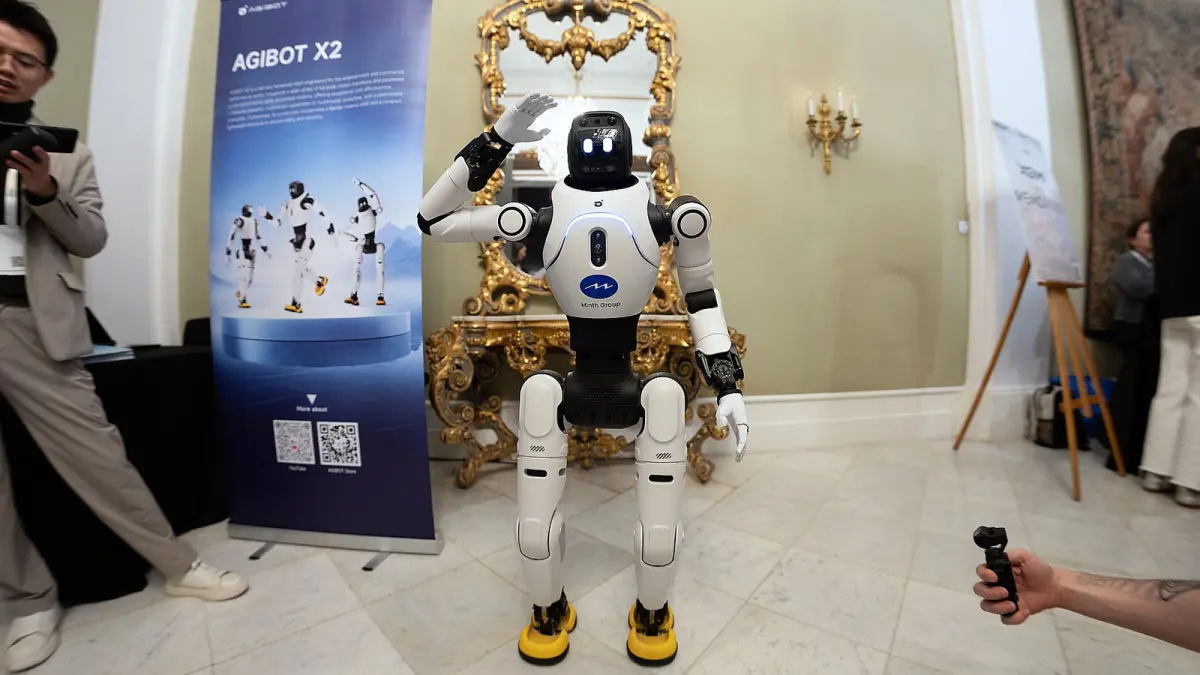
Jinan, 24 October. A total of 110 Expedition A3 humanoid robots made by the Chinese company AgiBot performed a synchronised dance in Jinan, the capital of Shandong province, and received the Guinness World Records title for the most humanoid robots dancing simultaneously, the Global Times newspaper reported.
The human-sized robots changed positions, jumped, did flips and regrouped into formations. Synchronisation was provided by the LinkBots cluster-control platform and ultra-wideband radio positioning, which, according to AgiBot, locates each robot to within a centimetre. The count of 110 machines was confirmed by a Guinness World Records adjudicator, who presented the certificate on site.
The record turned out to be a record in its own weight class. Guinness also has an older record for the most robots dancing simultaneously: in February 2018 in Rome, 1,372 UBTECH Alpha 1S robots danced, each less than 40 cm tall. The new title belongs to the humanoid robot category, and reports do not specify how exactly the two categories are distinguished.
For AgiBot the performance was a test of whether dozens of full-size robots can work together without losing their positions. The company plans to use them in cultural and tourist shows, public services, research and education. Wang Peng, an associate research fellow at the Beijing Academy of Social Sciences, noted that in real conditions robots are hampered by changing lighting, uneven floors and unexpected obstacles, and that small errors accumulate over long tasks.
The record fits China’s drive to deploy such machines at scale. According to China’s Ministry of Industry and Information Technology, Chinese companies developed more than 400 humanoid robot models and produced more than 40,000 units in the first half of 2026, and in June the authorities launched a programme to train and use them in real production and everyday settings.
What it means: A Chinese company has shown that it can precisely control more than a hundred full-size robots at once. The dance is a showcase of cluster-control technology, but, experts say, robots still have a long way to go before they work reliably in unpredictable conditions.
Who benefits: AgiBot gains publicity and a record to show clients in entertainment and services. China’s humanoid robot industry gains another demonstration before moving to mass deployment.
Background: Humanoid (anthropomorphic) robots are machines with a human-like body: two legs, arms and a head. In China dozens of companies make them; among the best known are AgiBot and Unitree.


