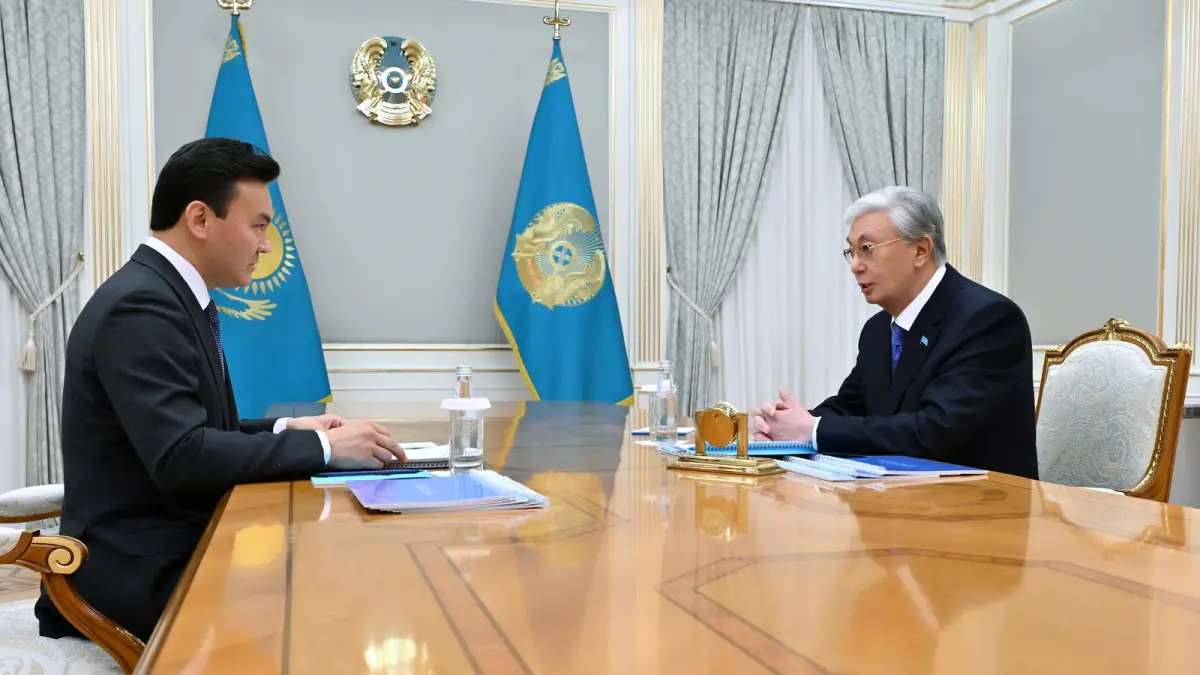
Astana, 9 November. President Kassym-Jomart Tokayev received Rauan Kenzhekhanuly, chairman of the international society Kazak Tili, who described a joint project with OpenAI: the Kazakh-language text corpus has reached 14 billion tokens and the audio base 12,000 hours, Akorda said.
The President was told that the society works in three areas: improving the methods of teaching Kazakh, enriching Kazakh-language content and widening the use of the language in new technology. Over the past three years 13 popular films from Disney, Pixar and Sony have reached cinemas dubbed in Kazakh. On the Qazaq Tili Endowment fund, it was reported that total contributions have reached 824 million tenge. Tokayev praised the society’s work and stressed the importance of making full use of artificial intelligence in learning and teaching the state language and in translating scientific literature.
A token is a unit of text: AI models split words and sentences into such units when processing language, 24KZ explained. A corpus is a body of texts gathered to train a model: the Kazakh Text Corpus includes material on education, science, technology, economics, law, medicine, history, ethnography and media, plus children’s content, BAQ.KZ said. The material is classified by subject, genre and age category and cleaned.
The 12,000-hour audio base consists of recordings of Kazakh speech cleaned of extraneous sound. The accuracy of speech-recognition models adapted for Kazakh, according to BAQ.KZ, has been brought to 98%.
Kenzhekhanuly himself explained the purpose. “It is important for us that such a tool works in Kazakh without errors and without, as they say today, hallucinations,” he said (hallucinations are answers a model invents). According to him, a system such as ChatGPT is being “retrained” on the collected data together with OpenAI’s team. The difficulty, he told Kazinform, is that there is far less Kazakh-language data for training than English or Russian, so material is gathered in archives, museums and libraries after the necessary permissions. The work is carried out under an agreement signed on 7 November 2025 in Washington during the Head of State’s visit to the United States.
How much the project costs, who pays for it, when and in which version of ChatGPT Kazakh will improve and how quality will be measured, Akorda’s report does not say. The statement that ChatGPT is being retrained on this data belongs to the head of the society; confirmation from OpenAI is absent from the material reviewed.
What it means: The state names artificial intelligence a tool for preserving and teaching Kazakh, and the OpenAI project shows what this looks like in practice: data is collected and put in order for training. The project’s figures, 14 billion tokens, 12,000 hours of speech and 98% accuracy, are the contractor’s own report; there is no independent assessment of quality yet.
Who benefits: According to the President, people learning and teaching the state language and translators of scientific literature. Kenzhekhanuly added that the improved model will also help users in other languages who are interested in Kazakhstan’s history and culture. What OpenAI gains, the terms of the agreement do not disclose.
Background: The international society Kazak Tili is a public organisation working on the development of the Kazakh language. Qazaq Tili Endowment is a fund of target capital: an endowment is capital whose income goes to statutory purposes.
We have also reported on Huang proposing that Kazakhstan become a hub of physical AI.