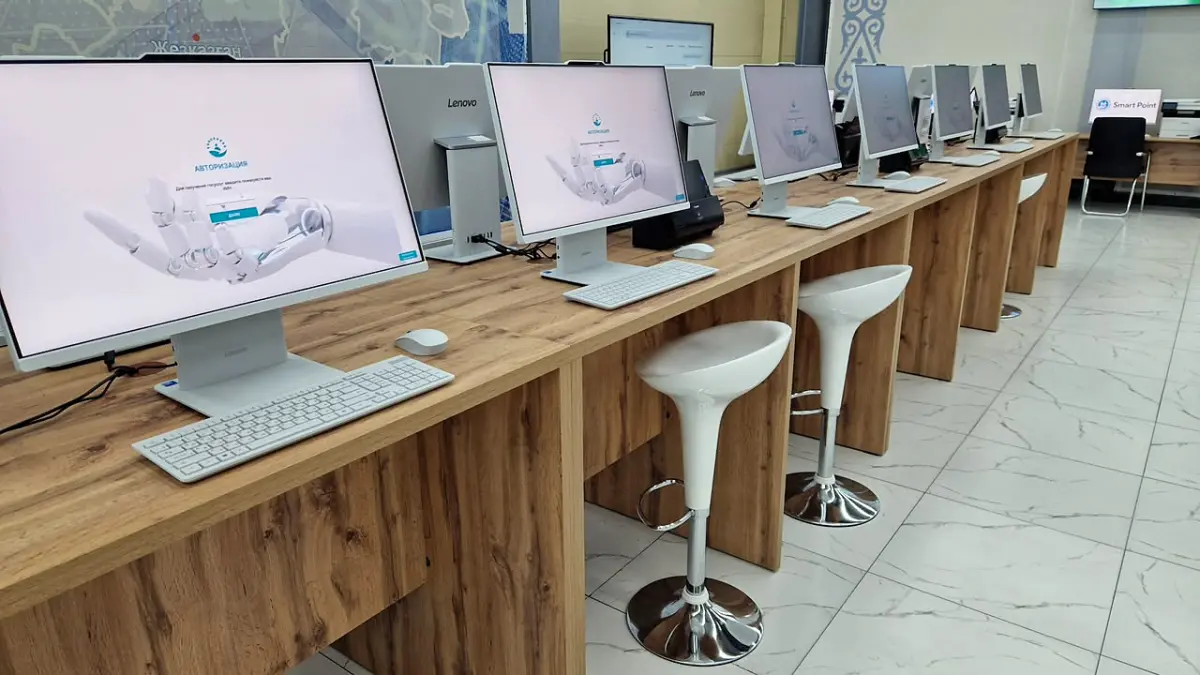
Astana, November 17. Kazakhstan now has nine digital public service centres (PSCs), where a digital assistant, eGov GPT, helps visitors choose and apply for a public service, the Ministry of Artificial Intelligence and Digital Development said on November 17.
Such offices are open in Astana, Shymkent, Turkistan, Zhezkazgan, Satpayev, Uralsk, Petropavlovsk, Karaganda and Taraz.
Digital PSCs have no general queue: visitors choose the service themselves at a terminal or at a workstation. The office space is divided into three zones. The express zone takes up 70% and is equipped with terminals with the built-in eGov GPT assistant, which suggests which service is needed and what steps to take next, and guides the application online. The expert zone takes up 20% and is staffed by consultants, while the training zone, at 10%, teaches digital literacy.
“Digital offices are not a separate project but part of a single ecosystem of public services based on artificial intelligence,” the ministry quoted Deputy Prime Minister – Minister of Artificial Intelligence and Digital Development Zhaslan Madiyev as saying. “At the same time, the protection of personal data remains an absolute priority for us,” he added.
The first such office opened in Zhezkazgan in June 2026, followed by offices in Turkistan, Astana and Satpayev. The ninth, opened on November 13, was the office in Taraz: it was inspected by the akim of Zhambyl Region, Yerbol Karashukeyev, and the chair of the management board of the Government for Citizens state corporation, Arman Kenzhegaliyev. According to the ministry, more than 90% of public services are already available online, and requests to PSC operators have fallen by 30%. Plans include round-the-clock issue of completed documents through parcel lockers and the opening of new-format PSCs in all regional centres; the ministry gave no timetable.
What it means: The state is turning the familiar PSC, with its queue ticket and operators’ windows, into a self-service hall where a terminal with an AI assistant does most of the work and consultants are needed only for complex cases. Nine offices are still a pilot network: most regional centres do not yet have one.
Who benefits: Visitors who can apply for a service themselves without queuing, and the state corporation, which needs fewer operators for the same workload. For older people and those who do not use digital services, the ministry offers the training zone and consultants.
Background: eGov GPT is an assistant based on artificial intelligence; according to DigitalBusiness, it accepts text and voice requests in Kazakh and Russian. The ministry’s statement did not say how many services it helps with. The President of Kazakhstan declared 2026 the Year of Digitalisation and Artificial Intelligence.
We have also reported on a digital PSC with an AI assistant opening in Uralsk.



